

I cannot get some combination of the quote attributed to William Gibson—“The future is already here — it’s just not very evenly distributed”—and the idea that World War III has already begun out of my head these days. World War III, it turns out, is the same fight for democracy over fascist imperialism as the last world war. But it’s not evenly distributed yet, and so too many remain blissfully unaware.
By my reading of Victor Klemperer’s diary, and if one were to make a rough comparison to the timeline of Nazi Germany and the coming of World War II, we’re still somewhere in the 1936-1938 timeframe. Technically, the war had not yet arrived, but with the benefit of hindsight, it’s clear that Hitler’s plans were already well underway. Open warfare was meant to be the culminating point of a battle that had been waged sub rosa, but only barely, for years.
All of that to say, the war for democracy has, once again, just begun. This point was driven home last week in an essential article from The Guardian, in which pro-democracy activists from Hungary, Turkey and El Salvador shared their advice for those of us in the United States who are now joining the fight. They see in our story a case study of both how quickly democracies can slide into authoritarianism and the kinds of mistakes pro-democracy resistance movements make early on that enable that slide.
Perhaps most importantly, they caution us that there is no quick fix or return to “normal.” Fighting back takes long-term stamina, listening to citizens’ concerns, and defending democratic institutions at every turn.
Over at Democracy Americana, historian Thomas Zimmer makes the point even more bluntly. Even though he, like other astute analysts of our current moment, sees emerging cracks in the regime power base, he warns, “Whatever form MAGA takes in the coming post-Trump era, the idea that American politics will soon experience a return to ‘normalcy’ is dangerously fanciful.”
Guilty as charged. I will admit that I still operate too often in the delusional world where this is all going to come to an end soon(ish). But it’s just not. I know that. But still, it’s hard to admit.
The system, our system if we could keep it—and we didn’t—has already been destroyed. Even if we get Trump out, it will be a long time before things are repaired…if they ever are. There’s no “going back” to “normal.” We shouldn’t go back even if we could. After all, normal got us into this mess. The normal system, as it turns out, had massive flaws that every future Trump now knows how to exploit. We will need to build something more robust next time.
But we’re not to next time yet. We’re only at the start of our journey to next time. And that, many days, is a daunting, depressing, and sometimes debilitating realization. So what can we do?
We can do what we can, when we can. We can live our lives as best we can. We can live normally without normalizing our political situation. This may sound trite or like a contradiction. It is neither.
As we have emphasized in recent posts, there are essential, invaluable lessons for us when we read history. Halik Kochanski’s monumental 2022 book, Resistance: The Underground War Against Hitler, 1939-1945, contains many such lessons.
One of those lessons struck me hard recently as I sat, listening to the audiobook on a flight back to the United States and worrying about my return to a country rapidly deteriorating into fascist tyranny. That lesson is this:
Contrary to popular belief, WWII-era resisters across Europe were neither superhuman, nor constantly engaged in their resistance activities. They were ordinary people leading normal lives, balancing their resistance efforts with everyday responsibilities.
But don’t take my word for it. Listen to Dr. Kochanski:
Those who took part in the resistance were not supermen and superwomen but were drawn from all walks of life. Some of the most heroic acts of resistance were performed by people who would not have been expected - even by themselves - to be heroes of any kind at all. Relatively few lived a continuous underground existence and the majority participated in normal life while taking part in resistance activities on occasion as and when needed.
The resisters also like to emphasize that their activities in the resistance did not preclude the majority from enjoying a normal life. Jean-Pierre Lévy described their lives:
We lived in the shadows as soldiers of the night but our lives were not dark and martial. We were young and we were gay. We loved and we made love and we laughed ... There were arrests, torture, and death for so many of our friends and comrades, and tragedy awaited all of us just around the corner. But we did not live in or with tragedy. We were exhilarated by the challenge and rightness of our cause. It was in many ways the worst of times and in just as many ways the best of times, and the best is what we remember today.
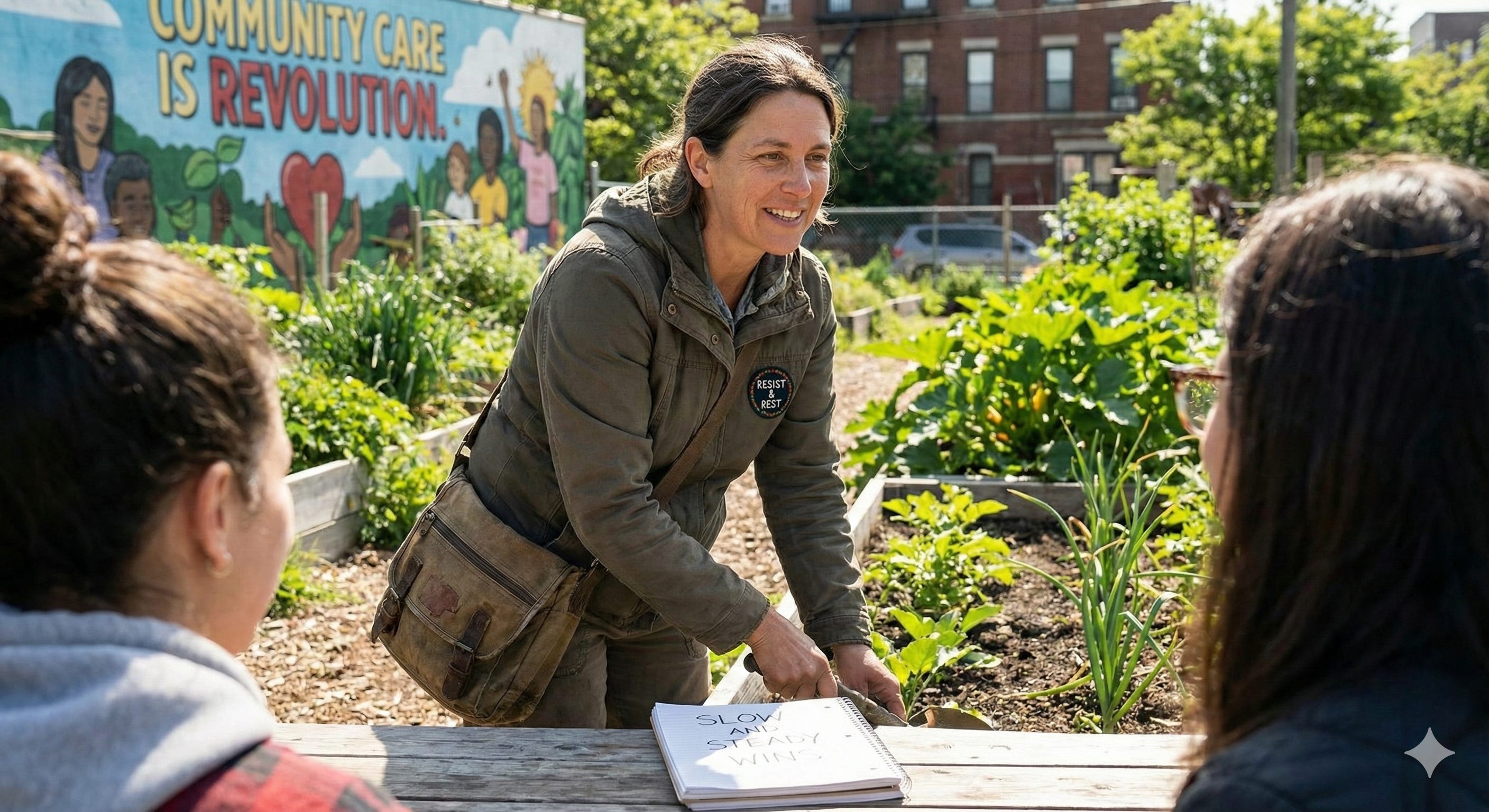
It’s easy to feel like we always have to be doing something more, something more heroic or dangerous, as though true resistance looks like a scene from Army of Shadows rather than posting a newsletter or helping out our neighbors or making stickers or painting pictures or…or…or…
But the fact of the matter is that most who took part in anti-Nazi resistance during the last world war were not engaged in derring-do. They engaged in many of the same, seemingly mundane resistance activities we engage in now. And many of them paid the ultimate price for those mundane activities. Being caught in possession of a foreign newspaper, posting an anti-regime flyer, handing out pamphlets, or helping their persecuted neighbors resulted in death for tens of thousands or more. Your “not enough” resistance activities can still get you killed. We all just have to do what we can given our circumstances and tolerance for risk. No one else can make those decisions for us.
Believing otherwise limits the field of opportunity for broad participation in the resistance at a time when we need the broadest coalition we can get. Framing resistance as derring-do tends to downplay the vital role that women and other marginalized groups have historically played in resistance, as much of the “heroic” action was traditionally denied to them. Dr. Kochanski writes,
Pre-war society was still essentially very male-dominated and women often found a new sense of freedom and independence by serving with the resistance during the war. Few actually fired weapons but many proved their worth by undertaking the extremely perilous roles of couriers, carrying messages and contraband materiel from one group of resisters to another, as well as hiding those in danger, and working for the clandestine press. Campaigns for female suffrage had a long history in Europe, with many countries rewarding women for their sacrifices and work during the First World War with the right to vote. Similarly, the Second World War or shortly thereafter led to equal voting rights for women in the remaining countries such as France, Italy, Albania, Yugoslavia, and Greece.
You are enough, just by educating yourself, trying to stay informed, sharing information with others, helping your neighbors, refusing in whatever small way you can to “go along” with or normalize regime oppression.
You are one of the vast numbers whose names will never be known but who, according to none other than Winston Churchill, will be vital to this long “War of the Unknown Warriors” against the “dark curse” of fascism.
With that, I leave you with more words of education and inspiration from Dr. Kochanski and Churchill:
Indeed, the most prevalent feeling among those who resisted was the discovery of the sheer variety of people who worked together during the war yet who in peacetime would have had no reason to be in contact with each other. Winston Churchill summed up the situation well in a BBC broadcast from July 1940:
This is no war of chieftains or of princes, of dynasties or national ambition; it is a war of peoples and of causes. There are vast numbers not only in this island but in every land, who will render faithful service in this war, but whose names will never be known, whose deeds will never be recorded. This is a War of the Unknown Warriors; but let all strive without failing in faith or in duty, and the dark curse of Hitler will be lifted from our age.
Without The Rule of Law, There Is No Law Enforcement

The House Committee on Homeland Security today held a hearing entitled, “When Badges Become Targets: How Anti-Law Enforcement Rhetoric Fuels Violence Against Officers.” The Republicans who organized the hearing point to an almost 700% increase in attacks against ICE and immigration agents from 2024 to 2025 as the reason for calling the hearing. Their go…
Early on I reminded those friends and coworkers, who were a little reluctant to do anything, that resistance comes in many forms. Do what you are comfortable doing. It all counts! Ten Thousand Eyes by Richard Collier is an excellent read about the spy network which included ordinary average citizens helping to crack Hitlers Atlantic wall before D-Day. I am very much inspired by their stories of resistance.
After 9/11, I read a great book on the Battle of Britain in WWII. What surprised me the most was learning that the reason Britain survived wasn’t just the brave pilots getting in the planes (as often not returning)—it was regular, ordinary Britons who 1) did their jobs repairing damaged runways…every day 2) did their jobs repairing damaged telephone lines 3) called in aerial alerts.
Seriously. No runway? No takeoffs and landings. But those of us outside aviation don’t realize that.
That book forever changed my perspective on how ordinary people doing mundane, ordinary things can be part of something extraordinary.
Thank you for reminding me of that.