

Welcome!
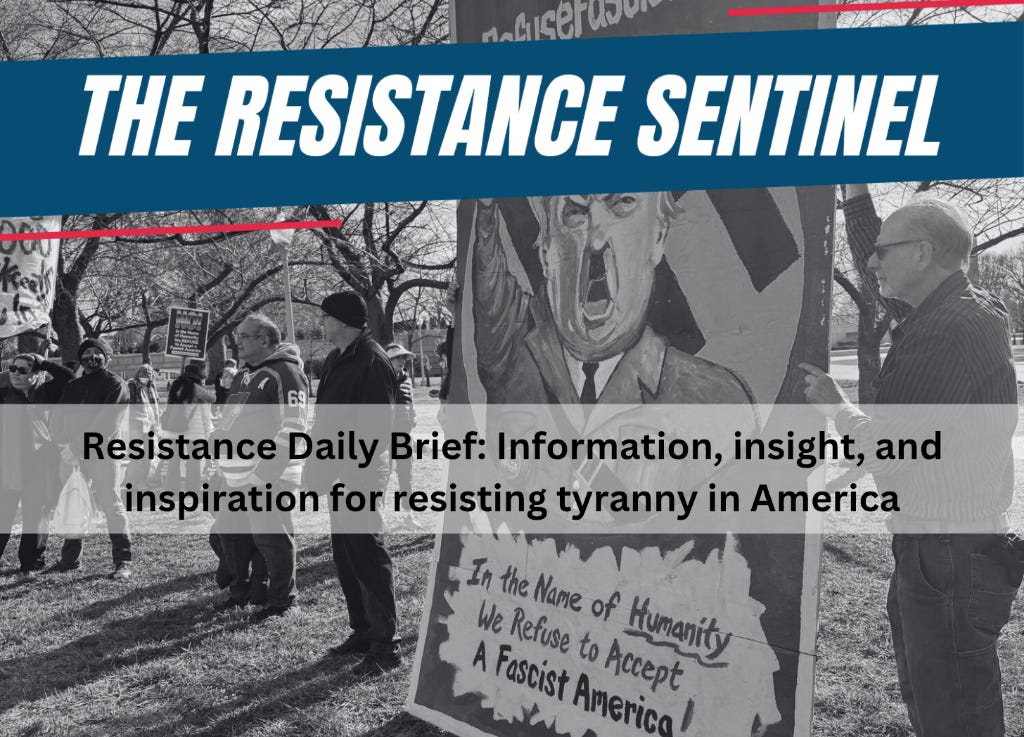
Welcome to The Resistance Sentinel, a publication dedicated to documenting and amplifying the movement to defend democracy against authoritarian rule. Nationwide protests intensified over the weekend as thousands mobilized against threats to democracy, science, and civil rights under the Trump administration. The demonstrations coalesced around three main issues: protecting scientific research from funding cuts, with "Stand Up for Science" rallies in over 30 locations; defending women's and LGBTQ+ rights during International Women's Day marches; and opposing Elon Musk's Department of Government Efficiency (DOGE), which has eliminated over 62,000 federal jobs. The economic impact of this resistance is already visible as Tesla's stock has fallen to pre-election levels, erasing a 91% gain and reducing Musk's net worth by $134 billion. At the same time, markets continue to respond negatively to Trump economic policies, in particular his trade war with Canada. Resistance to Trump and isolation of the United States is growing among European allies. Meanwhile, internal rifts have emerged within the administration as Secretary of State Marco Rubio publicly clashed with Musk over staffing decisions, and House Speaker Mike Johnson distanced himself from DOGE, promising that recent drastic cuts will be "corrected."
Daily Inspiration
At Resistance Sentinel, we try to bring you daily doses of inspiration to keep you going during the difficult struggle against tyranny in the United States. One crucial source of inspiration is historical case studies of successful resistance campaigns. The Velvet Revolution of 1989 is one such example. It demonstrated how sustained nonviolent resistance ultimately toppled Communist rule in Czechoslovakia, showing that even the most entrenched authoritarian regimes can fall when faced with unified public opposition.
What happened: The Velvet Revolution began on November 17, 1989, when student protesters filled Prague's streets, soon joined by hundreds of thousands of citizens occupying Wenceslas Square. Despite initial police brutality, the protesters remained nonviolent, and by November 28, the Communist Party announced it would cede power. This revolution was decades in the making, building on earlier resistance movements including the 1968 Prague Spring (crushed by Soviet tanks) and the self-immolation protest of student Jan Palach in 1969, who sacrificed himself to "make people wake up."
Why it matters: The Velvet Revolution demonstrates how nonviolent civil resistance can succeed against seemingly invincible authoritarian regimes when diverse segments of society unite in opposition. The movement's success hinged on strategic factors: building on decades of underground resistance, using symbolic dates and locations to mobilize public support, and maintaining nonviolent discipline even when faced with repression. The revolution shows that when enough people withdraw their consent and cooperation from a regime, even powerful authoritarian systems cannot sustain themselves. This case illustrates how seemingly small acts of resistance can accumulate over time, eventually creating conditions where rapid political transformation becomes possible.
Resources
Resistance Today
Civil Society & Publics
The weekend saw intensified nationwide protests against the Trump administration and Elon Musk, with thousands mobilizing against threats to democracy, science, and rights. Demonstrators focussed on three areas: protecting scientific research from funding cuts; defending women's and LGBTQ+ rights from policy rollbacks; and opposing Musk's influence through DOGE, which eliminated over 62,000 federal jobs. These diverse coalitions employed nonviolent resistance, though some Tesla-related protests have turned destructive. The economic impact is evident as Tesla's stock has fallen to pre-election levels, erasing a 91% gain and reducing Musk's net worth by $134 billion.
Widespread Protests Against Trump Administration Policies
What happened: Thousands of people gathered across the United States on March 7 to protest the Trump administration's funding cuts and job eliminations at federal science agencies. The "Stand Up for Science" movement organized protests in more than 30 U.S. locations, with scientists, researchers, and concerned citizens demonstrating against the elimination of global health programs, the overturning of climate policies, and dismissals at agencies like the NSF, NIH, CDC, and EPA12. Former NIH director Dr. Francis Collins, who abruptly resigned in February, expressed concern about the country's direction at the main rally on the National Mall, where he played his trademark guitar for attendees2. The protests highlighted how these cuts threaten research on vaccines, climate science, and public health.
Why it matters: These protests represent a significant pushback against authoritarian tendencies to silence scientific expertise and dismantle independent institutions. When authoritarian regimes consolidate power, they often target scientific and academic institutions to control information and suppress evidence-based criticism of their policies. By mobilizing to defend scientific institutions, protesters are protecting not just research funding but the independent knowledge production necessary for democratic governance. The broad coalition of scientists, students, and concerned citizens demonstrates how diverse stakeholders can unite around shared democratic values, creating the kind of cross-class, multi-racial front that historically has been effective in resisting authoritarian consolidation. These protests also highlight how economic noncooperation and public pressure can potentially induce defections among those loyal to authoritarian leadership.
The Headlines
Science supporters rally across US to protest Trump research cuts: See photos
Hundreds gather outside Nebraska Capitol to protest Trump administration
Hundreds gather in Little Rock to protest Trump administration
International Women's Day Protests Against Reproductive Rights Restrictions
What happened: On March 8, International Women's Day, thousands of protesters gathered in cities across the United States to demonstrate against the Trump administration's policies affecting women's rights. In Lansing, Michigan, hundreds rallied at the state Capitol with signs reading "Feminists Against Fascism" and "A Woman's Place is in the Revolution," expressing concerns about reproductive rights rollbacks and attacks on LGBTQ+ rights, especially against transgender women. Similar protests occurred in Boston, Chicago, New York, and other cities, with participants chanting "We won't go back" and expressing fears about potential restrictions on abortion access, defunding of Planned Parenthood, and the resurrection of the 1873 Comstock Act to ban mailing abortion medication. Speakers at these rallies emphasized the need for sustained resistance and community organizing to protect women's rights.
Why it matters: These International Women's Day protests represent a crucial form of resistance against authoritarian efforts to control women's bodies and restrict gender equality. Historically, authoritarian regimes often target reproductive rights and gender minorities early in their consolidation of power, using these issues to rally their base while testing the boundaries of resistance. By mobilizing diverse coalitions around women's rights, these protests build the kind of broad-based, feminist pro-democracy movement that can effectively challenge authoritarian rule. The emphasis on "not going back" reflects an understanding that protecting local communities and subjugated groups requires sustained organizing and alternative institutions. These protests also demonstrate how scheduled events like International Women's Day can serve as focal points for building momentum, documenting abuses, and developing leadership within pro-democracy movements.
The Headlines
On International Women's Day, Thousands Gather to Protest Trump
Thousands of demonstrators protest Trump, Musk during Boston rally for International Women's Day
Chicagoans Mark International Women's Day With Anti-Trump March Through Downtown
Protests Against Elon Musk's Role in Government and Tesla Boycotts
What happened: A wave of protests and some incidents of violence have targeted Tesla facilities across the United States in response to CEO Elon Musk's role in the Trump administration. Peaceful "Tesla Takedown" demonstrations occurred in multiple cities, with protesters criticizing Musk's leadership of the Department of Government Efficiency (DOGE), which has cut over 62,000 federal jobs since January. In Chicago, hundreds marched past a Tesla dealership chanting "Elon Musk has got to go," carrying signs reading "Launch Musk to Mars" and "Democracy Dies with DOGE". Some Tesla owners expressed regret about their purchases, with singer Sheryl Crow donating her Tesla to National Public Radio. Alongside peaceful protests, there have been incidents of vandalism at Tesla facilities, including arson at charging stations in Massachusetts, graffiti at dealerships, and six arrests at a New York City showroom occupation.
Why it matters: The protests against Musk and Tesla represent a strategic targeting of economic and corporate pillars supporting the authoritarian administration. By focusing on Tesla as a visible symbol of Musk's power, protesters are attempting to create economic pressure that could induce defections within the business community supporting the administration. These actions demonstrate how economic noncooperation can be a powerful tool in pro-democracy struggles, potentially more effective than street protests alone. The targeting of Tesla has already had economic consequences, with the company's stock price falling back to pre-election levels, erasing a 91% gain and reducing Musk's net worth by $134 billion from its peak. These protests also show how pro-democracy movements can identify and pressure specific individuals within an authoritarian coalition, potentially weakening the regime's pillars of support through targeted economic action rather than confronting the entire system at once.
The Headlines
Molotov cocktails, arson and graffiti: Tesla facilities attacked in wake of Elon Musk's role in the White House
Tesla Stock's Election Rally Is All Gone—Erasing 91% Gain
'Takedown Tesla' protest: Hundreds gather in Chicago to criticize spending cuts by Elon Musk and Donald TrumpElon Musk's Tesla facilities in the US face 'Takedown' protests
Bureaucratic & Executive
Federal workers, particularly veterans, are actively resisting the Trump administration's DOGE cuts through whistleblowing, public criticism, and internal documentation of harmful impacts, showing how bureaucratic resistance can expose authoritarian overreach and protect essential services.
What happened: Inside the Veterans Affairs Department, employees are documenting and exposing the chaotic implementation of DOGE cuts, revealing how critical medical research and patient services have been disrupted. VA officials have been making "frantic appeals" to roll back contract terminations that were deemed "mission critical," warning these cuts would "lead to catastrophic mission failure for essential veteran programs or health care operations.” Despite being fired, veterans like James Stancil and Nathan Hooven are speaking out publicly about their terminations, challenging the administration's claims about their job performance and exposing the arbitrary nature of the cuts.
Why it matters: Bureaucratic resistance represents a crucial form of nonviolent opposition to authoritarian consolidation, as civil servants can document abuses, slow implementation of harmful policies, and expose contradictions within the regime. This resistance from inside government institutions can induce defections among the regime's pillars of support by revealing the gap between public claims of efficiency and the reality of service disruption. By speaking out, these veterans are building public awareness that can mobilize broader resistance and protect vulnerable communities, demonstrating how civil servants who can offer friction to the consolidation of power become essential to democratic defense during periods of authoritarian overreach. Their actions exemplify how potential wavering of loyalties among members of the civil service can help build pressure for institutional accountability.
The Headlines
Chaos at the V.A.: Inside the DOGE Cuts Disrupting the Veterans Agency
Veterans fired from federal jobs say they feel betrayed, including some who voted for Trump
Legal & Judicial
Federal courts continue to play a crucial role in checking Trump administration power, but with mixed results as seen in Judge Kollar-Kotelly's decision not to restrict DOGE access to Treasury data. While judicial intervention has successfully blocked some executive overreach, this ruling demonstrates the limits of court resistance against expanding presidential authority.
What happened: Federal Judge Colleen Kollar-Kotelly declined to block Elon Musk's Department of Governmental Efficiency (DOGE) from accessing Treasury Department data, ruling that plaintiffs failed to demonstrate imminent irreparable harm despite acknowledging their concerns were "understandable and widely shared." This decision comes amid several other significant judicial rulings affecting the Trump administration, including a judge finding that Trump violated federal law by firing NLRB Chair Gwynne Wilcox without cause, explicitly rejecting the unitary executive theory. Meanwhile, labor unions have filed for emergency relief to prevent DOGE from accessing sensitive Social Security data of millions of Americans, highlighting ongoing legal battles over presidential power and data privacy.
Why it matters: The mixed judicial responses to DOGE's data access attempts illustrate both the potential and limitations of courts as bulwarks against authoritarian tendencies. While some judges have successfully checked executive overreach by protecting independent agencies and rejecting unitary executive theory, others have declined to intervene without evidence of imminent harm, creating vulnerabilities in democratic safeguards. This pattern demonstrates that judicial resistance alone is insufficient to protect democratic institutions—it must be complemented by legislative action, civil society mobilization, and bureaucratic resistance. The Treasury data case specifically shows how courts may hesitate to act preventively, potentially allowing damage to occur before legal remedies become available, underscoring the need for multiple layers of democratic defense.
The Headlines
Judge Orders Trump to Release Some Of $2B in Frozen Foreign Aid
Trump Violated Federal Law in Removing Labor Board Chair, Judge Finds
Unions ask court to stop DOGE from accessing Social Security data of millions of Americans
Congress & Lawmakers
Democratic lawmakers are struggling with internal divisions over how to effectively counter Trump's agenda, with some joining Republicans on issues like cryptocurrency while others are seeking new communication channels to reach key demographics. The lack of a unified response to Trump's joint address to Congress exemplifies deeper strategic challenges in opposing authoritarianism, as disorganized resistance weakens democracy's defenses against autocratic consolidation.
Democrats Continue to Struggle Finding their Voice
What happened: Democratic lawmakers are struggling to present a unified front against President Trump, with public disagreements over protest tactics during his address to Congress and divergent approaches to engagement with the administration. Some Democrats are joining Republicans on controversial policies like cryptocurrency deregulation while others are stepping into resistance leadership roles.
Why it matters: These divisions weaken the opposition's ability to effectively counter authoritarian tendencies, as unified resistance is crucial for preventing democratic backsliding. When pro-democracy forces appear disorganized or inconsistent in their messaging, it creates openings for autocratic leaders to consolidate power and diminish democratic institutions.
The Headlines
Some Democrats Regret Their Scattered Responses to Trump's Speech to Congress
Schiff: Democrats lacked 'coordinated response' to Trump joint address to Congress
Dems Are Joining Republicans On Trump's Alarming Crypto Agenda | Opinion
Slotkin says Trump has Democrats 'on their heels' since election
Policy Battlegrounds Expose Democratic Vulnerabilities
What happened: Democrats are losing ground on immigration policy as Trump successfully frames the issue around security concerns, while also facing internal conflicts over economic policies like cryptocurrency regulation and tariffs. Some Democrats are pushing back against the administration's firing of veterans, introducing legislation to force their rehiring.
Why it matters: Policy disagreements within the Democratic Party reflect deeper strategic challenges in countering authoritarian governance. When opposition forces fail to present coherent policy alternatives that address public concerns, it allows autocratic leaders to exploit these divisions and implement policies that further erode democratic norms.
The Headlines
Democrats introduce bill forcing Trump administration to rehire fired veterans
Shapiro, Fetterman responses to Trump spotlight political differences, challenges for Democrats
Resistance Leadership and Public Engagement
What happened: Bernie Sanders is drawing massive crowds as he steps into leadership of the anti-Trump resistance, while other Democrats are exploring new communication channels like sports radio to reach young men. At town halls, constituents are demanding to know what Democrats are doing to fight Trump's agenda.
Why it matters: Effective resistance to authoritarianism requires broad-based mobilization and leadership that can unite diverse constituencies. Building alternative communication networks and engaging directly with the public are essential strategies for maintaining democratic momentum when traditional institutions are under threat.
The Headlines
Drawing huge crowds, Bernie Sanders steps into leadership of the anti-Trump resistance
Democrats Turn to Sports Radio and Podcasts to Try to Reach Young Men
State & Local Governments
Twenty state attorneys general have sued the Trump administration over mass firings of probationary federal workers, claiming the actions are illegal and causing harm to their states. The lawsuit seeks to halt the terminations, reinstate affected employees, and prevent similar actions in the future as states struggle with the economic and administrative fallout of these sudden job losses.
What happened: A coalition of 20 Democratic attorneys general filed a lawsuit against the Trump administration for firing approximately 24,000 probationary federal employees without proper notice or following reduction-in-force (RIF) regulations. The lawsuit, filed in the U.S. District Court of Maryland, argues that the mass terminations violated federal laws requiring 60-day written notices, job placement assistance, and veteran preference protections. The attorneys general claim these firings were politically motivated rather than performance-based, as many agencies had already determined the employees were performing well.
Why it matters: This case represents a critical challenge to executive overreach and demonstrates how legal action by state officials can serve as an essential check on federal power. The mass firings have created significant economic disruption, straining state unemployment systems and social services while depriving citizens of essential government functions. By working collectively through the court system, these states are exercising institutional resistance to protect both individual rights and democratic norms, showing how formal channels can be leveraged to contest authoritarian actions. The outcome will determine whether federal employees maintain basic job protections or can be arbitrarily removed based on political considerations.
The Headlines
AGs sue over 'reckless and illegal' mass firings of probationary federal workers - Colorado Newsline
States sue Trump administration over mass firings of federal employees
Media & Tech
Media and technology platforms continue to show mixed efforts to resist authoritarian consolidation. On one hand, progressive media outlets are experiencing a surge in popularity as Democrats seek new ways to counter Trump's influence, with MeidasTouch leading the charge by overtaking Joe Rogan in podcast rankings while Democratic politicians increasingly embrace digital platforms to reach younger audiences. Comedy and entertainment programs speak out against Trump and weak Democratic responses while mainstream outlets, like the Washington Post, continue to falter in their coverage.
What happened: Progressive media outlets like MeidasTouch, Pod Save America, and The Young Turks are seeing dramatic growth in their audiences since Trump took office. MeidasTouch, which began as a PAC in 2020 before becoming a media company, briefly surpassed Joe Rogan's show on podcast charts and has attracted high-profile Democratic politicians like Adam Schiff to appear on their platforms. Democratic leaders are now actively working to build relationships with digital creators and influencers, recognizing the need to compete with Republicans' well-established media ecosystem. The entertainment world is also responding, with shows like Saturday Night Light featuring Mike Myers as Elon Musk in a sketch about White House power dynamics and John Oliver criticizing Democrats' response to Trump's congressional address. Meanwhile, traditional media faces challenges, as evidenced by Washington Post editor Ruth Marcus resigning after accusing the CEO of killing her column criticizing owner Jeff Bezos' editorial edict.
Why it matters: This media shift represents a strategic adaptation by opposition forces to counter authoritarian messaging by creating alternative information channels. By developing their own digital-first media ecosystem, progressives are establishing platforms that can rapidly respond to government narratives and mobilize resistance. These emerging media networks serve as crucial counterweights to state-aligned media, providing spaces where opposition voices can be amplified and where citizens can access information that challenges official narratives, essential elements for maintaining democratic resilience against authoritarian tendencies.
The Headlines
MeidasTouch Pops on Podcast Charts as Progressives Search for Answers
John Oliver Criticizes Democrats Over Response to Trump's Speech to Congress
'S.N.L.' Imagines an Oval Office Meeting With Trump, Rubio and Musk
If you're a federal employee—current or recently laid off—Slate Plus is free for six months.
Washington Post editor resigns after accusing CEO of killing column
Mike Myers Dropped a Dr. Evil Reference as Elon Musk in SNL's March 8 Cold Open
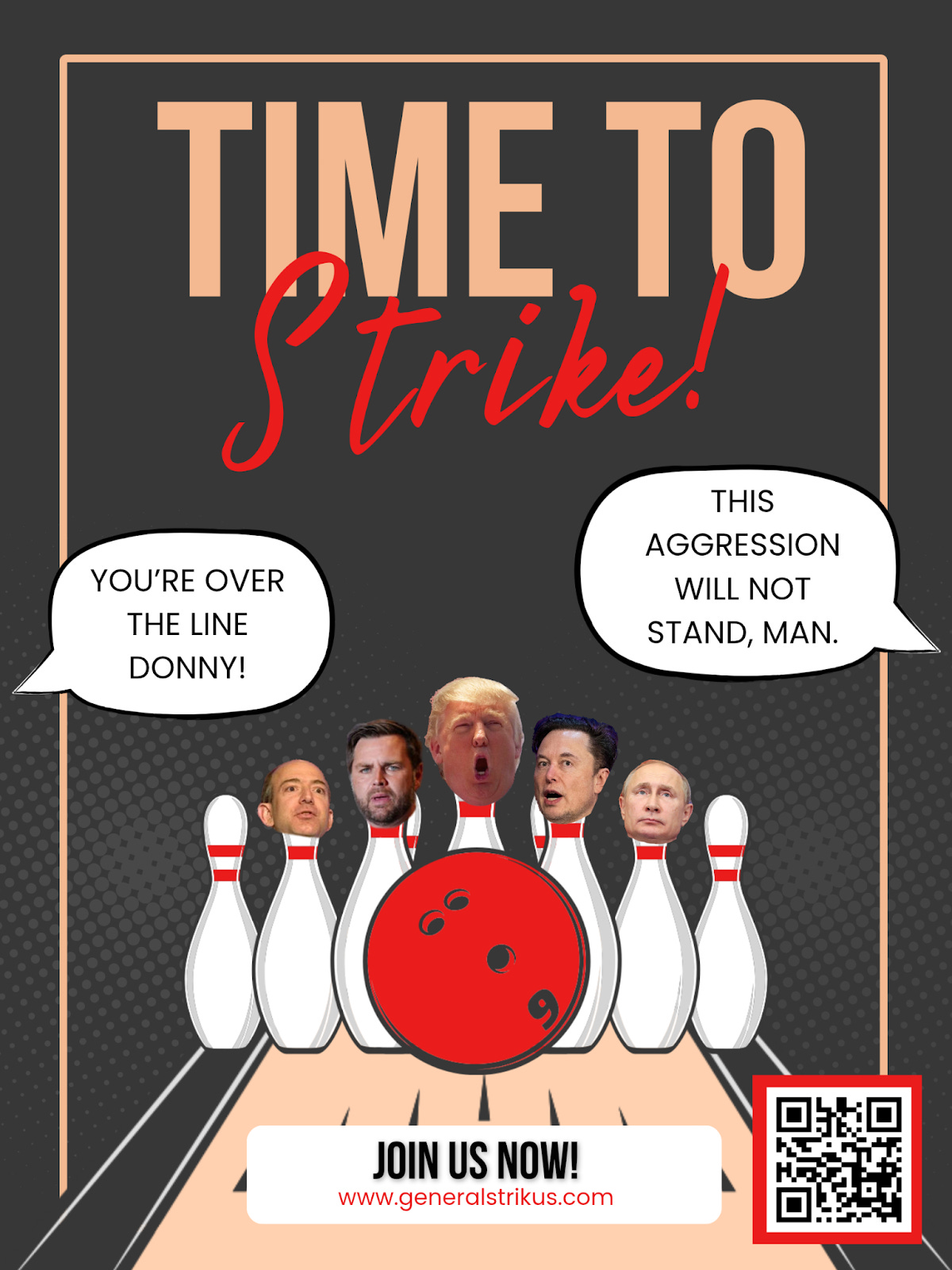
(Source: General Strike Flyer uses Big Lebowski Themes)
International Resistance
Global resistance to authoritarianism is intensifying through digital activism, European defense mobilization, and North American political tensions. The hacking group Dark Storm Team's claimed DDoS attack on X (formerly Twitter) represents a significant escalation in digital resistance against Elon Musk, who faces mounting protests over his role in the Trump administration. Meanwhile, European nations are strengthening defense cooperation and supporting Ukraine as Trump suspends U.S. military aid. In North America, Canada-U.S. relations have deteriorated dramatically with trade wars, electricity export taxes, and strong pushback against Trump's rhetoric about annexing Canada.
Ukraine, Palestine & European Resistance
What happened: European leaders are mobilizing to fill the void left by suspended U.S. military support to Ukraine. EU Commission President Ursula von der Leyen has declared "nothing is off the table" regarding defense funding, proposing an €800 billion plan to increase military spending. Polish officials have clashed with Elon Musk over Starlink satellite services for Ukraine, with Foreign Minister Sikorski threatening to seek alternative providers if SpaceX proves unreliable. Pro-Palestinian protesters have engaged in direct action across Europe, with one man scaling London's Big Ben with a Palestinian flag and others vandalizing Trump's Turnberry golf resort in Scotland by painting "GAZA IS NOT 4 SALE" on the lawn.
Why it matters: This European resistance to U.S. policy shifts represents a critical moment for democratic solidarity against authoritarian expansion. The willingness of European nations to increase defense spending and maintain support for Ukraine demonstrates a growing recognition that collective security requires concrete commitments, not just rhetoric. Poland's confrontation with Musk highlights how digital infrastructure has become a crucial battleground in modern resistance, while the symbolic protests at high-profile locations like Big Ben and Trump's golf course demonstrate how citizens are finding creative ways to challenge policies they view as threatening to human rights and international norms. These diverse forms of resistance show how Europeans are asserting their values in the face of shifting global power dynamics.
The Headlines
Polish PM Tusk cautions 'friends' against arrogance after Starlink spat
Poland responds to Musk on Starlink shutdown: We will seek other providers
'Nothing is off the table' on EU defence funding, says Ursula von der Leyen
Video. Trump's halt of Ukraine military support sparks protests in Italy
Majority of French, Germans and British think Trump is a 'dictator'
Man arrested after scaling London's Big Ben with Palestinian flag
The Crumbling North American Alliance
What happened: Relations between the United States and Canada have deteriorated dramatically, with Ontario imposing a 25% tax increase on electricity exports to the U.S. in response to Trump's trade war. Canada's new Prime Minister Mark Carney forcefully declared that Canada "never, ever, will be part of America in any way, shape, or form," directly challenging Trump's rhetoric about making Canada the "51st state." Thousands of protesters gathered outside the U.S. Consulate in Montreal on International Women's Day to demonstrate against the Trump administration, while anti-Trump sentiment has manifested in Canadians booing the American anthem at sporting events and boycotting American products.
Why it matters: The rapid deterioration of U.S.-Canada relations demonstrates how quickly authoritarian tendencies can damage even the most stable international partnerships. The economic countermeasures taken by Ontario show how smaller powers can leverage specific dependencies to resist pressure from larger neighbors, creating costs for aggressive policies. Prime Minister Carney's strong stance reflects the importance of defending national sovereignty and democratic values when faced with authoritarian rhetoric. This resistance from Canada serves as a powerful reminder that democratic nations must be prepared to defend their independence through both symbolic gestures and concrete economic actions.
The Headlines
Ontario slaps 25% tax increase on electricity exports to US in response to Trump's trade war
Canada 'never, ever, will be part of America': Next prime minister pushes back on Trump
International Women's Day: Thousands protest Trump administration outside Montreal's U.S. Consulate
Digital Resistance
What happened: The hacking group Dark Storm Team has claimed responsibility for a major DDoS attack on X (formerly Twitter), causing widespread outages. This cyberattack comes amid hundreds of protests at Tesla dealerships globally, as activists apply economic pressure against Elon Musk for his influence in the Trump administration and support for far-right groups. Musk believes that "a large, coordinated group and/or a country is involved" in the attack, which has caused significant disruption to his social media platform.
Why it matters: Digital resistance has emerged as a powerful tool for challenging authoritarian figures who control both government policy and private infrastructure. The coordinated attack on X demonstrates how vulnerable even the most powerful tech platforms can be to organized resistance, potentially limiting their effectiveness as propaganda tools. The targeting of Musk's businesses shows how civil resistance can create economic consequences for individuals who enable authoritarian policies. These actions highlight how resistance movements are adapting to confront power in its various forms—whether through direct cyber attacks, economic pressure, or symbolic protests that generate global attention.
The Headlines
Resistance Tomorrow
Vulnerabilities & Exposures
The Trump administration's economic policies are causing market turmoil, farmer distress, and Republican infighting, threatening both economic stability and political cohesion just two months into the second term. Trump's tariffs and spending freezes have triggered market selloffs, disrupted agricultural operations, and sparked open conflicts between cabinet officials and Elon Musk's DOGE initiative. These developments reveal significant vulnerabilities in the administration's governance approach as economic indicators flash warning signs.
Trump’s Economic Meltdown
What happened: Trump's tariffs on Canada, Mexico, and China have triggered market turmoil, with stocks dropping significantly and Treasury yields falling as investors worry about economic slowdown. When asked if his policies could cause a recession, Trump declined to rule it out, instead describing a "period of transition" while implementing his America First agenda. The Atlanta Fed's GDPNow tracker now shows the first quarter tracking for a 2.4% contraction, while JPMorgan has downgraded growth expectations to 1% if tariffs on Canada and Mexico are imposed. Global markets have reacted strongly, with the S&P 500 down 1.99% and NASDAQ falling 3.48% in a single day.
Why it matters: The market reaction signals serious concerns about Trump's economic approach that could undermine his political support. What was once called "American exceptionalism" in economic performance is now "fading" according to Bank of America analysts, with growing likelihood of stagflation—a toxic combination of weak growth and high inflation. This economic uncertainty threatens the very constituencies that supported Trump, including farmers and manufacturing workers, while potentially benefiting economic rivals like Europe and China who are ramping up stimulus measures. The administration's claim that tariffs will eliminate the $2 trillion federal deficit appears mathematically impossible, as it would require average tariffs exceeding 60% on all imports.
The Headlines
Stocks drop with Treasury yields as Trump interview fuels growth worries
Trump Declines to Rule Out Recession as Economic Policies Take Hold
Farmers in Distress
What happened: Farmers across the country are facing severe disruptions as the Trump administration has frozen USDA grants and loans while conducting a broad review of federal spending. The freeze has affected programs related to soil and water conservation, organic and local food systems, regional food networks, and support for minority and women farmers. Some farmers report being weeks away from bankruptcy due to the freeze.
Why it matters: The agricultural sector's distress reveals a critical vulnerability in Trump's political coalition, as farmers have historically been loyal supporters. The freeze comes at a particularly difficult time as farmers already face pressure from low grain prices, with U.S. farm bankruptcy filings jumping 55% in 2024 compared to the previous year. The situation is exacerbated by Trump's tariff policies, which have sparked trade wars with major buyers of U.S. farm products. Though the administration has suggested it may provide direct payments to farmers for trade-related losses as it did during Trump's first term, the current uncertainty has left many farmers unable to plan or invest, potentially threatening food security and rural economic stability.
The Headlines
Internal GOP Rifts
What happened: Serious rifts have emerged within the Trump administration, particularly between cabinet officials and Elon Musk's Department of Government Efficiency (DOGE). In an extraordinary cabinet meeting, Secretary of State Marco Rubio openly clashed with Musk, defending his department's staffing decisions and challenging Musk's accusations. House Speaker Mike Johnson has also distanced himself from DOGE, promising that recent drastic cuts to government programs and employees will be "corrected." Meanwhile, right-wing media personalities are reporting that their audiences are fracturing, with callers expressing surprise and dismay that Trump's policies are affecting them personally despite their support for him.
Why it matters: These internal conflicts reveal significant governance challenges just two months into Trump's second term. The public clash between Musk and cabinet officials like Rubio demonstrates a power struggle that threatens policy coherence and administrative stability. Speaker Johnson's break with DOGE suggests growing concern among elected Republicans that Musk's unelected influence could damage their political standing. The fracturing coalition between right-wing media and its audience indicates that Trump's policies may be eroding his base of support faster than anticipated. These divisions could seriously undermine the administration's ability to implement its agenda and maintain political cohesion as economic conditions potentially worsen.
The Headlines
Inside the Explosive Meeting Where Trump Officials Clashed With Elon Musk
Elon Musk Is Making Republicans Sweat and Giving Democrats a New Target
Musk Humiliated as Trump’s Own Advisers Brutally Expose DOGE Fiasco | The New Republic
Actions This Week
🚨 Don’t buy from Amazon this week! A recent survey shows that 9% of Amazon shoppers plan to participate in a weeklong boycott of Amazon organized by The People’s Union USA, with higher participation rates among minority groups and younger generations. This consumer-led economic action demonstrates how collective purchasing power can be leveraged as a form of nonviolent resistance against corporate entities allied with authoritarian regimes. 🚨
What happened: A survey by Numerator revealed that 9% of Amazon shoppers intend to participate in a planned weeklong boycott of the e-commerce giant. Participation intent is significantly higher among Black (23%), Hispanic (13%), and Asian (11%) shoppers, as well as among Gen Z (17%) and millennial (12%) consumers. Of those planning to boycott, 28% indicated they would redirect their purchases to local retailers or small businesses, while 22% would simply shift the timing of their Amazon purchases to before or after the boycott period.
Why it matters: This boycott represents a form of economic noncooperation, a powerful nonviolent action strategy that can pressure powerful entities through withdrawal of economic support. The higher participation rates among minority groups and younger generations highlight how marginalized communities can effectively organize to express collective dissent. The connection to the previous February 28 Economic Blackout (with 72% crossover participation) demonstrates how these actions can build momentum and create networks of resistance. By redirecting purchases to local businesses, participants are not only withdrawing support from a target but also strengthening alternative economic structures.
The Headlines
🚨 Make a plan to put pressure on your representatives during the upcoming Congressional recess. The "Musk or Us" campaign is mobilizing citizens to confront their representatives during Congressional recess about Elon Musk's growing political influence and harmful policies, with organized town halls and accountability events planned from March 15-23, 2025. 🚨
What happened: Indivisible has launched the "Musk or Us" recess toolkit to help citizens organize resistance during the upcoming Congressional recess from March 15-23, when Members of Congress return to their home districts. The campaign focuses on confronting representatives about the Trump-Musk coup and Republican tax policies that benefit billionaires while cutting essential programs. Indivisible is calling on citizens to demand town halls from their representatives, organize "empty chair" events for those who refuse to meet constituents, and directly question lawmakers about their support for policies that favor wealthy interests over working families.
Why it matters: When elected officials avoid public accountability while supporting policies that concentrate power in the hands of billionaires like Musk, it undermines democratic governance and representation. Strategic nonviolent action through organized town halls creates spaces for citizens to directly question their representatives, making the political costs of supporting anti-democratic policies visible. By coordinating nationwide actions during the recess period, citizens can demonstrate collective power and solidarity, forcing representatives to publicly defend their positions and potentially reconsider their support for policies that harm their constituents. Such events have already shown success in opening cracks in the GOP base and encouraging Democratic lawmakers to up their resistance game. Keep up the pressure during the upcoming Congressional recess!
Resources
I very much appreciate these rundowns of what is going on around the country and world in response to MAGA Coalition & President Trumps attempt to remake America on his image.
I know you list some resistance events coming up, but I’m certain we need a more complete statewide and nationwide calendar of listings. Is there a way to 1) create a single calendar with all planned events that are linked to the more detailed information that you have providing, & 2) is there way to find/encourage more of organizations involved in resistance activities to share their plans ahead of time?
It’s hard to keep up, and I keep feeling like I’m a day late and dollar short.
I’m also very interested in knowing if you know whether or not anyone is working on an alternative means of communication between the people and resistance group. I think it’s plausible that online social media may begin to cooperate with MAGA government agencies by engaging in surveillance, or even dropping any users who criticize MAGA Gov or plan demonstration’s.
I worry I’m going to wake up one day and have no idea who to connect with or how to connect with anyone.
I guess I just want to know if we are ready if and when anti-pro-Democracy efforts by MAGA Gov start cracking down on us. It would be so much better if we plan ahead for worst case scenario, rather then wait until the s*** hits the fan.