

Welcome!
Welcome to The Resistance Sentinel, a publication dedicated to documenting and amplifying the movement to defend democracy against authoritarian rule. Our collective of researchers and analysts highlights the inspiring responses of citizens and organizations across the country while providing curated coverage of resistance activities and practical knowledge for effective engagement. Join us in turning awareness into action as we work together toward a more just and democratic future.
Daily Inspiration
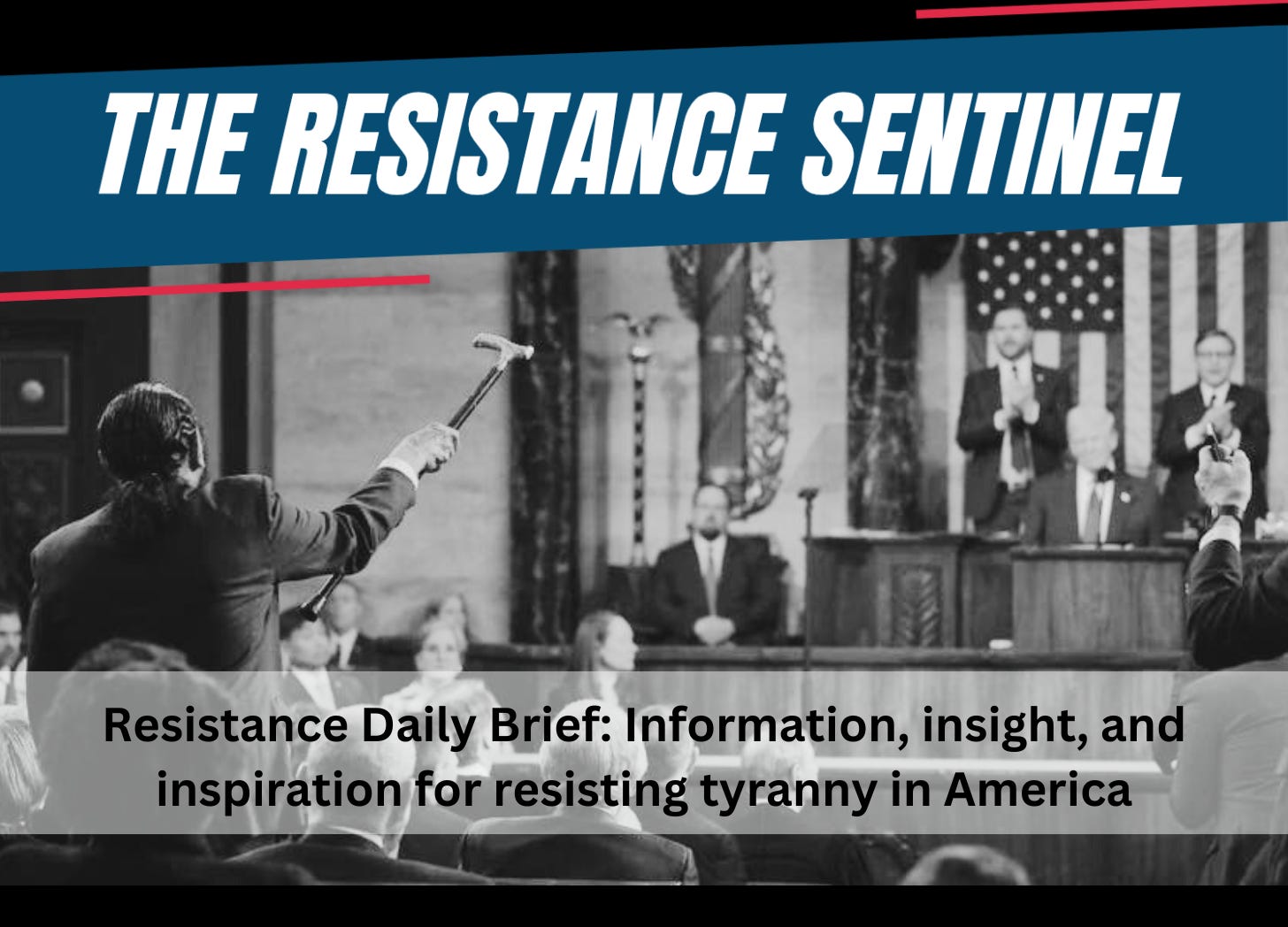
Representative Al Green's protest during President Trump's address to Congress highlights growing tensions and resistance to proposed policy changes, particularly regarding Medicaid cuts. This incident underscores the importance of dissent and the right to protest in democratic societies, even in formal settings.
What happened: During President Trump's joint address to Congress, Rep. Al Green (D-Texas) interrupted the speech, shouting that Trump had "no mandate to cut Medicaid." Green was subsequently removed from the chamber by the sergeant-at-arms. The House Freedom Caucus plans to introduce a resolution to censure Green for his actions. Other Democrats also engaged in various forms of protest during the speech, including holding signs and wearing shirts with messages of resistance.
Why it matters: This act of protest demonstrates the power of individual voices in challenging authority and defending vulnerable populations. By disrupting a high-profile political event, Green drew attention to concerns about potential cuts to crucial social programs like Medicaid. Such actions can inspire broader public engagement and mobilization against policies perceived as harmful. Green provided an example of individual courage and conviction in the face of a tyrant, demonstrating the kind of fortitude many had wished to see from the rest of the Democrats in Congress but did not. The only thing any of us can control is our own actions. We should choose to act virtuously, in support of truth and in support of justice for our fellow citizens. Rep. Green did just that and should be an inspiration to us all.
The Headlines
House Conservatives Plan Censure Resolution Against Rep. Al Green for Heckling Trump
Rep. Al Green is removed from chamber during President Trump's address

Representative Green offers a contemporary example of the story that philosopher Massimo Pigliucci provides from Rome, in his book, How to Be a Stoic:
According to our friend and guide, “When Vespasian sent to him not to come into the Senate he answered, ‘You can forbid me to be a senator; but as long as I am a senator I must come in.’ ‘Come in then,’ he says, ‘and be silent.’ ‘Question me not and I will be silent.’ ‘But I am bound to question you.’ ‘And I am bound to say what seems right to me.’ ‘But, if you say it, I shall kill you.’ ‘When did I tell you that I was immortal? You will do your part, and I mine. It is yours to kill, mine to die without quailing: yours to banish, mine to go into exile without groaning.’ What good, you ask, did Priscus do, being but one? What good does the purple do to the garment? Just this, that being purple it gives distinction and stands out as a fine example to the rest.” (From: Massimo Pigliucci, How to Be a Stoic)
Resistance Today
Civil Society & Publics
Tesla investors criticize Elon Musk over stock performance, highlighting concerns about leadership accountability. Target faces backlash during an economic boycott, reflecting consumer dissatisfaction with its policy changes. Republican leaders advise lawmakers to avoid town halls amid growing public discontent with government actions. Protests and pressure campaigns are having an effect. American pro-democracy forces must not let up and must redouble their efforts.
What happened: Tesla shareholders expressed frustration with CEO Elon Musk over the company's declining stock value, questioning his focus and leadership priorities. Target experienced a significant drop in web traffic during a nationwide economic boycott organized by The People’s Union USA, which coincided with criticism of its rollback on diversity, equity, and inclusion (DEI) initiatives. Meanwhile, Republican congressional leaders advised their members to avoid town halls as constituents voiced anger over federal budget cuts and perceived centralization of power under the Trump administration.
Why it matters: These events underscore the growing tension between corporate and political leadership and public accountability. The Tesla incident highlights the importance of shareholder activism in holding executives accountable for decisions that impact financial stability. But that shareholder activism likely would not have come without the widespread, ongoing public protests against the company worldwide. The Target boycott reflects the power of organized consumer action to challenge corporate policies perceived as regressive. Some questioned the effectiveness of a one day boycott. This reporting shows that the boycott did, indeed, have measurable impacts in addition to building capacity for organizing such campaigns. The next campaign against Target--see Actions this Week below--is planned to last for 40 days. Lastly, the Republican avoidance of town halls reveals a potential erosion of public engagement, even with their base. Together, these developments signal a critical juncture for civil society to assert influence over both economic and political systems to resist authoritarian tendencies. In short, protests and pressure campaigns are having an effect. American pro-democracy forces must not let up and must redouble their efforts.
The Headlines
Tesla investors furious at stock’s plunge turn tables on CEO Elon Musk
Target Loses Web Traffic As Costco Gains On Feb. 28 Economic Blackout Day
GOP Leaders Are Telling Lawmakers to Simply Stop Hosting Town Halls
Bureaucratic & Executive
Federal agencies face turmoil as USAID dismantling and National Science Foundation (NSF) firings spark widespread dissent. Hundreds of State Department officials and civil servants challenged the administration's actions, highlighting threats to U.S. global leadership and humanitarian efforts, while some fired NSF employees were reinstated. These are small but important wins, demonstrating a continued willingness to speak out within the civil service and a successful reversal of at least some portion of DOGE’s agenda.
What happened: The National Science Foundation (NSF) has reinstated 84 probationary employees it previously fired, following a federal judge's order declaring the mass firings illegal. Meanwhile, over 700 U.S. foreign service officers and civil servants have signed a dissent cable urging Secretary of State Marco Rubio to halt the dismantling of the U.S. Agency for International Development (USAID). The cable argues that the agency's hollowing out endangers American lives, weakens global standing, and undermines U.S. economic dominance.
Why it matters: These events demonstrate the power of collective action and institutional resistance against authoritarian tendencies within government. The dissent cable and legal challenges to agency dismantling showcase how civil servants can leverage formal channels to oppose policies they view as harmful to national interests. This resistance helps maintain checks and balances within the government, preserving democratic norms and preventing the consolidation of power in the executive branch. These are small victories. But at this moment, American pro-democracy forces need all the victories they can get. Victories like these are good for morale, which is essential to maintain hope and motivation to continue the fight. While we should not become complacent, of course, we should also not discount such victories, but rather, celebrate them.
The Headlines
Legal & Judicial
The Supreme Court rejected Trump's attempt to withhold foreign aid funds, while Trump publicly confirmed Elon Musk's controversial role in the Department of Government Efficiency (DOGE) during his State of the Union Address. This decision from the Trump-allied Supreme Court is a small victory while Trump’s oversharing on the national stage may set him up for additional losses in court in the weeks to come.
What happened: The Supreme Court voted 5-4 to deny President Trump's emergency request to avoid paying nearly $2 billion in foreign aid funds for already completed work. Chief Justice Roberts and Justice Barrett joined the three liberal justices in the majority. Meanwhile, Trump inadvertently disclosed that Elon Musk is heading DOGE during his State of the Union speech to Congress, contradicting the administration's previous claims about Musk's role and raising questions about the legality and transparency of the agency's operations.
Why it matters: This decision represents an important check on executive power and reaffirms Congress's role in appropriating funds. It protects the work of humanitarian organizations and upholds the rule of law by preventing the president from unilaterally withholding congressionally approved funding. The revelation about Musk's role in DOGE exposes potential conflicts of interest and raises concerns about the concentration of power in the hands of unelected individuals. Both issues demonstrate the importance of maintaining checks and balances and transparency in government operations to prevent authoritarian tendencies and protect democratic institutions. Once again, these are examples of perhaps small wins or openings to be exploited that should be celebrated and upon the which pro-democracy forces should capitalize.
The Headlines
Trump Unleashes Legal Chaos for Elon Musk's DOGE in Speech to Congress
Supreme Court rejects Trump's bid to avoid paying nearly $2 billion in foreign aid
SCOTUS Denies Trump's Request to Lift Order Requiring Release of $1.5 Billion in Foreign Aid
Congress & Lawmakers
President Trump's address to Congress sparked protests and walkouts from Democrats, highlighting deep political divisions and concerns over his policies. Critics argued that Democrats' response to Trump's address lacked strategic impact, with protests and visual statements seen as ineffective or counterproductive in countering authoritarian consolidation. This demonstrates that Democrats still have a long way to go to become an effective resistance and that pro-democracy forces need to continue pushing them in that direction.
What happened: President Trump delivered his first primetime speech of his second term to a joint session of Congress, touting economic gains and a crackdown on illegal immigration. Several Democratic lawmakers, including some from Oregon, walked out in protest. Democrats held up signs criticizing Trump's statements and policies, while some wore pink as a visual protest against his administration's impact on women's issues. Some viewed these efforts as performative and lacking substance, with MSNBC's Symone Sanders Townsend likening the protest signs to "bingo cards" and asserting that such visuals failed to resonate with the public. Critics also noted that Democratic leadership appeared divided, with some members choosing to heckle or leave while others opted for more restrained responses like Senator Slotkin's moderate rebuttal.
Why it matters: The dramatic protests and walkouts during a presidential address to Congress represent an escalation of partisan tensions and a breakdown of traditional decorum. This open defiance of the president in such a formal setting signals deep concerns among Democrats about the direction of Trump's policies and their effects on democratic norms. The protests aim to draw public attention to opposition viewpoints. Nonetheless, the Democrats’ protests fell flat with many supporters. These criticisms highlight a broader challenge for pro-democracy movements: the need for cohesive, impactful strategies to counter authoritarian rhetoric and policies effectively. Performative or fragmented responses risk undermining public confidence in opposition efforts and failing to mobilize broad-based support. Effective resistance requires unified messaging, strategic planning, and actions that resonate with diverse constituencies, fostering a robust pro-democracy coalition. While the Democrats do not appear to have yet achieved that goal, it is noteworthy that we are seeing at least more symbolic attempts at resistance than we were seeing before. Pro-democracy forces, therefore, need to continue putting as much or more pressure on Democrats as Republicans, urging them to get in the fight in more substantial ways.
The Headlines
Oregon Democrats walk out as Trump says 'America is back' in joint address
Democratic Senator Slotkin reaches for the political center in rebuttal to Trump
MSNBC host on Democrats at Trump speech: 'The signs are not landing'A protest in pink: Democrats respond to Trump's speech through clothes
State & Local Governments
Governors Pritzker and Healey's sharp criticisms of President Trump's policies highlight growing state-level resistance to perceived federal overreach and threats to democratic norms. The Illinois and Massachuesetts governors have emerged as strong, state government voices against the Trump-Musk regime. Pro-democracy forces must encourage other blue state governors to follow their lead.
What happened: Following President Trump's address to Congress, Illinois Governor JB Pritzker and Massachusetts Governor Maura Healey issued strong rebukes of the administration's policies. Pritzker criticized Trump's budget cuts and tariffs, stating they will increase costs for working families. Healey blasted Trump's tariffs as "the largest tax increase in a generation" and accused him of making life harder for vulnerable groups. Both governors vowed to fight for their states' interests against federal policies they view as harmful.
Why it matters: State-level resistance to federal policies perceived as authoritarian is crucial for maintaining democratic checks and balances. Governors' public opposition signals to citizens that state governments can serve as a bulwark against federal overreach. This resistance from state leaders helps preserve federalism, protects minority rights, and maintains alternative power centers that can challenge and limit autocratic tendencies at the national level. By vocally opposing policies they see as harmful, governors like Pritzker and Healey are modeling democratic dissent and signaling their states will not simply acquiesce to all federal directives. The federal system in the United States offers a unique tool for countering the consolidation of authoritarian rule in Washington, D.C. More state governors must be encouraged to follow Pritzker and Healey’s leads and stand up to the Trump-Musk regime.
The Headlines
Pritzker, Illinois politicians react to President Trump's address to Congress
Governor Healey blasts Trump over Elon Musk, tariffs as she amps up criticism
Media & Tech
The New York Times' framing of Representative Al Green's protest during Trump’s State of the Union speech as "heckling," highlights the media's continued failure to effectively support resistance to authoritarianism. Stephen Colbert's critique of Democrats' symbolic dissent, on the other hand, demonstrates an understanding of the dangers of the current moment and is encouraging more effective resistance. The New York Times’ mischaracterization, however, trivializes legitimate acts of opposition and reflects broader challenges in mobilizing effective pro-democracy responses. The differences between trivializing and construction critique, even if in the form of humor, is essential to grasp at this moment.
What happened: During President Trump's speech to Congress, Rep. Al Green vocally protested proposed Medicaid cuts, leading to his removal from the chamber. The New York Times described Green’s protest as "heckling," while Stephen Colbert mocked Democrats' symbolic acts of dissent, such as wearing pink and holding signs, as ineffective gestures against authoritarianism. Colbert criticized their lack of substantive action, encapsulating his frustration with a sign reading, "Try doing something."
Why it matters: By framing Green's protest negatively, mainstream media like the New York Times undermine the urgency of resisting authoritarianism. Such narratives discourage bold dissent and fail to highlight the critical need for organized, disciplined resistance in defending democracy. Effective resistance requires not only vocal opposition but also strategic coalition-building and action that can challenge authoritarian consolidation, rather than dismissing them as disruptions. There is a difference between understanding the seriousness of the moment and using humor or mockery to encourage greater, bolder action--as Colbert did--and framing such bold act as mere disruption or lack of decorum.
The Headlines
Stephen Colbert's brutal three-word message to Dems who protested Trump speech
Al Green Removed From House Chamber for Heckling Trump During Speech
International Resistance
A coordinated global backlash against authoritarianism is unfolding through economic resistance and public dissent in North and Central America, as well as across Europe. Elon Musk's alignment with far-right movements and controversial actions have sparked global protests, including arson attacks on Tesla facilities and declining sales in Europe and Canada, reflecting widespread public backlash against his perceived complicity in authoritarian agendas. Grassroots resistance against Musk exemplifies how collective action can weaken authoritarian power by targeting influential allies. This matters because it demonstrates the power of collective action and strategic nonviolence in countering authoritarian policies and figures and contributes to the further isolation of the Trump-Musk regime on the global stage.
Trade Wars and Economic Retaliation
What happened: The U.S., under President Trump, has intensified trade tensions by imposing tariffs on key trading partners, including Mexico and Canada, prompting retaliatory measures. Mexico plans counter-tariffs targeting U.S. goods, while Canadian Prime Minister Trudeau has refused to lift any of his retaliatory tariffs unless the U.S. removes all of its own. With regard to Panama, President Trump falsely claimed the U.S. is reclaiming the Panama Canal, sparking backlash from Panamanian President Mulino, who accused Trump of lying and reaffirmed Panama's sovereignty. These actions have disrupted critical sectors like oil pipelines and auto manufacturing, with Canadian oil flows to the U.S. slowing significantly.
Why it matters: Economic retaliation highlights the use of nonviolent resistance to challenge authoritarian economic aggression and protect national sovereignty. By refusing to capitulate to unilateral demands, countries like Canada, Mexico, and Panama are asserting their independence while exposing the vulnerabilities of authoritarian overreach. This approach aligns with strategies that weaken authoritarian regimes by targeting their reliance on economic control and international cooperation. The United States is powerful, but not so powerful that it can take on the entire world. Countries targeted by the Trump-Musk regime must band together to counter the United States’ malign influence, which will itself be of assistance to pro-democracy forces inside the United States.
The Headlines
Mexico will react to Trump tariffs on Sunday, President Sheinbaum says
Trudeau not willing to lift Canada's retaliatory tariffs if Trump leaves some tariffs on Canada
Canada's oil pipelines to the U.S. slowed within hours of Trump's tariffs, data show
Trump to Pause Auto Tariffs for One Month as Other Levies Continue‘Trump is lying’: Panama’s president refutes claims that US will take back canal
International resistance to authoritarian allies
What happened: Elon Musk’s political affiliations with far-right movements and his role in President Trump’s administration have triggered widespread public backlash. Tesla sales have plummeted in Europe and Canada due to Musk's controversial actions, including promoting far-right parties in Germany. Protests have escalated globally, with arson attacks on Tesla facilities and petitions in Canada calling for Musk's citizenship revocation. These acts of dissent reflect growing public resistance against figures seen as complicit in authoritarian agendas.
Why it matters: Grassroots mobilization against Musk illustrates how collective action can undermine the legitimacy of authoritarian collaborators. Public boycotts, protests, and symbolic acts of defiance weaken support for oppressive regimes by targeting their influential allies. Such resistance aligns with nonviolent strategies that erode authoritarian power through societal pressure and independent activism.
The Headlines
Resistance Tomorrow
Vulnerabilities & Exposures
Trump's tariffs and Republican backlash reveal deep fractures in economic policy and party accountability, signaling growing challenges to the Trump regime from its own supporters. Supporters are increasingly questioning the wisdom and effects of Trump’s tariffs while right wing radio hosts and GOP congressional representatives face backlash from constituents at town halls across the country.
Doubts about Trump tariffs
What happened: The imposition of sweeping tariffs by President Trump on imports from Canada and Mexico has drawn sharp criticism from economists, business leaders, and conservative voices. Analysts warn that these tariffs could lead to significant economic downturns, with some predicting the worst U.S. economic performance since the COVID recession. Meanwhile, the International Chamber of Commerce cautions that the escalating trade war risks triggering a global depression. Conservative commentators have expressed concerns about government cuts and tariff policies, highlighting their potential to destabilize markets and harm American workers.
Why it matters: These developments underscore the dangers of erratic economic policies under authoritarian-leaning leadership, which can erode trust in government institutions and weaken economic stability. Trade wars and fiscal mismanagement not only harm citizens' livelihoods but also create opportunities for authoritarian leaders to consolidate power by exploiting economic fears. Resistance to such policies requires transparent communication, coalition-building among affected sectors, and sustained public pressure to demand accountability.
The Headlines
Fox's Maria Bartiromo worries Trump's federal government cuts could "induce a recession"
Trump's tariffs and burgeoning trade war add to economic chaos
Tariff War Risks Sinking World Into New Great Depression, International Chamber of Commerce Warns
Republican backlash
What happened: Republican lawmakers are avoiding town halls amid growing public discontent over President Trump’s policies, including his trade decisions and cuts to veterans' benefits. Conservative media figures like Sean Hannity are facing backlash from their audiences, with some accusing them of staging callers critical of Trump. Reports also highlight a broader conservative disillusionment with Trump’s leadership, as evidenced by heated exchanges at town halls and on right-wing talk radio.
Why it matters: The retreat of Republican lawmakers from public engagement signals a breakdown in democratic accountability, as elected officials evade scrutiny from their constituents. This avoidance undermines trust in representative democracy and weakens public oversight of government actions. To counteract such trends, citizens must demand transparency and accountability through collective action while fostering open dialogue between representatives and their communities. In short, pro-democracy forces must keep up their efforts to reach out to Trump’s increasingly disillusioned supporters, encouraging defections from this camp.
The Headlines
Actions This Week
🚨 Starting today! Target faces a 40-day consumer boycott over its shift away from diversity, equity, and inclusion policies, highlighting the power of collective action in challenging corporate decisions that impact marginalized communities. NO TARGET PURCHASES FOR 40 DAYS 🚨
What happened: Target announced significant changes to its DEI programs, including eliminating hiring goals for minority employees and ending an executive committee focused on racial justice. This decision came in response to conservative pressures and the Trump administration's threats to investigate "illegal DEI" practices. The boycott, initiated by Rev. Jamal Bryant, aims to protest Target's perceived abandonment of its commitment to diversity and inclusion.
Why it matters: This boycott demonstrates the potential of collective consumer action to hold corporations accountable for their social responsibilities. By leveraging economic pressure, communities can challenge decisions that undermine progress towards equality and inclusion. This form of nonviolent resistance serves as a powerful tool against authoritarian tendencies that seek to suppress diversity and maintain systemic inequalities, empowering citizens to actively shape corporate policies and societal norms.