

Welcome!
Welcome to the Resistance Daily Brief from The Resistance Sentinel, a publication dedicated to documenting and amplifying the movement to defend democracy against authoritarian rule. Today, we highlight congressional Democrats’ plans to push back against Trump’s State of the Union address tonight, resistance from federal workers, more legal setbacks for Trump, and growing vulnerabilities to the regime as they openly mock veterans and crash the economy. Join us in turning awareness into action as we work together toward a more just and democratic future.
Daily Inspiration
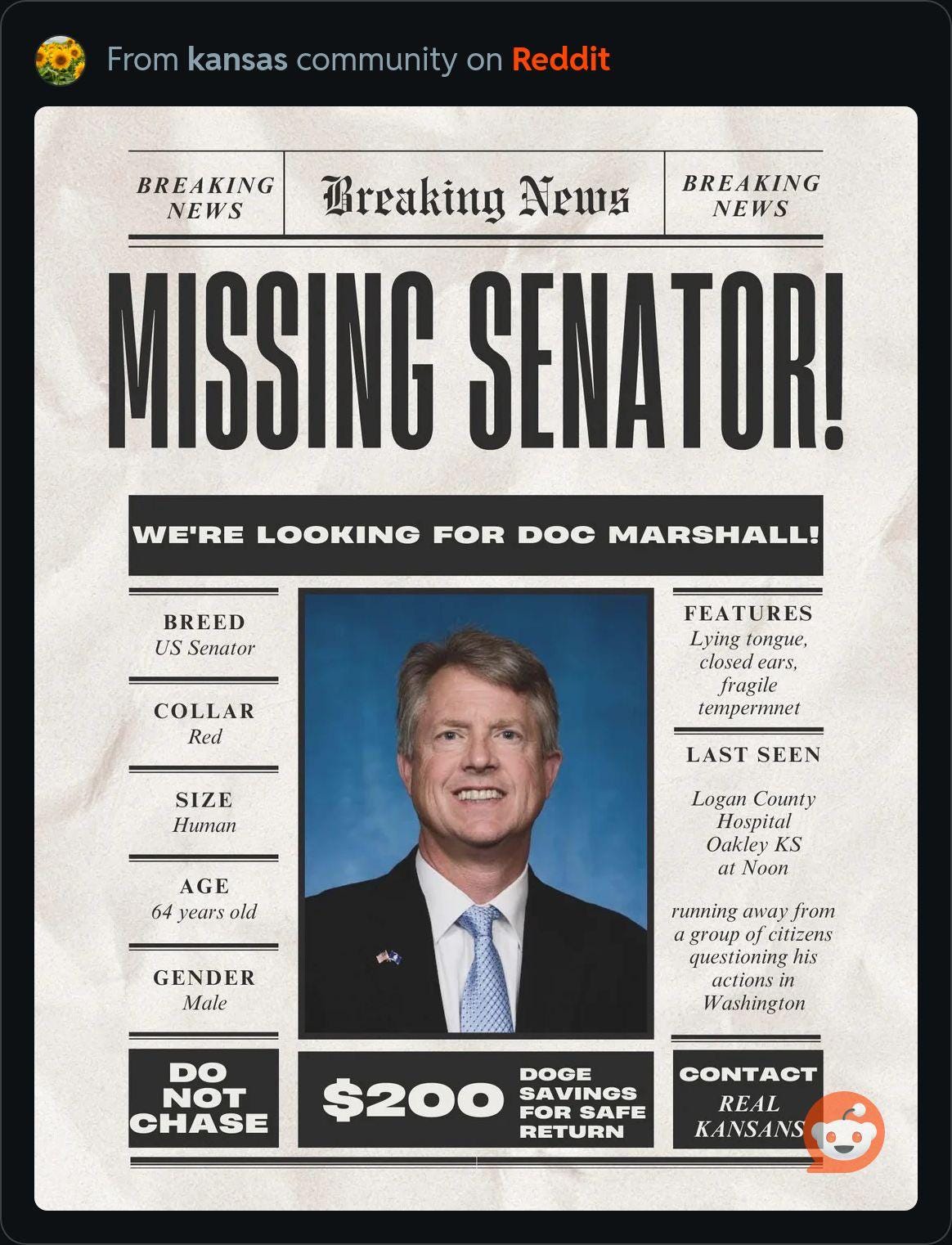
Found on Kansas community sub-Reddit, a satirical "missing person" poster targeting Senator Roger Marshall. It describes him as a "64-year-old male" with features such as a "lying tongue" and a "fragile temperament," last seen fleeing Logan County Hospital in Oakley, Kansas, after being confronted by constituents about his actions in Washington. The poster offers a reward of "$200 Doge Savings" for his safe return and humorously advises not to chase him. This comes in response to Marshall fleeing his own town hall meeting when faced with tough questions from angry constituents.

Resistance Today
Civil Society & Publics
A statement from the George W. Bush Presidential Center criticized the Trump-Musk regime's shift toward appeasement of authoritarian regimes, particularly in its abandonment of Ukraine and support of Russia. Statements from former presidents and associated organizations could be an important means of communicating to the public the uniquely dangerous situation facing the country right now.
What happened: The statement criticized the controversial meeting in which President Trump and Vice President Vance ambushed Ukrainian President Volodymyr Zelenskyy and lied about Russia's responsibility for the war. It argued that Ukraine is fighting not only for its sovereignty but also for global democratic values and warned against appeasement strategies reminiscent of pre-WWII policies. The statement emphasized Ukraine's resilience, the strategic benefits of U.S. support, and the dangers of ceding ground to Russian and Chinese authoritarianism.
Why it matters: Supporting Ukraine is critical to resisting authoritarian expansion and safeguarding democracy worldwide. Appeasement risks emboldening aggressors like Russia and setting a precedent for other authoritarian regimes to exploit weaker states. As history shows, dictatorships thrive on perceived weakness and disunity among democratic nations; thus, sustained support for Ukraine is essential to countering such threats and reinforcing the principles of self-determination and freedom. A statement from an organization associated with a former Republican president, though a perhaps too small gesture, is, nonetheless, a hopeful sign. We would encourage all former presidents to come together to warn the nation in clear terms about the uniquely dangerous situation in which the country finds itself.
The Headlines
Some protestors may be engaging in vandalism against Tesla charging stations, as evidenced by a Tesla charging station fire in Littleton, Massachusetts, which was determined to be an act of arson. Such acts are evidence of the growing anger directed at Elon Musk and the destruction being carried out by his DOGE team. Acts of violence, however, are to be discouraged.
What happened: Investigators concluded that a fire at a Tesla Supercharger station in Littleton, Massachusetts, was intentionally set. The fire caused extensive damage to seven chargers and was extinguished after local authorities cut power to the site. Law enforcement is soliciting public assistance to identify the perpetrator, offering a reward for information leading to their capture.
Why it matters: This deliberate attack on critical infrastructure highlights the risks posed by targeted acts of sabotage, which can erode public trust and disrupt essential services. From the perspective of resisting authoritarianism, such incidents emphasize the need for resilient local institutions and community solidarity to deter destabilizing actions. Transparent investigations and public accountability are crucial to preventing exploitation of such incidents by authoritarian forces who will use them to justify crackdowns on dissidents. Pro-democracy movements must maintain discipline in the face of regime provocations, keep their justified anger and indignation at regime abuses under control, and emphasize to members the need to avoid the use of violence that plays into the adversary’s hands.
The Headlines
Bureaucratic & Executive
Federal workers are speaking out publicly, forging alliances with civil society organizations and Democratic lawmakers, and engaging in malicious compliance behind the scenes to slow Trump-Musk authoritarian consolidation. Civil servants are crucial to fighting back when slowing power consolidation is crucial to buying time to raise a broad resistance coalition.
What happened: Federal workers across the U.S. are resisting mass layoffs and restructuring initiatives led by the Trump administration, which have targeted civil servants, probationary employees, and federal agencies. These efforts include protests, lawsuits, online organizing, and community mobilization to counter what many perceive as an authoritarian attack on the federal workforce. In other cases, federal workers are describing in online forums how they are pushing back from within with delay tactics and other forms of “malicious compliance.” In some cases, they are seeing limited success, as in the reinstatement of some fired probationary employees at the National Science Foundation and the resignation of a top official at Health and Human Services after clashing with Secretary Robert F. Kennedy, Jr. over the agency’s response to the growing measles outbreak.
Why it matters: These stories highlight the critical role of civil servants in maintaining democratic governance and institutional integrity. By organizing protests, sharing information, engaging in tactics of malicious compliance, and pursuing legal challenges, these workers exemplify nonviolent resistance strategies that can weaken authoritarian consolidation by exposing abuses, building solidarity, and mobilizing public opinion. They also cause friction for the regime at a crucial moment when time is of the essence in mobilizing a broader pro-democracy coalition.
The Headlines
VIDEO: Federal workers rally in West Haven against Trump administration’s mass firings
Fired worker returns to Fort McHenry to protest Trump cuts, mark 100th anniversary
National Science Foundation is reinstating fired probationary employees
Fired federal workers to join Democrats at Trump's speech to Congress
Malicious compliance: Encrypt emails if forced by leadership
Legal & Judicial
A federal judge ruled that President Trump illegally fired the chair of the Merit Systems Protection Board, violating federal law and exceeding his authority. This decision upholds the independence of crucial government oversight bodies and protects federal workers from unjust termination, serving as a critical check on executive power.
What happened: U.S. District Judge Rudolph Contreras ordered the reinstatement of Cathy Harris as chair of the Merit Systems Protection Board (MSPB), ruling that Trump violated the 1978 Civil Service Reform Act by firing her without cause. The judge cited the MSPB's mission to operate independently from White House control and emphasized that board members can only be removed for specific reasons such as inefficiency, neglect of duty, or malfeasance in office. This ruling follows a similar decision that found Trump exceeded his authority in firing the head of the Office of Special Counsel.
Why it matters: This ruling is crucial for maintaining the separation of powers and preventing executive overreach. By protecting the independence of oversight bodies like the MSPB, the decision safeguards the rights of federal employees and ensures that government agencies can operate without undue political influence. The ruling also sets an important precedent for resisting attempts to consolidate power within the executive branch, which is essential for preserving democratic institutions and preventing the erosion of checks and balances. Furthermore, it demonstrates the judiciary's role in upholding the rule of law and constraining potential authoritarian tendencies in government. The courts continue to serve as a central battlefield against the ongoing Trump-Musk coup, which is as it should be. As we have noted before, however, the courts cannot stop the coup alone. Legislators, governors, civil society organizations, and the public must mobilis, en masse, and quickly, to stop the destruction of government agencies, services, and democracy itself.
The Headlines
Federal Judge Says Trump Illegally Fired Chair of Federal Workers Protections Board
Trump cannot oust chair of federal employees' appeal board, US judge rules
Congress & Lawmakers
Democratic lawmakers are employing various strategies to resist Trump administration policies, ranging from symbolic protests during the State of the Union address to legislative and oversight challenges in Congress. These actions aim to uphold democratic norms and maintain institutional accountability amidst concerns about executive overreach and hopefully signal growing resistance efforts by Democratic lawmakers who have been criticized for a tepid and disorganized response thus far.
Democratic Responses to Trump's State of the Union Address
What happened: Democratic lawmakers are planning a range of protests during President Trump's State of the Union address, including wearing coordinated colors, walking out during controversial remarks, or sitting silently without applause. Some members, like Rep. Gerry Connolly, are boycotting the event altogether in solidarity with federal workers affected by mass layoffs. Others aim to disrupt the speech by bringing guests who have been negatively impacted by Trump's policies. Still others, like Representative Alexandria Ocasio-Cortez and Senator Ron Wyden will hold online counter-events during Trump’s speech.
Why it matters: These acts of protest symbolize a broader effort to challenge what many Democrats rightly perceive as authoritarian consolidation by the Trump administration. By using high-profile events like the State of the Union to draw attention to these issues, lawmakers aim to mobilize public opinion and demonstrate unity against actions that undermine democratic governance and the rule of law. Such resistance is critical for maintaining checks on executive power and ensuring that dissent remains visible during periods of democratic backsliding.
The Headlines
Democrats looking to 'express our outrage' at Trump's speech tonight
Virginia Democrat to boycott Trump address in solidarity with federal workers
Broader Democratic Lawmaker Resistance
What happened: Beyond symbolic protests, Democrats are taking legislative action to counter Trump's policies. They are investigating Elon Musk's role in DOGE and its mass layoffs, demanding reinstatement of unlawfully terminated federal workers, and questioning Trump's directives on gun regulations. Lawmakers are also addressing issues like Medicaid cuts and the dismantling of key agencies like NOAA, arguing that these moves undermine public welfare and democratic accountability.
Why it matters: These legislative oversight efforts, though likely ineffective, nonetheless reflect an attempt to use institutional mechanisms to resist executive overreach. By demanding transparency and accountability, Democrats aim to preserve democratic institutions and protect vulnerable populations from harmful policies. Such actions are essential for safeguarding rule-of-law principles and preventing the erosion of checks and balances that underpin a functioning democracy. Even if unsuccessful, they help call attention to the regime’s misdeeds and offer hope of an alternative that can serve to encourage broader resistance.
The Headlines
Democrats seek to probe Musk conflicts and DOGE firings with resolutions of inquiry in the House
Colorado Democrats press for answers on Trump's 'dismantling' of NOAA
Dems demand details from AG Bondi on Trump's directive to review gun regulations
Dems hit Medicaid, Elon Musk fears in expensive campaign targeting 23 House Republicans
State & Local Governments
Democratic governors are actively recruiting federal workers laid off by the Trump administration, offering thousands of job openings across multiple states. This move highlights the growing tension between state and federal governments, and demonstrates how local authorities are stepping up to support displaced public servants.
What happened: President Trump has initiated mass layoffs and buyouts of federal employees, falsely citing a bloated and inefficient executive branch. In response, Democratic governors from New York, Maryland, Hawaii, and New Mexico have launched recruitment campaigns targeting these displaced workers. New York alone has advertised 7,000 public-sector job openings, while other states are fast-tracking hiring processes and organizing job fairs. Even Republican-led Virginia is encouraging laid-off federal workers to transition to the private sector.
Why it matters: This situation represents a significant shift in the balance of power between federal and state governments. By absorbing federal talent, states are not only preserving vital public services but also strengthening their own capacities to govern independently. This decentralization of skilled workforce could lead to more robust and resilient state-level institutions, potentially acting as a counterweight to federal overreach. Furthermore, this initiative demonstrates how coordinated action by state governments can provide a safety net for citizens affected by abrupt federal policy changes, fostering resilience in the face of political upheaval. We encourage much more of such actions on the part of blue state governors, especially with respect to public health and the funding of medical research. The creation of such parallel or alternative institutions will be critical to responding to current and future public health crises like measles and H5N1 bird flu.
The Headlines
International Resistance
The U.S. faces escalating international isolation and resistance as a result of trade wars and abandonment of traditional allies. These interconnected challenges highlight growing global instability that come with authoritarianism. The isolation and negative consequences for the Trump regime, though painful to Americans, are a necessary part of resisting his attempts to consolidate and then maintain authoritarian control.
Trade wars breaking the North American alliance
What happened: The U.S., under President Donald Trump, has implemented sweeping tariffs on imports from Canada, Mexico, and China, triggering immediate retaliatory measures. Canada imposed 25% tariffs on $30 billion worth of U.S. goods, with Ontario Premier Doug Ford threatening to cut electricity exports to the U.S. if tariffs persist. Mexico responded with heightened nationalism, promoting domestic goods through a "Made in Mexico" campaign and preparing its own counter-tariffs. These actions have strained relationships between the U.S. and its closest trading partners and North American allies.
Why it matters: These trade wars undermine international cooperation and economic stability, fostering nationalist sentiment that can be exploited by authoritarian regimes. We already see this when MAGA Trump supporters boo or speak out against Canada for no other reason than that Trump has told them Canada is now an enemy of the United States. By weaponizing economic interdependence, such policies risk eroding alliances critical for resisting authoritarianism globally, which seems to be the very point of Trump’s moves as he realigns the U.S. with the interests of authoritarian regimes in Russia, China, and North Korea. Retaliatory measures like Canada's electricity threats or Mexico's nationalist economic campaigns are inevitable and necessary steps to isolate and try to limit the damage done by Trump’s recklessness.
The Headlines
Ontario's Doug Ford says he could cut electricity to US over tariffs
US tariffs take effect and Mexico, Canada and China retaliate with their own tariffs on the US
Canada imposing 25% tariffs on $30 bln of US imports, Trudeau says
Ukraine & deteriorating relations with Europe
What happened: European favorability toward the U.S. has plummeted following Trump's re-election, driven by controversial policies such as allying with Russia against Ukraine and threatening to seize Greenland. Meanwhile, Elon Musk has amplified far-right rhetoric across Europe, supporting extremist parties like Germany's Alternative für Deutschland (AfD), which has gained traction amid rising populist sentiment. These developments coincide with heightened criticism of U.S. leadership over its treatment of Ukraine and allies like the UK and France.
Why it matters: The erosion of trust in democratic powers like the U.S., combined with the normalization of far-right ideologies in Europe, weakens collective resistance to authoritarianism worldwide. Figures like Musk leveraging their platforms to promote divisive politics further destabilizes democratic institutions. Such trends highlight how populist movements can exploit crises to undermine democratic norms and consolidate power globally. Nonetheless, Europe’s rejection of authoritarian parties in recent elections and growing sense of urgency to rearm to resist Putin and Trump are positive signs for pro-democracy forces.
The Headlines
European favourability of the USA falls following the return of Donald Trump
Musk rallies the far right in Europe. Tesla is paying the price.
Wałęsa condemns Trump treatment of Zelensky, likening it to communist interrogation
Resistance Tomorrow
Vulnerabilities & Exposures
Trump's economic policies face mounting criticism as markets tumble and supporters express discontent. Tariffs, federal layoffs, and controversial remarks spark economic uncertainty and erode trust in the administration.
Trump's tanking economy
What happened: The U.S. economy is showing signs of strain under Trump's policies, with tariffs triggering retaliatory actions from China and other trading partners. Stock markets have suffered sharp declines, with major indices like the Dow and Nasdaq falling, while consumer spending has dropped significantly. Economists warn of a looming recession as federal layoffs and spending cuts exacerbate economic challenges.
Why it matters: Economic downturns can serve as catalysts for social and political change. As more people experience financial hardship, there may be increased scrutiny of government policies and growing demands for accountability. This economic pressure could foster solidarity among diverse groups affected by the policies, potentially leading to broader coalitions opposing authoritarian tendencies. Additionally, economic instability may erode support for the administration among its traditional base, creating opportunities for alternative political movements to gain traction.
The Headlines
China hits US soybean firms, halts lumber imports as it steps up retaliation against Trump tariffs
Trump's China tariffs trigger retaliation against U.S. farm products | Reuters
Stock Market Today: Dow, S&P 500 and Nasdaq fall continuing Trump tariff tumble
On Fox Business, Newt Gingrich predicts "we are sliding towards a recession"
Fox Business co-host on economic slow down: "Expect a little bit of pain in the short term"
Criticism from supporters
What happened: Trump's supporters are voicing discontent over mass layoffs of veterans and federal employees, as well as inflammatory remarks by administration figures about veterans' fitness for employment. Talk radio callers are expressing concerns about job losses and economic uncertainty, while some Republican representatives face backlash at town halls over government cuts and policy decisions.
Why it matters: Criticism from within Trump's base could signal a fracturing of support for authoritarian policies. This internal dissent may create openings for democratic opposition to gain traction and build broader coalitions. When supporters begin to question the impact of policies on their own lives, it can lead to increased civic engagement and a reevaluation of political allegiances. A significant enough shift in sentiment among the base could potentially constrain the administration's ability to implement further controversial measures and may encourage more moderate voices within the party to assert themselves.
The Headlines
Actions This Week
As always, we end with some ideas for what you can do to help resist Trump tyranny in America.
🚨 TONIGHT: Do not tune in to the State of the Union. The White House says it will be “must-see TV,” further debasing our political discourse by turning it into a cruel form of reality TV. Instead, watch the counter-events by Representative Alexandria Ocasio-Cortez and/or Senator Ron Wyden. They will hold online events where they discuss the damage that Trump, Musk, and their Republican sycophants in Congress are doing to government agencies and services, our economy, the Constitution, and the lives of everyday Americans. Don’t give the adversary what he wants; don’t tune in to his cruel spectacle. 🚨