


Welcome!
In today’s Brief, widespread protests against the Trump-Musk regime, legal challenges to administration policies, and growing international tensions. The issue highlights resistance activities across civil society, government institutions, and media, while also noting vulnerabilities in the regime's support base, including economic instability and declining public approval.
Daily Inspiration
The Danish Prime Minister, Mette Frederiksen, delivered a powerful and inspiring speech in Kyiv. She called for unwavering European support for Ukraine, including the immediate scaling up of military and financial aid. She advocated for Ukraine's NATO membership or an equivalent long-term security guarantee. Her speech demonstrates the increasing isolation of the Trump-Musk regime on the global stage, especially among the United States’ now former European allies. Such isolation will be necessary to undercut the regime’s authority and legitimacy long term.
Community activists in Los Angeles are actively disrupting ICE operations, using tactics like early morning patrols, sirens, and bullhorns to warn immigrants of potential raids. These efforts have the potential to significantly impact ICE's ability to carry out arrests.
What happened: Volunteer groups in Los Angeles, part of the Community Self-Defense Coalition, are conducting daily pre-dawn patrols to spot and disrupt Immigration and Customs Enforcement (ICE) operations. Using tactics such as bullhorns, sirens, and social media alerts, these activists aim to prevent arrests by warning immigrants of ICE presence in their neighborhoods. The coalition, comprising over 60 organizations, has reportedly disrupted ICE operations and prevented arrests in areas like Alhambra and San Fernando.
Why it matters: These grassroots efforts represent a significant challenge to the current administration's increased immigration enforcement actions. By alerting communities and educating immigrants about their rights, these activists have the potential to significantly reduce ICE's ability to carry out arrests, potentially protecting undocumented individuals from deportation. The situation highlights the growing tension between federal immigration policies and local community resistance, potentially forcing ICE to adapt its tactics or face continued disruption of its enforcement efforts. These activities represent the kind of solidarity and mutual aid activities that scholars of effective resistance find are essential to countering the actions of authoritarian regimes.
Resistance Today
Civil Society & Publics
Widespread protests erupted across the U.S. over the weekend against Trump administration policies and Elon Musk's destruction of government services. Pro-democracy demonstrators targeted federal buildings, Tesla locations, national parks, and other symbolic sites in at least 22 states. Protestors expressed their anger over DOGE cuts to federal jobs and services, immigration policies, Trump’s abandonment of Ukraine and our European allies, and destruction of democratic governance. The widespread nature of these protests demonstrates increasing public engagement and resistance to the Trump-Musk regime and a growing coalition of grassroots movements aiming to halt the regime’s consolidation of authoritarian rule.
Mass Protests Against Trump Administration and DOGE
What happened: Thousands of protesters gathered in cities across the United States to demonstrate against recent actions by the Trump administration and Elon Musk's Department of Government Efficiency (DOGE). Protesters targeted Tesla stores, federal buildings, and other symbolic locations to voice opposition to government cuts, immigration policies, and Musk's role in slashing federal jobs and programs. The protests were part of a coordinated nationwide movement using hashtags like #50501 and #TeslaTakedown.
Why it matters: These large-scale protests indicate growing public discontent with the administration's policies and could build momentum for broader resistance. By disrupting Tesla's business operations and garnering media attention, protesters are attempting to exert economic and political pressure on Musk and the administration to change course. The involvement of diverse groups and creative protest tactics could help sustain the movement and attract broader public support.
Pro-Ukraine protests erupt across US after Trump and Vance 'ambush' Zelenskyy
Fired federal workers, union leaders protest Trump administration firings in Detroit
Federal employees in Seattle rally against mass Trump administration layoffs
Crowd lines road near Tesla center in Dayton area to protest Musk
'Tesla Takedown' protesters gather outside showrooms to rally against Elon Musk's role with DOGEProtesters in Tallahassee and Tampa join national movement pushing back against Trump
Demonstrators protest Trump budget cuts at Biscayne National Park
Protesters rally against Elon Musk, DOGE at SpaceX headquarters in Hawthorne
Protesters march and rally against Trump administration in Wilkes-Barre
Tesla store gets taken over by Musk protesters, 9 people arrested
Hundreds protest Elon Musk, Donald Trump outside Tesla dealership in Owings Mills
Immigration Policy Protests
What happened: Faith leaders, immigration advocates, and concerned citizens organized marches and rallies in several cities to protest the Trump administration's immigration policies, including mass deportations, the removal of protections for certain immigrant groups, and proposals to use former prisons as immigrant detention centers.
Why it matters: These protests highlight the human impact of recent policy changes and aim to build solidarity between different groups affected by the administration's actions. By framing the issue in terms of human dignity and moral values, protesters seek to shift public opinion and pressure policymakers to reconsider harsh immigration policies.
Faith leaders, immigration advocates protest Trump policies at LA 'March for Dignity'
Hundreds protest proposal to reopen Dublin women's prison as ICE detention center
Student and Religious Activism
What happened: Student groups and religious organizations have been instrumental in organizing many of the recent protests, using social media and local networks to mobilize participants. Some protests have incorporated prayer, music, and other creative elements to engage demonstrators and frame their activism in moral terms.
Why it matters: The involvement of students and faith communities adds moral weight to the protests and could help sustain the movement by tapping into existing social networks. Student activism in particular often plays a key role in social movements and can inspire wider participation.
Data Collection and Analysis of Protest Activity
What happened: Researchers are collecting and analyzing data on the recent wave of protests, documenting the scale and frequency of demonstrations across the country. Early analysis shows that the scale and frequency of protest activity has spiked in recent weeks.
Why it matters: Systematic data collection on protest activity can help researchers, policymakers, and the public understand the scope and nature of civil resistance movements. This information can be valuable for assessing the impact of protests and informing resistance strategies. It can also provide inspiration and courage for more people to take action when they see that others are increasingly speaking out.
Bureaucratic & Executive
The Trump administration's federal workforce cuts, NIH funding freeze, and privatization proposals are dismantling democratic institutions and public trust, while fired federal workers are speaking out to expose the damage. Billionaire Mark Cuban has urged these workers to band together to create their own consulting firms, a move that seeks to use privatization of government services as a weapon against the regime but may have the opposite effect, further legitimizing such privatization.
What happened: The Trump administration has carried out mass layoffs of federal employees, including veterans and probationary workers, leaving thousands scrambling for new jobs. Many of these workers are telling their stories, highlighting the harm caused to families and public services. Simultaneously, the NIH has frozen research grants despite court orders to resume funding, paralyzing biomedical research and further undermining checks and balances. Amid this upheaval, billionaire Mark Cuban has encouraged laid-off workers to form private consulting companies to provide critical services that the government may later need to outsource.
Why it matters: These actions exemplify strategies often seen in authoritarian regimes: weakening public institutions, centralizing power, and undermining accountability. The layoffs erode government capacity and target vulnerable employees, while the NIH funding freeze disrupts scientific progress and defies judicial authority. However, the fired workers' willingness to speak out and Cuban's call for collective action underscore the importance of organized resistance. While building alternative institutions can counteract such authoritarian tactics by preserving expertise, fostering solidarity, and maintaining pressure on those in power, Cuban’s recommendation risks legitimizing Trump-Musk efforts to privatize government services.
Legal & Judicial
Legal challenges mounted against Trump administration policies on Friday and over the weekend. These focused on immigration, elections, and DOGE’s destruction of government, with new lawsuits filed and adverse court rulings for the Trump-Musk regime. The courts continue to be a primary battleground for non-violent resistance to authoritarian consolidation.
What happened: The ACLU and other advocacy groups sued to block migrants from being sent to Guantánamo Bay and challenged the Trump administration's policy of deporting migrants to Central American countries like Panama, even if the deportees are not from those countries. Judges ruled that Trump's mass firings of federal employees were unlawful, ordered the halting of attempts to slash the federal workforce, and ruled that administration officials must testify in court about their actions, while motions were filed to sanction DOG lawyers for lying to the court. The Democratic Party filed a lawsuit against Trump's executive order seeking control over independent agencies like the Federal Election Commission.
Why it matters: These legal actions represent crucial efforts to check executive overreach and protect democratic institutions. By challenging policies in court, civil society groups and opposition parties are utilizing non-violent methods to resist authoritarian tendencies, uphold the rule of law, and defend the rights of vulnerable populations. The lawsuits aim to preserve the independence of government agencies, protect workers' rights, and ensure fair elections - all key pillars of a functioning democracy. The courts remain a vital battleground for resisting authoritarian consolidation, and rightly so. However, it remains to be seen how long this will last as the Trump-Musk regime and their GOP allies ignore court orders and call for the impeachment of judges who rule against the regime. The courts cannot hold out alone. More resistance from other sections of American society are necessary to stop the slide into authoritarianism.
ACLU and other advocates sue to block migrants from being sent to Guantánamo Bay
Judge Rules Trump Officials Must Testify in DOGE Data Lawsuit
Judge Says Trump Administration Ordering Mass Firings Was Unlawful
Judge extends block on Trump's plan to pull funding over health care for transgender youth
Lawsuit Against Panama Challenges Detention of Trump Deportees
Democrats challenge Trump effort to control Federal Election Commission
Motion for Sanctions filed for Govt Lawyers Who Lied to Court About ElonMail
Congress & Lawmakers
Congressional Democrats are intensifying efforts to resist Trump's policies through legal challenges, public mobilization, and legislative strategies, while also preparing a coordinated response to his upcoming State of the Union address. However, the party faces internal divisions and criticism for its fragmented and so-far unsuccessful approach. Continuing resistance pressure on congressional Democratic leadership is as important as more direct resistance to the Trump-Musk regime. Without institutional support from a courageous and coordinated opposition party, resistance from civil society groups and the judiciary will founder.
Congressional resistance
What happened: House Democrats are leveraging lawsuits, investigations, and legislative tools to challenge President Trump's sweeping reforms, including his controversial Department of Government Efficiency (DOGE) initiatives. Key actions include probing DOGE's access to sensitive data, pressing for reinstatement of unfairly fired federal workers, and demanding accountability for mass layoffs at health agencies. Lawmakers are also uniting to counteract budget cuts targeting Medicaid and SNAP, which disproportionately affect vulnerable populations, often in red states that supported Trump.
Why it matters: These efforts reflect a critical strategy to uphold democratic norms by holding the executive branch accountable. By resisting overreach and protecting civil servants, lawmakers aim to prevent the normalization of autocratic practices that undermine institutional checks and balances. This aligns with broader pro-democracy strategies emphasizing legal recourse, coalition-building, and public mobilization as tools to counter authoritarianism. It also appeals to members of the Trump base who will be disproportionately impacted by the cuts being made to government services, potentially inducing defections among Trump supporters.
Responding to Trump's State of the Union
What happened: Democrats are preparing a coordinated response to President Trump's upcoming State of the Union address. Senator Elissa Slotkin will deliver the official rebuttal, focusing on economic security and protecting social programs like Medicaid. Democratic leaders have urged members to invite guests impacted by Trump's policies, highlighting the administration's perceived failures.
Why it matters: This response underscores the role of public messaging in countering authoritarian narratives. By spotlighting policy impacts on ordinary citizens, Democrats aim to galvanize public support and frame themselves as defenders of democracy and economic justice. Such efforts are integral to building a united front that challenges authoritarian tendencies through narrative control and grassroots engagement.
Democrats tap Sen. Slotkin for rebuttal to President Trump's Tuesday address
Column | 'Let him stew in his own juice,' Pelosi advises ahead of Trump's speech
Failures & challenges
What happened: Democrats face criticism for their fragmented approach in opposing Trump's policies, with internal divisions hampering cohesive action. Public satisfaction with congressional Democrats has reached an all-time low, while Republicans enjoy record-high approval amid perceived legislative successes, even as they support the Trump-Musk regime’s destruction of government agencies and services.
Why it matters: The inability to present a unified strategy risks weakening opposition efforts against Trump’s authoritarian consolidation. Effective resistance requires cohesive messaging and robust coalition-building to inspire public trust and engagement. Addressing these shortcomings is vital for sustaining long-term democratic resilience against the Trump-Musk regime. Trump-Musk policies are increasingly unpopular, even among Republicans, and will become more so as their impacts ripple throughout society. Democrats must find effective leadership, a clear message, and the courage to resist the destruction of the United States government at every turn.
State & Local Governments
Democratic governors are taking a stand against Trump's policies, offering support to fired federal workers and amplifying their opposition to protect civil rights and state interests. Such efforts demonstrate the potential for using the U.S. tradition of state’s rights as a powerful tool of decentralized resistance to Trump-Musk authoritarian rule.
What happened: Several Democratic governors, including Wes Moore of Maryland, Maura Healey of Massachusetts, and JB Pritzker of Illinois, are actively opposing Trump administration policies. Maryland's governor announced new resources and job opportunities for federal workers who lost their jobs due to Trump's mass layoffs. Other governors are recruiting laid-off federal employees to their states and speaking out against Trump's actions, such as banning transgender athletes from women's sports.
Why it matters: These actions by Democratic governors represent a crucial form of resistance against authoritarian tendencies. By providing alternative employment and support for displaced federal workers, they are maintaining institutional knowledge and capacity that could otherwise be lost. Their vocal opposition and legal challenges to controversial policies serve as a check on executive power, preserving democratic norms and civil liberties. This coordinated effort among state leaders demonstrates the importance of decentralized power structures in resisting autocratic governance. Unlike other historical and contemporary examples of autocratic takeover, the United States’ federal structure and strong tradition of state’s rights provides a powerful tool against authoritarian consolidation at the federal level. More Democratic governors need to follow the lead of their colleagues in Illinois, Massachusetts, and Maryland in resisting the Trump-Musk coup.
Maryland's pitch to fired federal workers: Come work for the state
'The Interview': Gov. Maura Healey Wants Democrats to Put Up a Fight
Media & Tech
National and local weather reporters took aim at the Trump-Musk regime's dismantling of government weather services while Saturday Night Live provided a blistering and hilarious portrayal of Trump and JD Vance’s ambush of Ukrainian President Zelenskyy in the Oval Office. Meanwhile, Bill Maher suggested Senator John Fetterman, who has so far appeased the Trump-Musk regime, as a potential Democratic presidential candidate. These developments demonstrate the ongoing difficulties mainstream media is facing in conveying the severity of the current situation.
What happened: The Trump administration has begun implementing Project 2025's plan to gut the National Oceanic and Atmospheric Administration (NOAA) and National Weather Service (NWS), laying off hundreds of employees. This has prompted warnings from meteorologists about risks to public safety. Meanwhile, Saturday Night Live featured Mike Myers in a surprise appearance as Elon Musk, satirizing recent political events including Trump's meeting with Ukrainian President Zelenskyy. Additionally, Bill Maher advocated for Senator John Fetterman as a potential Democratic presidential candidate, praising his authenticity and ability to connect with everyday Americans.
Why it matters: The dismantling of government weather services threatens lives, potentially leaving the public vulnerable to natural disasters, all while undermining scientific research. The fact that local and national weather reporters brought this fact to viewers indicates how important local news media is, but it also highlights the ongoing failings of large, national mainstream news outlets. SNL's political satire serves as a form of nonviolent resistance by exposing and mocking authoritarian tendencies in government. Humor and mockery are well-known and effective forms of nonviolent resistance, so SNL is to be applauded. Maher's promotion of Fetterman, on the other hand, highlights the ongoing difficulty that mainstream media influencers are having with understanding and conveying the dire situation in which the United States finds itself. Fetterman has been widely criticized for appeasing the Trump-Musk regime and has been held up as an example of Democrats’ failure to be an effective opposition party. These events demonstrate some positive signs in the media landscape while showing that this institution is still far from fully grasping the danger of the current moment.
Mike Myers Crashes 'SNL' as Elon Musk as Cold Open Takes on Trump-Zelenskyy
Mike Myers Unveiled His Elon Musk Impression in SNL's Cold Open: Watch
John Fetterman for president? Bill Maher says Democrats should make it happen
International Resistance
Canada and Mexico are navigating heightened tensions with the United States, marked by public backlash and health-related travel advisories. Meanwhile, European leaders are rallying around Ukraine amid a diplomatic fallout with the U.S., with growing calls for increased defense spending and collective defense of European sovereignty. These developments highlight the growing fragility of American international alliances, both with its neighbors and traditional European allies as many within each region increasingly come to see the United States as an adversary. International resistance that further isolates the Trump-Musk regime is an important tool for eroding the regime’s authority and legitimacy at home and abroad.
Canada & Mexico
What happened: In Canada, tensions with the U.S. escalated after Toronto wrestling fans booed the U.S. national anthem during a WWE event, reflecting growing hostility fueled by Trump’s threats of tariffs and annexation of the longtime U.S. ally. Meanwhile, Mexico issued a travel advisory warning its citizens against visiting Texas and other states due to a measles outbreak, citing 106 confirmed cases and one death in Texas—the first in the U.S. since 2015.
Why it matters: These incidents underscore the erosion of trust between North American allies, exacerbated by preventable public health crises. From a resistance perspective, fostering cross-border solidarity is crucial to counter authoritarian narratives that exploit divisions. Public health crises, like the measles outbreak, also reveal systemic vulnerabilities that can be weaponized to justify restrictive policies or undermine cooperation. Citizens of the U.S., Canada, and Mexico must develop and maintain a sense of solidarity and mutual support to protect each other from the effects of the health crises, as well as whatever political advantage the Trump-Musk regime may try to take of these crises.
Ukraine & Europe
What happened: Ukrainian President Volodymyr Zelensky faced a contentious meeting with U.S. President Donald Trump, leading to global reactions condemning Trump's stance and reaffirming support for Ukraine's sovereignty. European nations convened in London to bolster military aid for Ukraine, with Norway considering tapping its sovereign wealth fund to increase contributions. Meanwhile, uncertainty over U.S. troop commitments in Europe has fueled anxiety about NATO's future.
Why it matters: The diplomatic rift between Ukraine and the U.S., coupled with Europe's efforts to fill the leadership void, highlights the critical role of international solidarity in resisting authoritarian aggression. Strengthening European defense capabilities and sustaining support for Ukraine are pivotal in countering the emerging U.S.-Russia alliance against democracy wordlwide.
Europe loudly states support for Ukraine, quietly eyes Trump
Uncertainty over Trump’s plans for U.S. troops in Europe fuels anxiety
European leaders ‘doubling down’ on backing Zelensky after Trump blowup
Norway rethinks €1.7 trillion sovereign fund to boost support for Ukraine
Shocked by Trump Meeting, Zelensky and Ukraine Try to Forge a Path Forward
Resistance Tomorrow
Vulnerabilities & Exposures
The Trump administration's actions are causing significant disruptions across multiple sectors, including with veterans and national security, business and economy, and declining public support and increasing agitation in red states. These developments highlight growing regime vulnerabilities in pillars of its power, legitimacy, and authority.
National security & veterans
What happened: The Department of Veterans Affairs is undergoing massive layoffs, with thousands of veterans losing their jobs. The Minerva Research Initiative, a key social science program for national security, is being gutted. These actions are severely impacting veteran services and national security research.
Why it matters: These cuts to veteran services and national security research undermine the government's ability to support those who have served and to understand complex security threats. Undermining security services and veterans of those organizations, which continue to have connections to those currently serving and who are respected or even revered in society, is a vulnerability for the regime's legitimacy that should be exploited by democratic forces. Democratic forces should emphasize their desire to protect both veterans and national security, unlike the Trump-Musk regime. These are values that have strong bipartisan support and could help encourage defections from the Trump-Musk base.
DOGE Is a Cruel Joke. The Punchline Is Making Life Hell for Veterans
Pentagon guts national security program that harnessed social science
Business & economy
What happened: The stock market experienced a rocky February under Trump's leadership, with Tesla stock plummeting nearly 28%. New tariffs are being implemented, causing uncertainty for American businesses and international trade relations. The economy is showing signs of potential contraction.
Why it matters: Economic instability and trade disruptions can lead to job losses and financial hardship for many Americans. This economic uncertainty can be exploited by authoritarian leaders to consolidate power, as people become more focused on immediate financial concerns rather than democratic principles. However, given Trump’s big promises about improving the economy and inflation, economic downturn and hardship for businesses and consumers is a vulnerability to regime stability, potentially encouraging defections and increased resistance from those being harmed. What’s more, falling profits and stock prices for Tesla puts direct economic and reputational pressure on dictator-CEO Elon Musk.
Why The Stock Market Slumped In Trump's First Month—Even After Inflation Boost
Stocks had a rocky February under Trump. Should investors worry about March?
Tesla investors furious at stock's plunge turn tables on CEO Elon Musk
Public opinion & outcry
What happened: Public opinion polls show growing disapproval of Trump's presidency. Right-wing radio shows are receiving calls from frustrated supporters, extremist Republicans are being checked by their own local parties, and GOP representatives are facing increasing pressure in their home districts. There's increasing concern about Trump's foreign policy decisions, particularly regarding Ukraine and Russia, with influential conservative opinion leaders like the Wall Street Journal criticizing Trump’s abandonment of Europe to support Russia’s dictator, Vladimir Putin.
Why it matters: Public dissatisfaction and vocal opposition are crucial for resisting authoritarian tendencies. The fact that even supporters are voicing concerns indicates a potential shift in public opinion that could lead to greater resistance against the Trump-Musk regime. Again, encouraging defection from the Trump base will be vital to stopping his plans for autocracy.
CNN Poll: Public remains negative on Trump ahead of address to Congress
People are calling into right-wing radio shows to voice frustrations with the Trump administration
Opinion | Putin Wins the Trump-Zelensky Oval Office Spectacle
Republican committee condemns delegate calling Hitler a hero
Pennsylvania Republicans who narrowly won their House seats feel the heat of early votes back home
Actions This Week
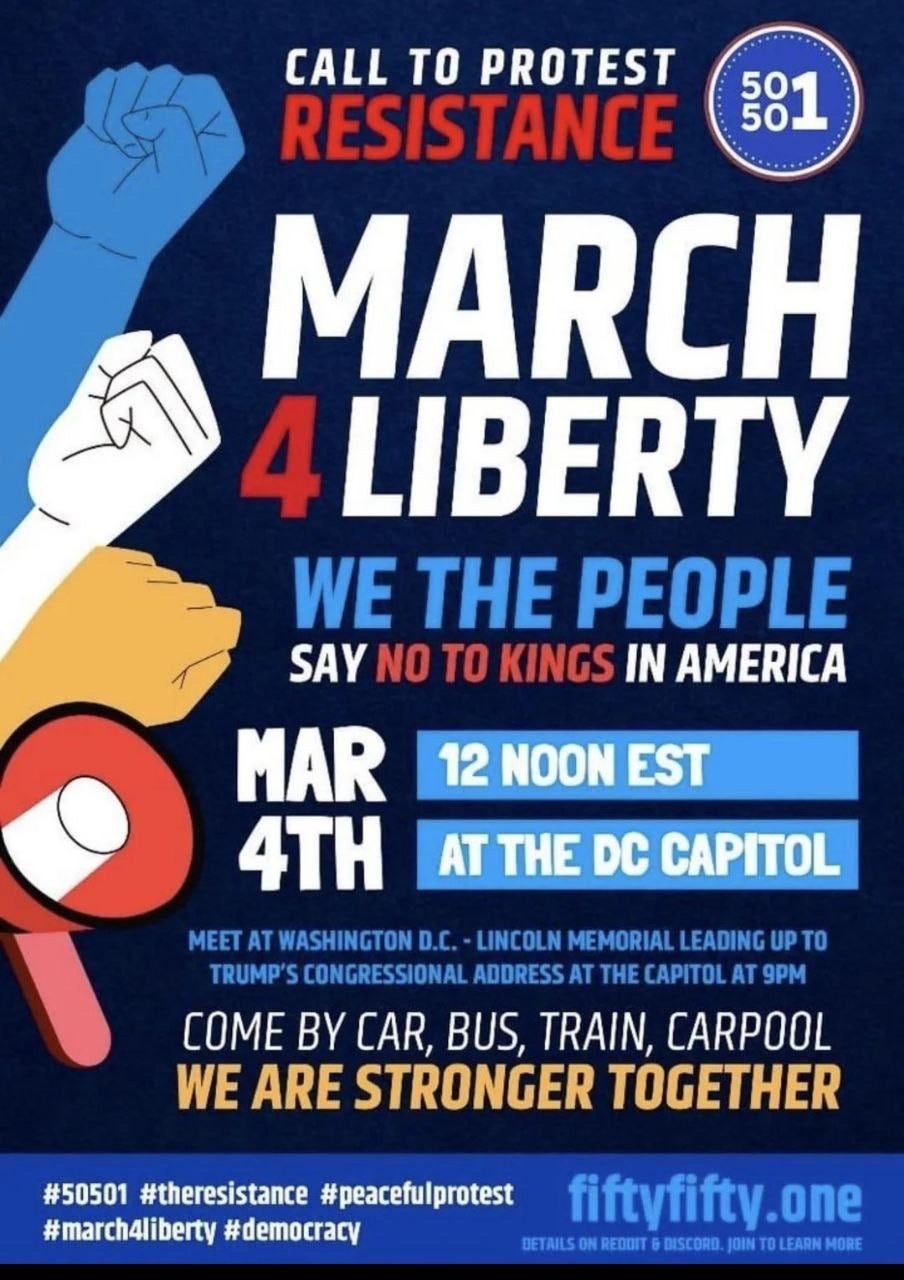
🚨 Find your local March 4th protest action HERE 🚨

🚨 Find your local march 7th Stand Up for Science event HERE 🚨