

TODAY: Veterans' Services Saved, Protests Surge, and the Ambivalence of Judicial Resistance in the Trump-Musk Era
Welcome!
Welcome to The Resistance Sentinel, a publication dedicated to documenting and amplifying the movement to defend democracy against authoritarian rule. Our collective of researchers and analysts highlights the inspiring responses of citizens and organizations across the country while providing curated coverage of resistance activities and practical knowledge for effective engagement. Join us in turning awareness into action as we work together toward a more just and democratic future.
Daily Inspiration
See Steve. See Steve tell an uncomfortable truth. Be like Steve.
Resistance Today
Civil Society & Publics
Veterans Affairs abruptly reversed its decision to cancel 875 contracts worth nearly $2 billion after internal documents revealed these cuts would impact essential veteran services including medical care, cancer programs, and burial services. This reversal represents a significant setback to the administration's aggressive cost-cutting agenda, exposing the tension between streamlining government operations and maintaining critical support for veterans.
What happened: The Department of Veterans Affairs initially announced the cancellation of 875 contracts worth nearly $2 billion, which Secretary Douglas Collins claimed would save money without affecting core services. However, internal documents revealed these contracts supported essential functions including medical services, cancer programs, doctor recruitment, and burial services for veterans. Following significant backlash from lawmakers like Senator Richard Blumenthal and scrutiny of the affected services, VA leadership reversed course within 24 hours, directing staff to halt the terminations pending further review.
Why it matters: This reversal represents a significant setback for the administration's cost-cutting initiatives led by Elon Musk's U.S. DOGE Service, which has already resulted in thousands of VA employee layoffs. The incident highlights the tension between the administration's efforts to "streamline" federal bureaucracy and the potential harm to essential veteran services. The abrupt policy change demonstrates how public scrutiny and political pressure can force reconsideration of hasty decisions that threaten critical support systems for veterans, particularly when those decisions appear to contradict the government's obligation to provide comprehensive care for those who served.
VA Secretary announces cancellation of 875 contracts worth nearly $2 billion
VA leadership reverses contract cancellation decision within 24 hours
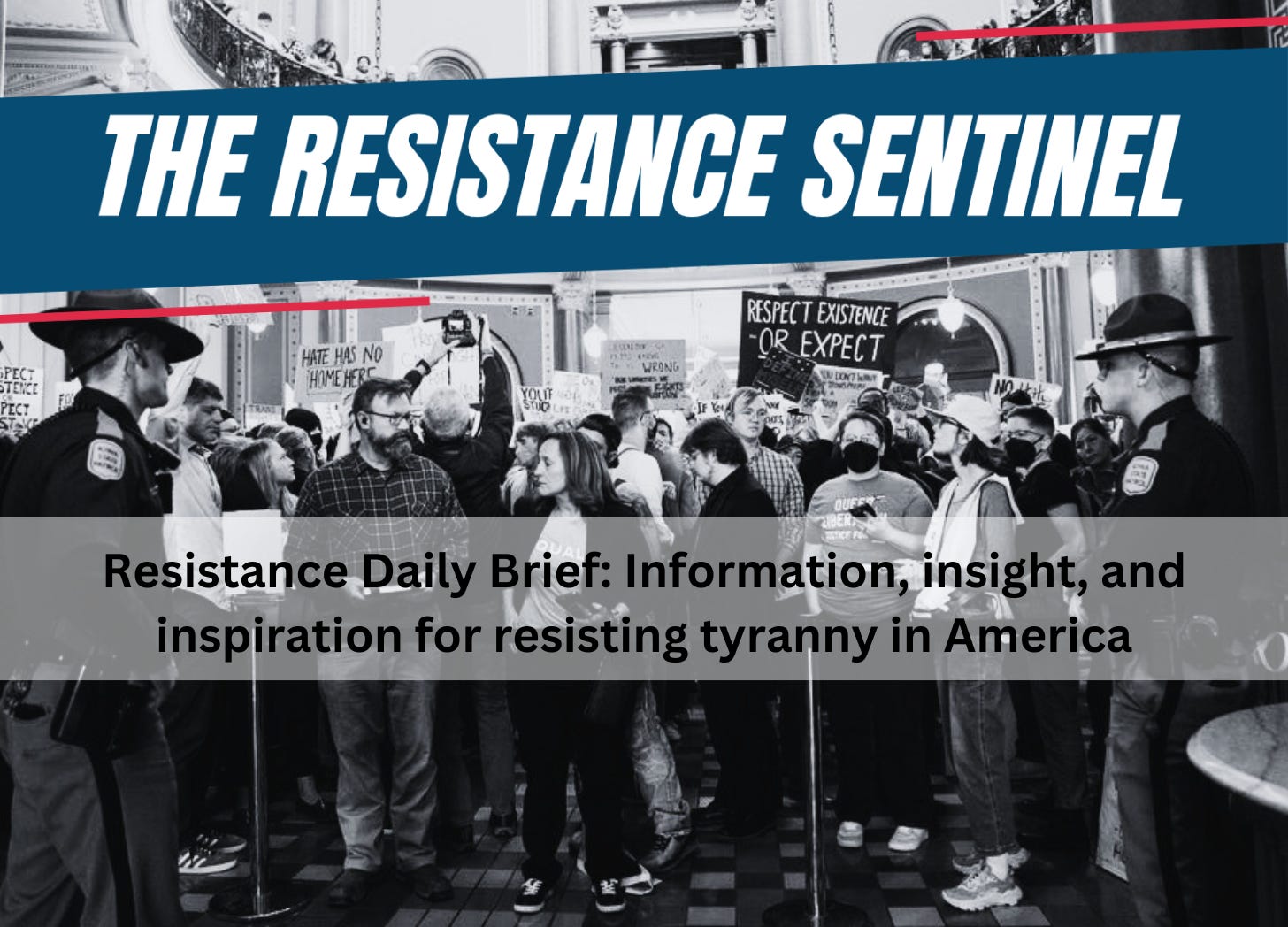
Hundreds of protesters mobilized across the country against the Trump administration's attacks on civil rights, with demonstrations occurring at the Iowa State Capitol against a bill removing transgender protections, and at Tesla dealerships nationwide against Elon Musk's role in government. The widespread resistance reflects growing public concern about concentrated power in the hands of billionaires with access to vast amounts of personal data and the erosion of civil rights protections for vulnerable populations.
What happened: Hundreds of protesters gathered at the Iowa State Capitol today to oppose House File 583, a bill that would remove gender identity protections from the Iowa Civil Rights Act, with demonstrators filling the rotunda and listening to public hearings on their phones while state troopers stood guard. Protesters have also mobilized across the United States this week, with demonstrations occurring at Tesla dealerships in Jacksonville, Fort Lauderdale, Seattle, San Francisco, and Chicago. The protests are part of a growing "Tesla Takedown" movement opposing Musk's role in the Trump administration, particularly his leadership of the Department of Government Efficiency (DOGE), which has already terminated thousands of federal employees, including 2,400 VA workers in February alone. Protesters are specifically concerned about Musk's access to Americans' personal data and the impact of federal workforce cuts on veterans' services.
Why it matters: The widespread resistance to Musk's government role reflects growing public concern about concentrated power in the hands of billionaires with access to vast amounts of personal data. Tesla's stock has plummeted 26% since Musk's controversial appearance at Trump's inaugural rally, representing approximately $400 billion in lost company value, while European sales dropped 45% year-over-year in January. The protests demonstrate how citizens are using economic pressure as a resistance tactic, with organizers encouraging Tesla owners to sell their vehicles and stock to "stop Musk now." However, some Tesla owners report facing vandalism and harassment, a tactic that is not likely to be effective in winning defectors and should be discouraged.
Legal & Judicial
While some judges have boldly challenged the Trump administration's overreach, the Supreme Court's recent actions signal a troubling willingness to accommodate executive power grabs, highlighting that judicial resistance alone cannot safeguard democracy against authoritarian ambitions.
What happened: The judicial branch is showing signs of fracture in its response to Trump administration actions. U.S. District Judge Amit Ali ordered the administration to unfreeze foreign aid and make payments for completed work, directly confronting Trump's Day 1 executive order that paused all foreign assistance. However, Chief Justice Roberts quickly intervened, temporarily freezing Judge Ali's order without providing any rationale. Meanwhile, Judge Dabney Friedrich, a Trump appointee, expressed frustration with the Justice Department's shifting interpretations of Trump's January 6 pardons, noting the extraordinary breadth being claimed for presidential power.
Why it matters: This judicial divide reveals the limitations of relying solely on courts to check authoritarian tendencies. The Supreme Court's willingness to quickly accommodate executive overreach suggests that a multi-pronged resistance strategy is essential. As experts on democratic backsliding note, effective resistance requires building broad coalitions across class and racial lines, establishing alternative institutions at local levels, inducing defections among regime supporters, and maintaining organizational discipline in the face of repression. The courts may provide temporary relief in some cases, but cannot alone prevent the erosion of democratic norms and institutions that characterizes modern authoritarianism.
Chief justice allows Trump administration to keep foreign aid frozen for now
DOJ has abruptly broadened its view of Trump's Jan. 6 pardons. A judge wants answers.
Recent analysis debunks the right’s dangerous claim that a 1973 incident shows that the military is allowed to ignore court orders. In fact, the Pentagon was prepared to comply with court orders halting bombing in Cambodia in 1973. This is an important correction to right-wing legal theories that could empower a dictator-president to use the U.S. military illegally at home and abroad.
What happened: Right-wing legal scholars have recently argued that a 1973 incident shows that the U.S. military is allowed to ignore court orders and is only obligated to follow the direction of the President. In 1973, Congresswoman Elizabeth Holtzman and Air Force pilots sought to stop the unlawful bombing of Cambodia through federal courts. Judge Orrin Judd declared the bombing unlawful, ruling that once Congress declined to authorize it, the President's Commander-in-Chief authority ended. After appeals and stays, Justice William Douglas reinstated the injunction, but the full Supreme Court quickly overruled him. The Pentagon had prepared directives to suspend bombing operations if formally served with Douglas's order, contradicting claims by scholars like John Yoo that the military simply "ignored" judicial orders.
Why it matters: This case establishes the critical precedent that military forces are bound to obey court orders defining lawful military activity, even during wartime. The Pentagon's preparation of suspension orders demonstrates their recognition of judicial authority over military operations, reinforcing separation of powers principles established in Youngstown Steel v. Sawyer. The fact that this argument is being advanced now, by scholars like John Yoo, notorious for his defense of torture during the War on Terror, indicates growing support on the right for allowing the President to use the military in any way he sees fit and beyond the scope of law or civilian oversight by the Judicial or Legislative branches of government. If the military were ever empowered to ignore court orders under unilateral presidential instructions, it could lead to authoritarian rule where "an elected despot can invoke the military and rule this nation by force."
Congress & Lawmakers
Representative Jasmine Crockett's forceful challenge in Congress highlights the critical role of elected officials in standing against misinformation and potential authoritarianism, demonstrating that effective resistance requires voices from diverse backgrounds within formal political structures.
What happened: The video shows Representative Jasmine Crockett speaking forcefully during a Congressional hearing, challenging colleagues to acknowledge the basic fact that Russia invaded Ukraine, not the other way around. She criticizes the administration for appeasing Putin and spreading misinformation about the invasion, warning that such behavior could lead to an "international crisis" or even "the next world war." Crockett offers to yield her remaining time to any colleague willing to state this basic fact, highlighting an apparent reluctance among her peers to do so.
Why it matters: Crockett's confrontational stance demonstrates how elected officials can serve as crucial voices of resistance when fundamental facts are being distorted or denied in political discourse. Her willingness to directly challenge both the administration and her hesitant colleagues illustrates the importance of having diverse representatives who are prepared to speak truth to power, even when politically difficult. This moment exemplifies how resistance to authoritarianism requires not just grassroots movements but also institutional actors willing to use their platforms to maintain democratic norms and factual reality. Also feel free to categorize this story under the Daily Inspiration heading!
Democratic Senator Andy Kim is advocating for a strategic response to counter Elon Musk's influence, particularly in the context of authoritarian and populist trends in the U.S. His approach emphasizes grassroots organizing, pro-democracy coalitions, and leveraging USAID to counteract authoritarianism.
What happened: Senator Andy Kim is proposing a plan to address Elon Musk's growing political and economic influence, which he views as emblematic of broader authoritarian trends. His strategy includes mobilizing grassroots support, fostering multiracial and cross-class coalitions, and utilizing USAID resources to strengthen democratic institutions and counter disinformation campaigns.
Why it matters: Sen. Kim's initiative highlights the intersection of corporate power and political influence in shaping democratic resilience. His focus on grassroots mobilization and coalition-building underscores the importance of proactive measures to counter authoritarian tendencies, providing a framework for resistance movements to safeguard democratic values.
State & Local Governments
State and local institutions continue their attempts to resist Trump administration actions, with state Attorneys General organizing Community Impact Hearings on the effects of Elon Musk’s mass firings of federal workers and halt to government payments while JD Vance's hometown newspaper publishes scathing criticism of what they call the “lap-dog Vice President.” These responses represent important attempts to check executive power from different levels of government and civil society.
What happened: State Attorneys General from Oregon, Arizona, and New Mexico have announced a series of Community Impact Hearings to document the effects of federal firings and DOGE funding freezes, with the first hearing scheduled for March 5th in Phoenix, AZ. The hearings aim to gather testimony from affected individuals and organizations about how these actions are "disrupting lives, straining workplaces, and harming communities and household budgets." Meanwhile, Vice President JD Vance faced blistering criticism from his hometown paper, the Ohio Capital Journal, which published an op-ed calling him a "lapdog vice-president" in a "nondescript role as an appendage in the Trump-Musk administration." The paper specifically condemned Vance's meeting with Germany's far-right AfD Party and his "tone-deaf speech on democracy" that has strained U.S.-Europe relations.
Why it matters: The Community Impact Hearings represent a coordinated effort by state-level officials to challenge federal executive actions, providing a platform for documenting the real-world consequences of DOGE's activities and potentially informing legal challenges. State AGs are positioning themselves as protectors of their constituents against what they view as harmful federal overreach. Similarly, the harsh criticism from Vance's hometown newspaper demonstrates how local institutions can serve as important voices of accountability, particularly when they can speak with the authority of knowing a politician's origins and claimed values. Together, these responses illustrate how America's federated system and independent press can function as important checks on power when other federal mechanisms may be compromised. Much more of this kind of resistance from state and local institutions is necessary.
Resistance Tomorrow
Vulnerabilities & Exposures
The Trump administration's DOGE initiative has led to significant job losses among federal workers, including forestry professionals in rural America, with terminated employees losing critical benefits like health insurance and paid leave. These cuts are creating personal hardships for affected workers while revealing tensions between political support and economic reality in communities that voted for the administration. Such cases increase the possibilities for defection from the MAGA movement, a key step to ending the Trump-Musk regime.
What happened: The Trump administration's federal workforce reduction program, known as DOGE, has resulted in the termination of probationary workers in the U.S. Forest Service. Ryleigh Cooper, a 24-year-old Forest Service employee in Baldwin, Michigan, lost her $40,000/year position despite receiving the highest possible performance evaluation score. Cooper, who had voted for Trump partly based on his promise to make IVF treatments free, now faces the loss of her health insurance, paid maternity leave benefits, and potential career advancement. The termination came as a shock to Cooper, who had been working toward a master's degree in forestry and was on track for a promotion that could have nearly doubled her salary.
Why it matters: These federal workforce cuts are creating profound personal consequences for workers in rural communities that largely supported Trump. As more federal workers like Cooper share their stories of personal hardship resulting from the DOGE initiative, these narratives can create cognitive dissonance among Trump supporters who believed his promises about protecting jobs and families. The growing collection of firsthand accounts from disappointed voters who directly experienced the gap between campaign promises and policy implementation provides compelling evidence that can help persuade wavering supporters to reconsider their allegiance, particularly when these stories come from individuals in rural, conservative communities who share similar values and concerns. Research suggests that encouraging such defections and welcoming defectors into the pro-democracy resistance will be crucial in overcoming the American slide into authoritarianism.
Actions This Week
🚨FRIDAY, 2/28 - TOMORROW🚨
Nationwide 24-Hour Economic Blackout Aims to Challenge Corporate Power
What happened: The People's Union USA, led by John Schwarz, is organizing a nationwide economic protest called the "Feb 28 Economic Blackout" asking Americans to halt all purchases from major retailers for 24 hours on February 28, 2025. The protest comes amid rising consumer prices and corporate rollbacks of DEI programs, with participants being urged to avoid spending at major chains like Amazon, Walmart, and fast-food establishments while supporting local businesses instead.
Why it matters: The economic blackout represents a significant test of collective consumer power against corporate interests, potentially demonstrating how coordinated action can influence corporate behavior and policy. While experts suggest a single-day boycott may have minimal direct financial impact, the movement's planned escalation to week-long targeted boycotts could create more substantial pressure on specific companies. The protest's focus on both economic justice and DEI rollbacks highlights growing public frustration with corporate practices and could serve as a catalyst for broader systemic changes in how major companies approach worker compensation and social responsibility initiatives.
Talk of a "Feb 28 Economic Blackout" is spreading on social media. What is it? - CBS News
Will Nationwide Economic Blackout on February 28 Work? - Newsweek
Talk of a "Feb 28 Economic Blackout" is spreading on social media. What is it? - CBS News
Economic Blackout: What to know about the February 28 boycott taking off on social media
February 28 Economic Boycott: What A One-Day Spending Freeze Means For Retailers