

Resistance Daily Brief for 2025-02-24
Welcome!
Welcome to The Resistance Sentinel, a publication dedicated to documenting and amplifying the movement to defend democracy against authoritarian rule. Our collective of researchers and analysts highlights the inspiring responses of citizens and organizations across the country while providing curated coverage of resistance activities and practical knowledge for effective engagement. Join us in turning awareness into action as we work together toward a more just and democratic future.
Resistance Today
Judicial Branch
Texas Judges Targeted with Suspicious "DOGE Emails" Requesting Work Justification
What happened: Federal judges in Texas received emails purportedly from the U.S. Office of Personnel Management demanding they justify their jobs by detailing their work from the previous week, raising concerns about potential executive overreach. Chief Judge Jennifer Elrod of the U.S. Court of Appeals for the Fifth Circuit dismissed the email, and legal experts have voiced concerns over the breach of protocol and potential intimidation of the judicial branch.
Why it matters: This incident highlights a potential vulnerability within the judicial system, as the executive branch appears to be testing the limits of its power and challenging the judiciary's independence. This could be an attempt to intimidate judges and undermine their authority, particularly in cases that challenge the administration's policies. Resistance could involve public statements from judicial organizations, legal challenges to executive overreach, and increased vigilance in protecting the judiciary's independence.
Supreme Court Temporarily Blocks Trump’s Bid to Fire Whistleblower Watchdog
What happened: The Supreme Court temporarily halted President Trump’s attempt to dismiss Hampton Dellinger, head of the Office of Special Counsel, an agency protecting whistleblowers. This decision maintains Dellinger’s position until February 26, when a lower court will revisit the case.
Why it matters: This marks the first major legal clash between the Trump administration and the judiciary during his second term, highlighting tensions over his aggressive efforts to reshape federal agencies. The ruling underscores the judiciary's role in checking executive power while leaving room for further legal battles. For resistance movements, this case illustrates vulnerabilities in Trump’s strategy of rapid dismissals, offering potential leverage points to challenge similar actions in court.
Federal Judge Blocks Trump's Anti-DEI Orders in Sweeping Decision
What happened: U.S. District Judge Adam B. Abelson in Maryland issued a preliminary injunction blocking key provisions of President Donald Trump's executive orders targeting diversity, equity, and inclusion (DEI) initiatives. The judge ruled that the orders likely violate constitutional protections, particularly free speech rights, and create a chilling effect on businesses and organizations supporting DEI programs.
Why it matters: This ruling represents a significant setback for the Trump administration's efforts to dismantle DEI programs across federal agencies, higher education, and the private sector. It highlights the ongoing tension between the administration's anti-DEI stance and constitutional protections for free speech and due process. The decision maintains the status quo for institutions engaged in diversity work while the legal challenge proceeds, potentially setting the stage for a broader debate on the role of DEI initiatives in American society and the limits of executive power in shaping social policy.
Federal Judge Blocks Musk's DOGE Team From Accessing Treasury Data https://www.nytimes.com/2025/02/21/nyregion/sdny-doge-elon-musk-treasury-injunction.html
What happened: A Manhattan federal judge issued an injunction preventing Elon Musk's Department of Government Efficiency (DOGE) team from accessing sensitive U.S. Treasury Department payment and data systems. The ruling came in response to a lawsuit filed by 19 state attorneys general who argued that giving political appointees and "special government employees" access to sensitive financial data was unlawful.
Why it matters: This ruling represents a significant check on the administration's attempt to consolidate control over sensitive government data systems and financial information of American citizens. The case reveals concerning vulnerabilities in data security protocols and oversight of political appointees, while demonstrating that the courts remain willing to challenge executive overreach. The successful legal challenge by state attorneys general shows that coordinated state-level resistance through institutional channels is an effective tool to counter federal power grabs, providing an important precedent for defending democratic guardrails.
Federal Judge Orders Release of Foreign Aid but Shows Limited Power to Enforce Trump's Compliance
What happened: A federal judge ordered the Trump administration to release billions in foreign aid that Congress had approved, but declined to hold officials in contempt despite their continued defiance of a January court order. Judge Colleen Kollar-Kotelly ruled that the White House must comply with releasing the funds, which were temporarily frozen as part of Trump's broader spending negotiation tactics.
Why it matters: This case exposes a deepening constitutional crisis as Trump openly defies judicial authority with seemingly no consequences. The judge's reluctance to issue contempt citations, despite clear violations of her previous order, reveals the judiciary's limited practical power to enforce rulings against an executive branch that simply refuses to comply. This situation demonstrates how traditional checks and balances are breaking down, with courts appearing hesitant to fully acknowledge or confront this erosion of constitutional order, perhaps out of concern that doing so would only further expose their inability to enforce compliance from an increasingly authoritarian executive.
Trump Administration Gets Green Light to Recall Thousands of USAID Workers, Showing Judicial Resistance Alone Won't Save Democracy
What happened: A federal judge has lifted the hold on the Trump administration's plan to put thousands of USAID workers on leave, including hundreds stationed overseas. Judge Carl Nichols ruled that initial concerns about staff safety and medical treatment disruption were overstated, determining that these potential impacts did not outweigh the administration's foreign policy objectives.
Why it matters: This ruling exemplifies why relying solely on the courts to defend democracy is insufficient and potentially dangerous. The penetration of Trump-aligned judges throughout the federal judiciary means legal challenges alone cannot safeguard democratic institutions. Historical examples show that successful resistance to authoritarianism requires broad-based coalitions combining legal advocacy with grassroots organizing, labor action, and mass mobilization across racial, ethnic, class and ideological lines. The case highlights the urgent need for building alternative power structures and united democratic fronts at local and state levels, as the traditional institutional checks and balances become compromised by authoritarian influence.
Legislative Branch
GOP Congressman Urges Trump to Avoid Public Clash with Zelensky
What happened: Republican Rep. Mike Lawler of New York publicly disagreed with former President Donald Trump's criticism of Ukrainian President Volodymyr Zelensky. Lawler advised against a public spat between Trump and Zelensky, emphasizing the importance of supporting Ukraine in its conflict with Russia.
Why it matters: This disagreement within the Republican Party highlights the complex dynamics surrounding U.S. support for Ukraine. Lawler's stance demonstrates that not all Republicans align with Trump's views on the Ukraine conflict, potentially revealing vulnerabilities in the party's unified front. The public nature of this disagreement could be exploited by pro-democracy movements to emphasize the importance of supporting democratic allies against authoritarian aggression. It also underscores the ongoing debate within U.S. politics about the extent and nature of support for Ukraine, which could impact future foreign policy decisions and international relations.
Executive Branch
Federal Workers Push Back with New Platform to Expose DOGE's Impact
https://www.theverge.com/news/617014/federal-workers-we-the-builders-website-doge
What happened: A group of current and former federal employees launched a website, "We the Builders," to anonymously share insights on the Department of Government Efficiency's (DOGE) efforts to dismantle government agencies. The platform highlights DOGE's negative impact on technology systems and public services, contrasting its approach with the U.S. Digital Service's past focus on efficiency and public good.
Why it matters: This initiative underscores growing resistance among federal workers against policies perceived as undermining public services and transparency. By sharing insider perspectives, the site aims to educate citizens on how these changes affect them directly and empower federal employees to speak out securely. This effort also highlights vulnerabilities in DOGE's approach, which critics describe as prioritizing disruption over understanding, creating an opportunity for organized resistance to advocate for more effective governance.
Federal Workers Mount Resistance Against Musk's Government Overhaul
https://www.nytimes.com/2025/02/22/us/politics/federal-employees-elon-musk.html
What happened: Federal employees across multiple agencies are actively resisting Elon Musk's government transformation efforts through protests, resignations, lawsuits, and internal opposition. Civil servants have documented unauthorized entries, joined unions en masse, created encrypted communication channels, and refused to comply with directives they consider illegal, while facing retaliation including email shutdowns and job terminations.
Why it matters: The widespread resistance from career civil servants reveals deep institutional opposition to radical changes in federal agencies, potentially slowing implementation of new directives and preserving institutional knowledge. The surge in union membership and coordinated legal challenges demonstrates the bureaucracy's capacity for organized resistance, though the administration has worked to dismantle traditional channels for addressing grievances. The targeting of oversight bodies like inspectors general and the Merit Systems Protection Board suggests the regime recognizes these institutions as potential centers of resistance, while the emergence of informal resistance networks through encrypted apps and social media shows adaptability in opposition tactics.
States
Maine Governor Defies Trump Over Transgender Athlete Ban
https://www.nytimes.com/2025/02/21/us/politics/trump-maine-governor-transgender-athletes.html
What happened: Maine Governor Janet Mills openly defied President Trump during a White House meeting, refusing to comply with his executive order banning transgender athletes from women’s sports. Mills asserted she was adhering to state and federal laws, prompting Trump to threaten federal funding cuts and legal action, to which Mills responded, "See you in court."
Why it matters: This confrontation highlights growing tensions between state and federal authority under Trump’s second term, especially on divisive social issues. Mills’s defiance underscores resistance from Democratic leaders against what they perceive as overreach by the administration. The incident also reveals vulnerabilities in Trump’s governance style, as public challenges like this could galvanize opposition and test his administration's ability to enforce controversial policies. For resistance movements, this moment demonstrates the potential impact of standing firm against federal pressure.
State Courts Emerge as Critical Battleground Against Federal Power Grab
https://www.democracydocket.com/opinion/dont-let-the-shock-and-awe-distract-you-from-the-importance-of-state-courts/
What happened: The second Trump administration has launched an aggressive campaign of executive orders characterized as "shock and awe," prompting increased attention on state courts as a crucial line of defense for civil rights and protections. In 2024, 32 state Supreme Courts held elections for 81 seats, with significant changes in Michigan, Ohio, and historic firsts in Kentucky and Louisiana, while Wisconsin and Pennsylvania face upcoming pivotal court elections in 2025.
Why it matters: State courts have historically served as powerful defenders of civil rights, from LGBTQ+ rights to environmental protections and abortion access, demonstrating their capacity to counteract federal overreach. The upcoming Wisconsin Supreme Court election, featuring Brad Schimel against Susan Crawford, and Pennsylvania's retention elections for three Democratic justices could dramatically shift the balance of power in these crucial battleground states. These state court races represent a critical opportunity for organized resistance to protect civil rights and democratic processes at the state level, particularly as federal courts become increasingly consumed with challenges to federal policies.
Public
Activists Thwart ICE Operation in Alhambra, California
https://www.foxla.com/news/ice-raid-alhambra-disrupted-activists
What happened: A planned ICE operation involving DEA and FBI agents in Alhambra, California, was disrupted by local activists from Union del Barrio on Sunday. The activists used loudspeakers to protest the presence of federal agents, who eventually left the area without making any arrests.
Why it matters: This incident highlights the growing resistance to federal immigration enforcement actions and the effectiveness of community organizing. The success of Union del Barrio's intervention demonstrates the power of local activism in challenging perceived threats to immigrant communities. It also underscores the tension between federal immigration policies and sanctuary city designations, as Alhambra recently reaffirmed its status as a sanctuary city. The event reveals potential vulnerabilities in ICE operations when faced with organized community resistance, suggesting that similar tactics could be employed by pro-democracy movements to counter authoritarian actions.
Grassroots Protests Target Tesla as Symbol of Musk's Growing Political Power
https://www.inquirer.com/opinion/commentary/tesla-protest-philadelphia-elon-musk-20250223.html
What happened: Nationwide protests dubbed #TeslaTakedown emerged across Tesla showrooms, with demonstrations in Philadelphia suburbs drawing crowds from dozens to hundreds of people. The protests target Elon Musk's role in the Trump administration, where he serves as head of the Department of Government Efficiency (DOGE) and has been implementing widespread federal layoffs while facing criticism for apparent Nazi salutes and concerning behavior.
Why it matters: The protests represent a significant shift in public resistance strategy, moving from traditional political channels to direct economic action targeting Musk's wealth through Tesla boycotts. The movement has already shown early signs of effectiveness, with Tesla's stock dropping 21% since Trump's inauguration and US market share falling below 50%. The protests also reveal growing public awareness of the dangers of concentrated corporate power in government, with protesters drawing explicit parallels to historical authoritarian movements. The grassroots nature of these protests, emerging spontaneously across multiple locations and drawing diverse participants including scientists and Holocaust descendants, suggests potential for sustained resistance against corporate-political consolidation of power.
Nationwide Wave of Protests Erupts Against Trump Administration and Musk Policies Over the Weekend
https://alabamareflector.com/2025/02/22/hundreds-rally-in-birmingham-in-support-of-immigrant-rights/
What happened: A coordinated series of protests swept across multiple states including Alabama, Texas, Maine, Massachusetts, Michigan, Rhode Island, Alaska, and Pennsylvania over the weekend. The demonstrations targeted various Trump administration policies and Elon Musk's involvement, with protesters raising concerns about federal job cuts, transgender rights, immigration policies, U.S. support for Ukraine, and what they describe as attacks on democratic institutions.
Why it matters: The geographic breadth and diversity of these protests reveals growing resistance to centralized authority across multiple sectors of society, demonstrating effective grassroots organizing capabilities. The involvement of state-level officials like Maine Governor Janet Mills shows how local government structures can be leveraged to resist federal policies, while the coordination across multiple states suggests improving inter-regional solidarity networks. The protests' focus on specific policy impacts (federal job cuts, funding withdrawals, transgender rights) rather than just general opposition indicates a strategic shift toward concrete, actionable demands that could pressure specific pressure points in the administration's authority.
Media
Associated Press Fires Back Over Trump Clampdown on Free Speech
https://www.theguardian.com/us-news/2025/feb/24/trump-free-speech-media-attack
What happened: President Trump has intensified his long-standing attacks on the media, barring Associated Press (AP) journalists from key events after the agency refused to adopt his renaming of the "Gulf of Mexico" to the "Gulf of America." In response, the AP has filed a lawsuit against three administration officials, citing violations of First Amendment rights and editorial independence.
Why it matters: This confrontation highlights a broader effort by Trump to control narratives by targeting critical media outlets, undermining press freedom while paradoxically championing "free speech." Such actions reveal vulnerabilities in the administration's commitment to democratic principles and could embolden resistance efforts by emphasizing the importance of independent journalism. The AP's legal challenge may set a precedent for safeguarding press rights against government retaliation, offering valuable lessons for resisting authoritarian tendencies.
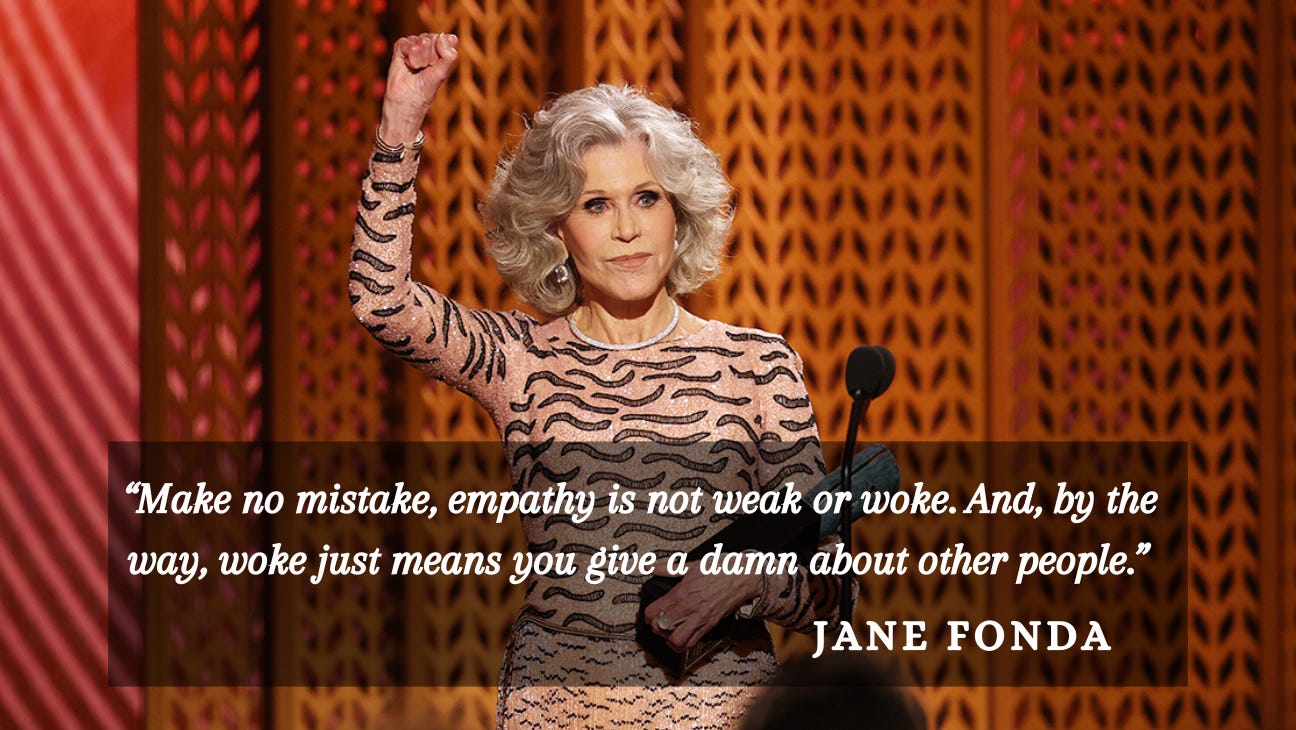
Jane Fonda's Powerful SAG Award Speech Calls for Unity and Action
What happened: Jane Fonda received the SAG Lifetime Achievement Award and used her acceptance speech to highlight the importance of collective action in addressing pressing global issues like climate change, inequality, and social justice. She urged the entertainment industry to leverage its influence to inspire meaningful change.
Why it matters: Fonda's speech underscores the power of storytelling and celebrity platforms in mobilizing public awareness and action on critical societal challenges. Her call for unity resonates at a time when democratic values face threats globally, emphasizing the need for solidarity and grassroots organizing. This aligns with broader lessons on leveraging influential voices to inspire hope, foster connections, and drive societal transformation during turbulent times.
MSNBC Silences Key Progressive Voice as Network Shifts Right Under New Leadership
https://www.forbes.com/sites/markjoyella/2025/02/23/report-msnbc-to-cut-joy-reid-as-network-revamps-prime-time/
What happened: MSNBC is planning to cancel Joy Reid's primetime show "The ReidOut" and revamp its entire lineup under new network president Rebecca Kutler. The changes include replacing Reid with a trio of more moderate hosts and potentially moving former White House Press Secretary Jen Psaki into the 9pm slot currently held by Alex Wagner.
Why it matters: This programming shift represents a concerning trend of mainstream media outlets moving away from progressive voices that challenge authoritarianism and systemic inequalities. The removal of Reid, one of the most prominent Black female voices in cable news, weakens media diversity at a critical moment when marginalized perspectives are needed to counter anti-democratic narratives. The network's apparent pivot toward more "centrist" voices, including former White House insiders, suggests an institutional retreat from hard-hitting political commentary in favor of access journalism and both-sides coverage that can normalize authoritarian behavior.
International
German Leader Warns of NATO's End as Trump Threatens European Security
https://www.politico.eu/article/friedrich-merz-germany-election-united-states-donald-trump-nato/
What happened: Friedrich Merz, poised to become Germany's new leader, declared the U.S.-Europe alliance effectively over under President Donald Trump, citing the administration's disregard for Europe and alignment with Russia. He urged Europe to bolster its defenses and consider replacing NATO within months.
Why it matters: This represents a historic shift in Germany's stance toward its most important post-WWII ally and reveals the deep erosion of trust in US security guarantees under Trump. The comments expose growing fears among European leaders about Trump's return to power and signal that key US allies are already preparing contingency plans to defend themselves without American support. This development could accelerate the fragmentation of the Western alliance system that has maintained relative peace and stability since 1945, while potentially emboldening authoritarian powers like Russia who seek to exploit divisions between democratic nations. For resistance movements or policymakers, this moment presents an opportunity to advocate for a stronger, unified European defense strategy while also reevaluating dependencies on external powers like the U.S.

Spotted in Oaxaca, Mexico (Source: https://www.thenerdreich.com/oaxaca-art-yescka-elon-musk-trump-nazi-salute/?ref=the-nerd-reich-newsletter)
Canadians Launch Mass Movement to Strip Elon Musk's Citizenship as Democracy Safeguard
https://www.cbc.ca/news/world/elon-musk-citizenship-petition-1.7466278
What happened: A parliamentary e-petition to revoke Elon Musk's Canadian citizenship has garnered over 76,000 signatures after being sponsored by NDP MP Charlie Angus, citing Musk's role in the Trump administration and attempts to influence Canadian politics. The petition specifically points to Musk's position as Trump's "cost-cutting chief" in the Department of Government Efficiency, his endorsement of Conservative Leader Pierre Poilievre, and his derogatory comments about Prime Minister Trudeau.
Why it matters: This grassroots response demonstrates how citizens can mobilize rapidly to challenge perceived threats to democratic sovereignty, even when targeting powerful figures previously considered untouchable. The petition's viral spread indicates growing public awareness of how wealthy individuals with divided loyalties can potentially undermine democratic institutions through both official government positions and social media influence. While the petition itself may be largely symbolic, it represents an important example of how democratic societies can use peaceful, institutional mechanisms to express resistance to authoritarian tendencies and foreign interference, though such tools must be complemented by stronger structural safeguards against anti-democratic influence.
U.S. Increasingly Isolated as Major Western Allies Split as Trump Sides with Russia While Others Boost Ukraine Support
https://kyivindependent.com/australia-new-zealand-introduce-new-sanctions-against-russia/
https://www.nytimes.com/2025/02/24/world/middleeast/us-eurpe-russia-ukraine-un.html
https://kyivindependent.com/starmer-announces-largest-package-of-sanctions-against-russia/
https://www.yahoo.com/news/eu-ukraine-3-7-billion-102910751.html
https://thedefensepost.com/2025/02/24/sweden-air-defense-ukraine/
What happened: The U.S. under Trump has dramatically shifted its Ukraine policy, voting against a UN resolution demanding Russian withdrawal and engaging in direct talks with Russia that exclude Ukraine. Meanwhile, multiple Western allies including the EU, Ireland Canada, Sweden, Spain, UK, Australia, and New Zealand announced their largest-ever sanctions packages against Russia, creating an unprecedented rift between the U.S. and its traditional partners.
Why it matters: This growing divide between the U.S. and its traditional allies reveals significant vulnerabilities in the Western alliance system that could be exploited by resistance movements. The stark contrast between Trump's pro-Russia stance and other allies' increased support for Ukraine creates opportunities for building alternative support networks that bypass U.S. influence. The willingness of smaller powers like Australia and New Zealand to defy the U.S. position demonstrates that resistance movements can potentially find support even when major powers shift allegiances. The UK's readiness to deploy peacekeepers while expanding sanctions shows that determined allies can maintain support for resistance causes even without U.S. backing.
Trump Advisor Elon Musk's Global Far-Right Campaign Faces Growing International Resistance
https://www.thenation.com/article/world/elon-musk-neo-nazi-regime-change/
What happened: Elon Musk, serving as head of Trump's Department of Government Efficiency (DOGE), has been actively promoting right-wing and neo-Nazi parties in at least 18 countries worldwide, using his position as Trump's advisor and his ownership of X (formerly Twitter) to influence foreign elections. His efforts have included endorsing Germany's AfD party, supporting Viktor Orbán in Hungary, and interfering in Canadian politics, while spending significant resources to support Trump's re-election.
Why it matters: The emergence of a powerful tech billionaire actively working to promote far-right movements globally represents an unprecedented threat to democratic institutions and international stability. However, there are signs of resistance, as evidenced by the AfD's underperformance in German elections and the Liberal Party's resurgence in Canada. Most significantly, traditional US allies like Germany's incoming Chancellor Friedrich Merz are now openly calling for European independence from American influence, suggesting that Musk's actions may ultimately accelerate the decline of US global influence rather than strengthen the far-right movement he supports.
Organized Opportunities
🚨THIS WEEK🚨
Nationwide 24-Hour Economic Blackout Aims to Challenge Corporate Power
https://www.cbsnews.com/news/economic-blackout-feb-24-hour-february-28-2025-peoples-union/
https://www.newsweek.com/will-nationwide-economic-blackout-work-2030187
https://www.cbsnews.com/news/economic-blackout-feb-24-hour-february-28-2025-peoples-union/
https://www.fastcompany.com/91282923/economic-blackout-february-28-boycott-social-media-what-to-know
https://finance.yahoo.com/news/february-28-economic-boycott-one-180022241.html
What happened: The People's Union USA, led by John Schwarz, is organizing a nationwide economic protest called the "Feb 28 Economic Blackout" asking Americans to halt all purchases from major retailers for 24 hours on February 28, 2025. The protest comes amid rising consumer prices and corporate rollbacks of DEI programs, with participants being urged to avoid spending at major chains like Amazon, Walmart, and fast-food establishments while supporting local businesses instead.
Why it matters: The economic blackout represents a significant test of collective consumer power against corporate interests, potentially demonstrating how coordinated action can influence corporate behavior and policy. While experts suggest a single-day boycott may have minimal direct financial impact, the movement's planned escalation to week-long targeted boycotts could create more substantial pressure on specific companies. The protest's focus on both economic justice and DEI rollbacks highlights growing public frustration with corporate practices and could serve as a catalyst for broader systemic changes in how major companies approach worker compensation and social responsibility initiatives.
Organizations & Resources
Federal Unionists Network - https://actionnetwork.org/groups/federal-unionists-network
Indivisible - https://indivisible.org/
5051 - https://www.fiftyfifty.one/
People’s Union USA - https://theonecalledjai.com/
Alliance for Justice - https://afj.org/resource-library/tools-for-effective-advocacy/
International Center on Nonviolent Conflict - https://www.nonviolent-conflict.org/
Choose Democracy - https://choosedemocracy.us/
We the Builders - Real stories from federal employees - https://www.wethebuilders.org/
The Leadership Conference on Civil and Human Rights - https://civilrights.org/
Action Network - https://actionnetwork.org/
Is this a coup? A project of Dissent Pins - https://isthisacoup.com/
Beautiful Trouble - https://beautifultrouble.org/
Waging Nonviolence - https://wagingnonviolence.org/
MAGA Regime CVEs
In cybersecurity, CVEs are “common vulnerabilities and exposures.” These are the cracks in the system that adversaries exploit for their own ends. Political CVEs are those cracks in an authoritarian regime, points of vulnerability that can be exposed and exploited by defenders of democracy.
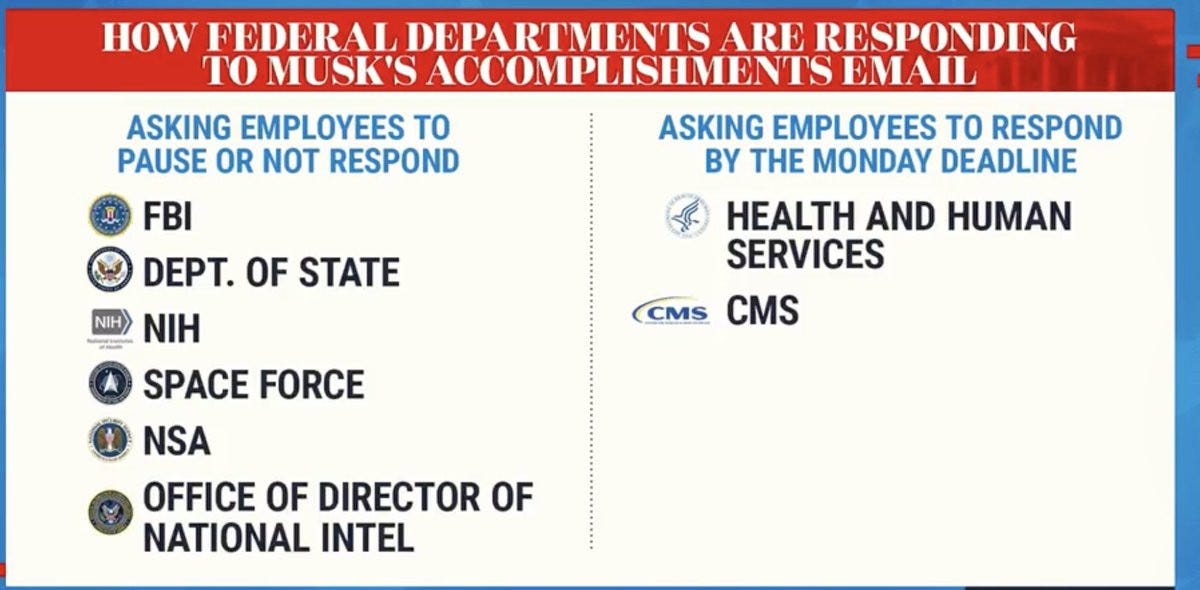
Musk's Demand for Federal Worker Reports Sparks Chaos and Resistance
https://www.politico.com/news/2025/02/23/musk-guidance-conflict-agency-leaders-00205640
What happened: Elon Musk's demand that federal employees detail their weekly activities triggered widespread confusion and resistance, with agency leaders issuing conflicting guidance and legal experts questioning Musk's authority. The demand, delivered via email with a threat of resignation for non-compliance, was met with internal directives from some agencies advising employees to hold off on responding.
Why it matters: This event underscores the vulnerabilities within the regime, as an unelected figure like Musk can create widespread disruption and anxiety among federal employees based on his proximity to the president; this also exposes a potential weakness that resistance groups could exploit by further sowing discord and distrust within the bureaucracy. The pushback from agency heads, even Trump loyalists, suggests a growing discomfort with Musk's overreach, indicating an opportunity for resistance to foster alliances within the system to counter DOGE's influence. The legal challenges and union opposition highlight the importance of leveraging existing legal and institutional frameworks to protect civil servants and impede DOGE's agenda, showing a practical avenue for resistance efforts. The backlash and confusion caused by Musk's demand reveal the potential ineffectiveness of shock-and-awe tactics without a clear strategy, as such actions can alienate even potential allies and galvanize opposition, offering a lesson for the resistance to focus on targeted and strategic actions.
Trump Officials Defy Musk as GOP Faces Voter Backlash
What happened: GOP representatives are facing voter anger over Elon Musk's "Department of Government Efficiency" (DOGE) cuts, while some Trump administration officials are defying Musk's orders, creating a chaotic situation. This defiance and voter anger present opportunities for Democrats to exploit divisions within the GOP coalition.
Why it matters: This situation reveals a vulnerability in the Trump-Musk alliance, as internal conflicts and public disapproval of DOGE could fracture the GOP base; this can be exploited by highlighting the negative impacts of DOGE cuts on essential services and forcing Republicans to publicly defend the unpopular policies. Resistance groups can capitalize on this division by targeting vulnerable Republicans with public pressure and ensuring voters understand their representatives' complicity in DOGE's agenda, potentially weakening the regime's hold on power and creating openings for a broader resistance movement by focusing on elites.
Musk's DOGE Decisions Blindside Trump Administration Officials, Revealing Internal Tensions
https://www.washingtonpost.com/business/2025/02/21/doge-cuts-frustration-musk-trump/
What happened: Elon Musk's Department of Government Efficiency (DOGE) has aggressively moved to reshape federal agencies through unilateral cuts and staff removals, causing friction with Trump's own Cabinet appointees. Senior officials, including Treasury Secretary Scott Bessent and Secretary of State Marco Rubio, have been blindsided by DOGE's actions, which include attempts to access sensitive Treasury payment systems and plans to drastically reduce USAID staff from 10,000 to under 600 employees.
Why it matters: The internal tensions between Musk's DOGE and Trump's appointed officials expose significant vulnerabilities in the regime's cohesion and command structure. The fact that Cabinet secretaries are learning about major policy changes through social media rather than proper channels reveals a breakdown in governmental coordination that could be exploited. DOGE's aggressive tactics, particularly in targeting career civil servants and institutional expertise, may accelerate institutional collapse but could also trigger pushback from within the system. The situation presents opportunities for resistance by highlighting how concentrated power in unaccountable hands (like Musk's DOGE) can threaten even those who are theoretically aligned with the administration.
Resistance School
Fighting Disinformation: Arming the Next Generation with Open Source Intel (OSINT) Skills
What happened: The article emphasizes the importance of equipping young people with open-source investigation skills to combat the spread of falsehoods in democratic societies, arguing that the ability to verify information should be as widespread as the ability to publish it. Bellingcat founder Eliot Higgins and Dr. Natalie Martin advocate for education and training programs that empower individuals to critically analyze and verify information they encounter online.
Why it matters: Democracies are vulnerable to disinformation campaigns, which can erode public trust and destabilize political processes. Equipping the younger generation with open-source investigation skills could create a more resilient and informed citizenry, capable of discerning fact from fiction. If resistance groups can master and disseminate similar techniques, they could expose regime propaganda and counter-narratives more effectively, potentially undermining the regime's legitimacy and control over information. Training in open-source intelligence (OSINT) could also provide a means for activists to independently verify claims made by state media.
Organizing and Mobilization during Democratic Backsliding
In this webinar from the Harvard Ash Center, esteemed panelists, including Erica Chenoweth, Marshall Ganz, Steven Levitsky, and Cornell Williams Brooks, draw upon lessons from around the world about how civil society groups can protect and promote democracy and the rule of law during episodes of democratic backsliding. This is essential viewing for anyone interested in how we can meaningfully and effectively resist the U.S. rapid decline into authoritarianism.
Daily Inspiration
Find more inspiring examples of noncooperation against Trump’s coup:
Thank you for this important work !