

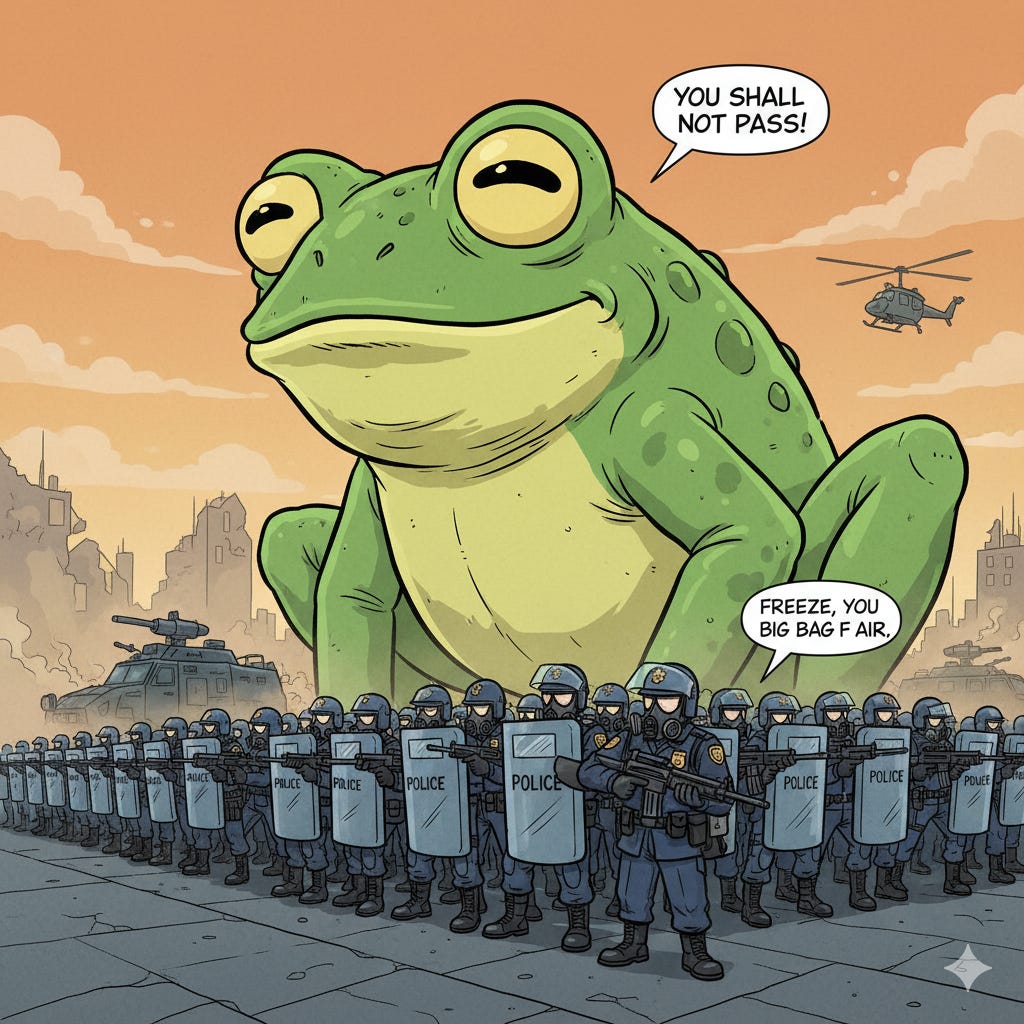
By now, we have all seen the images and videos of the inflatable frog in Portland, staring down and then moving a line of heavily armed federal police back as though using The Force. If not, take a look at one of the most iconic, inspirational, and hilarious moments of protest thus far in the escalating conflict between the Trump regime and American cities.
To say that the video has gone viral would be an understatement. What’s more, other protestors are now showing up in Portland, Chicago, and elsewhere wearing inflatable costumes of their own, including dinosaurs, unicorns, sharks, Pokemon characters, chickens, and many more.
The Portland Frog has become a symbol of resistance and spawned (pun intended) a wide variety of merch. Here’s but a small sample from Etsy. Similar items can be found across the e-commerce and print-on-demand landscape.

Besides being funny, why has the Portland Frog gotten so much attention and inspired so many others to don inflatable costumes of their own?
Laughtivism & Dilemma Actions
The Portland Frog and his army of inflatable friends is an example of what scholars and practitioners of nonviolent protest call “laughtivism.” The term is most associated with Serbian activist Srđa Popović, a founder and leader of the Otpor! movement that successfully brought down dictator Slobodan Milošević. Popović went on to found the Centre for Applied Nonviolent Action and Strategies and to write several books about nonviolent protest. In one of those, Pranksters vs. Autocrats: Why Dilemma Actions Advance Nonviolent Activism, he and coauthor Sophia McClennen explain the use of “dilemma actions” against authoritarian regimes. Humor is a key component of that strategy.
Humor as psychological weapon
Authoritarian regimes rely heavily on instilling fear and apathy in a population as a way to maintain the status quo and discourage dissent. Breaking that fear and apathy is critical to expanding participation in resistance to the regime. As it turns out, humor can be a potent weapon in that regard. But why?
First, humor presses the right wing authoritarian’s (RWA) psychological buttons. Research has shown that while RWAs do have a sense of humor, it often revolves around the “fun” of humiliating others rather than making jokes that most of us would find funny. In turn, having humor directed back at them is one of their greatest fears. This is why RWA regimes try to criminalize jokes, labeling them “extremist” or “disrespect.” See the recent incidents of Trump regime pressure on networks to cancel Stephen Colbert and Jimmy Kimmel. Humor is not just a fun but peripheral weapon. Rather, it strikes at the very heart of the RWA regime’s vulnerabilities.
Second, humor simultaneously has a positive psychological effect on those who may have been cowed into silence by the regime’s violence and intimidation. Visible acts of humor can help to break fear and build confidence, quickly inverting the power dynamic by allowing the public to laugh at abusive authority. As Ruth Ben-Ghiat noted last year, in addition to providing a sense of psychological relief, it allows people to cope with the daily trauma of fear and oppression. It also helps reveal the regime’s powerlessness, creating a sort of distance from which people can see the regime from a new, safer perspective. This, in turn, helps to mobilize greater dissent as people witness the courage of those performing the laughtivism, as well as its effects of undermining the regime’s narrative.
What better example of undermining the regime narrative that heavily armored men are defending Portland from rampaging antifa terrorists than a lone inflatable frog seemingly pushing them all back with the sheer force of the absurdity he was able to conjure in that moment?
Laughtivism → Dilemma → Backfire
The core logic behind how and why laughtivism works is the “dilemma action.” In Pranksters vs. Autocrats, Popović and McClennen quote from the CANVAS Curriculum:
Dilemma actions are designed to create a ‘response dilemma’ or ‘lose-lose’ situation for public authorities by forcing them to either concede some public space to protesters or make themselves look absurd or heavy-handed by acting against the protest.
They argue that the use of humor is especially effective at creating such lose-lose situations because “authoritarian power has no sense of humor” and can’t credibly absorb mockery without cracking its image.
When the authoritarian does respond with violence, it risks igniting a backfire effect. Professor Brian Martin explains that backfire occurs when either party to the conflict undertakes an action that “is perceived as unjust, unfair, excessive or disproportional. Information about the action is communicated to relevant audiences” and ends up creating “more support for or attention to whatever is attacked.”
Humor on its own is effective. It’s more effective when it results in backfire. But, as Prof. Martin writes, that does not happen by accident. Backfire must be cultivated by a social movement that is prepared to act quickly and deliberately with a communication strategy to raise awareness of the authoritarian’s injustice and counter the regime’s attempt to smear the victims.
Popović and McClennen agree, urging nonviolent activists to plan laughtivist dilemma actions strategically. This includes planning for “post-production” to amplify backfire and recruit new supporters. Deliberate, thoughtful planning and a clear media strategy are key.
A laughtivist action does not create the necessary dilemma for authorities without media visibility. If it can be ignored, it’s not creating the desired effect. Likewise, such actions fail if they backfire on the public rather than the regime. Activists must be careful not to harm their own side in the process. Finally, as Prof. Martin warns, authorities will attempt to quash outrage by coving up their oppression, reframing what happened, smearing the victims, intimidating witnesses, or launching sham investigations to give the appearance of justice. Activists must be ready in advance with an information and media plan to counter such efforts.
The need for disciplined, well-planned laughtivist dilemma actions will only increase as the regime escalates its use of violence against peaceful protestors. In fact, just today, ICE grabbed and arrested Robby Roadsteamer, a fixture of anti-ICE protests, while singing along with other protestors in inflatable costumes.
Conclusion
The Portland Frog and his growing army of inflatable friends have demonstrated once again the power of humor as a tool of nonviolent resistance. Humor is a potent psychological weapon against right wing authoritarians who use fear to control and silence a population but who desperately fear mockery themselves. But beyond the psychological effects on authoritarians and their opponents, deliberately planned laughtivist actions can put the regime on the horns of a dilemma, leading them to look ridiculous and cede ground in the public discourse or to overreact and spark a backlash to their violent repression.
In the coming days, American pro-democracy patriots in Portland and elsewhere must capitalize on the momentum seen in the wake of the Portland Frog’s viral moment. This will involve creating more of such incidents, deliberately and carefully, with an information and media plan ready to amplify a regime loss or fan the flames of backfire when the regime overreacts.
Generative AI use disclosure: Gemini was used to create the image at the top of this post.