Welcome!
Welcome to The Resistance Sentinel, a publication dedicated to documenting and amplifying the movement to defend democracy against authoritarian rule in America. Today we’re trying out a new format that highlights evaluation and analysis of ongoing resistance more and is also a little more concise--but, alas, still not as concise as we had hoped! This is still a work in progress and, as always, we welcome your feedback on what’s working and what’s not with the brief. But first, you’re dose of…
Daily Inspiration
Two impactful acts of courage are inspiring the pro-democracy resistance in the US: the massive “Fighting Oligarchy” rally led by Sanders and Ocasio-Cortez (including a huge turnout in conservative Utah), and Senator Booker’s record-breaking 25-hour Senate speech. Both highlight the importance of public defiance and principled leadership in challenging Trump’s consolidation of power. These moments break the isolation of dissenters, model the risks of resistance, and remind the public that democracy depends on individuals demanding accountability.
Key Developments
Approximately 20,000 people rallied in Salt Lake City against billionaire control, Trump, and authoritarianism, demonstrating that resistance is possible even in Republican strongholds. (Deseret News)
The rally focused on "class solidarity" and "people-powered politics," with attendees committed to reclaiming democracy despite attempts to delegitimize the movement. (Deseret News)
Senator Cory Booker broke the Senate record for the longest speech by speaking for over 25 hours without food or water to warn against Trump's threat to democracy. (Democracy Docket)
Booker's courageous and insightful speech connected the crisis to history and constitutional principles, showing how individual acts can inspire widespread resistance. (Democracy Docket)
Resistance Today
Civil Society & Publics
Mass protests and economic boycotts are emerging as critical tools against authoritarian consolidation under Donald Trump’s second term, exemplified by the April 5 "Hands Off!" demonstrations and reports of Target’s continued struggles after it eliminated its DEI programs under pressure from the far right. These developments highlight both the potential and challenges of mass mobilization in resisting authoritarianism, including strategic framing to counter regime narratives and sustaining momentum beyond single events. The strategic use of diverse spokespeople like veterans, federal workers, and unions underscores the importance of credibility in breaking regime propaganda, while the necessity for long-term organizational infrastructure remains a pressing challenge.
Key Developments
Millions participated in "Hands Off!" protests across all 50 states, marking one of the largest single-day demonstrations in U.S. history (The Guardian).
Target experienced its 10th consecutive week of foot traffic declines and a stock drop to a four-year low following its decision to cancel its diversity, equity, and inclusion (DEI) program, with a boycott led by Black pastors gaining over 150,000 participants (Retail Brew).
Costco, which defied demands from the Trump administration to abandon DEI programs, saw continued foot traffic gains and stock price increases, contrasting sharply with Target’s trajectory (Retail Brew).
Veterans and federal workers effectively countered Trump’s narrative by leveraging their credibility to reframe resistance as patriotic rather than elitist (The Guardian).
Analysts emphasize the need for sustained organization-building beyond protests to achieve long-term pro-democracy goals (The Guardian).
Historical insights suggest that moments of mass protest can shift public opinion, delegitimize authoritarian regimes, and create openings for democratic transitions (Waging Nonviolence).
The resistance movement against authoritarianism has seen notable engagement from diverse groups, including unions, parents, and students, emphasizing their critical role in defending democratic values. Recent developments illustrate both the challenges posed by authoritarian policies and the resilience of civil society in mobilizing against them. These actions underscore the importance of diverse coalitions in resisting authoritarianism and protecting democratic principles through grassroots mobilization and institutional resistance.
Key Developments
Federal sector unions are resisting efforts by the Trump regime to eliminate collective bargaining rights, signaling organized labor’s determination to oppose authoritarian consolidation. (In These Times)
Students and parents at Defense Department schools organized walkouts across more than a dozen schools globally to protest restrictions on DEI initiatives, demonstrating solidarity against policies undermining educational freedom. (CNN)
A Vermont high school is planning a private graduation ceremony for Nicaraguan students facing deportation, highlighting community efforts to support vulnerable individuals amid authoritarian crackdown. (Newsweek)
TikTok users disrupted pro-Trump digital propaganda through viral campaigns, showcasing the power of youth-led online activism in countering authoritarian narratives. (Resistance Kitty)
Bureaucratic & Executive
Col. Susannah Meyers demonstrated remarkable courage in speaking truth to power by refuting Vice President JD Vance's divisive remarks on Greenland's governance during his visit to the Pituffik Space Base. Her actions, which emphasized unity and dismissed partisan politics, showcased her commitment to fostering collaboration among the base's multinational staff despite the Trump regime's authoritarian consolidation. Meyers' dismissal by the Pentagon for "loss of confidence" highlights the regime's intolerance for dissent and its prioritization of loyalty over competence, posing a serious threat to democratic principles and resistance efforts within government institutions.
Key Developments
Col. Susannah Meyers refuted Vice President JD Vance’s remarks advocating U.S. control over Greenland, emphasizing unity and nonpartisanship in her communication to staff. (MSNBC)
Pentagon fired Meyers for "loss of confidence," accusing her of undermining the chain of command despite her apolitical stance. (MSNBC)
Legal & Judicial
The Trump administration's deportation of student activists, including Rumeysa Ozturk and Mahmoud Khalil, highlights its use of immigration policy to suppress dissent and target pro-Palestinian voices. This crackdown undermines democratic principles such as free speech and due process, creating a chilling effect on activism and resistance. The deportations, often justified with tenuous claims of antisemitism or terrorism, reveal the administration's broader strategy to stifle opposition under the guise of national security.
Key Developments
Immigration officials detained Tufts University student Rumeysa Ozturk despite a State Department memo finding no evidence of antisemitism or terrorism (Washington Post).
A judge ruled that Mahmoud Khalil, a lawful permanent resident and activist, could be deported after Secretary Rubio invoked a Cold War-era statute to justify his removal (NPR).
The partial reinstatement of DOGE access to Treasury Department systems marks a significant development in Elon Musk's controversial government efficiency program. While the court imposed strict conditions for access, this decision raises concerns about transparency and the potential misuse of sensitive financial data. The program’s critics view it as emblematic of authoritarian governance prioritizing loyalty over institutional integrity.
Key Developments
A federal judge allowed a DOGE member access to Treasury Department systems under strict training and disclosure requirements (New York Times).
The Supreme Court's unanimous order for the Trump administration to retrieve Kilmar Abrego Garcia from an El Salvador prison signifies a rare judicial pushback against executive overreach. This ruling underscores the stakes for constitutional governance, as defiance by the administration could signal further erosion of checks and balances and embolden authoritarian practices.
Key Developments
SCOTUS ordered the Trump administration to "facilitate" the return of Kilmar Abrego Garcia after his wrongful deportation (Democracy Docket).
The administration admitted Garcia's deportation was an administrative error but resisted compliance with lower court orders (The Atlantic).
Congress & Lawmakers
Democratic lawmakers are increasingly challenging the Trump regime's disregard for constitutional norms, but their efforts face significant resistance and non-cooperation. This dynamic illustrates both a growing pushback against authoritarianism and the entrenched obstacles that such movements encounter in regimes consolidating power. The refusal of the Trump administration to respond to congressional inquiries, alongside Democrats' calls for impeachment and investigations into ethical violations, underscores the regime's strategy of sidelining oversight and accountability mechanisms. These developments highlight the urgent need for strategic organizing, coalition-building, and sustained pressure to counteract authoritarian consolidation.
Key Developments
Democratic lawmakers have sent multiple unanswered letters to the Trump administration demanding explanations for Immigration and Customs Enforcement (ICE) detaining U.S. citizens, reflecting a broader pattern of executive stonewalling. (ProPublica)
A growing number of congressional Democrats are openly advocating for Trump's impeachment, citing his erosion of democratic norms and constitutional violations as existential threats to U.S. democracy. (MSNBC)
House Democrats have demanded that Elon Musk step down from his controversial government role by May 30, accusing him of conflicts of interest and harm to public services under federal law. (The Independent)
Senate Democrats have requested an SEC investigation into potential insider trading linked to Trump's tariff pause announcement, signaling concerns over market manipulation by the administration. (CNBC)
The recent "Fighting Oligarchy" tour led by Senator Bernie Sanders and Representative Alexandria Ocasio-Cortez represents a significant development in the mobilization of grassroots resistance against authoritarianism and plutocracy in the United States. This movement, which has drawn record-breaking crowds across multiple states, highlights the growing public appetite for systemic change and the potential for unifying diverse demographics under a shared vision of economic justice and democratic renewal. The tour's emphasis on combating corporate influence, wealth inequality, and political corruption underscores its strategic focus on addressing the structural roots of authoritarianism.
Key Developments
The two lawmakers have drawn record-breaking crowds across the country, most recently in deeply conservative Salt Lake City, Utah. (The Independent and The Guardian).
At Coachella, Sanders addressed younger audiences, urging them to take action against climate change, economic injustice, and political corruption (Newsweek).
Ocasio-Cortez exposed potential insider trading linked to Trump’s tariff policies, calling for a ban on congressional stock trading to curb corruption (New Republic).
State & Local Governments
Governor Whitmer's balancing act between engaging with the Trump administration and resisting authoritarianism has been criticized. Her appearance at a Trump press conference where he signed controversial executive orders drew backlash, highlighting the pressure on Democrats to oppose authoritarianism more forcefully. While Whitmer claims she was advocating for Michigan, the incident shows the risks for swing-state leaders navigating between democratic norms and federal resources, and demonstrates the regime's use of public spectacle to control the opposition.
Key Developments
Governor Whitmer was unexpectedly brought into a Trump Oval Office press conference, where she was photographed hiding her face as Trump signed executive orders targeting political opponents. (The Guardian)
Whitmer’s administration issued statements distancing her from the event, emphasizing she was caught off guard and did not endorse the actions taken. (The Guardian)
Democratic base voters and online commentators criticized Whitmer for not taking a stronger stand against Trump, reflecting growing frustration with perceived accommodation of authoritarian rule. (The Guardian)
Whitmer has publicly stated she does not see herself as “the leader of the opposition,” citing the need to work with a Republican-controlled state legislature. (The Guardian)
Political analysts note that Democratic governors in swing states face unique pressures to secure bipartisan wins while being attacked by both the regime and their own party’s base. (The Guardian)
West Coast governors are resisting Trump's executive order targeting state climate policies. Governors Ferguson, Newsom, and Kotek vowed to defend their state laws against federal intervention. While some support the order, others argue it's a precursor to lawsuits or funding cuts. This highlights the role of states in defending policy autonomy and environmental protections.
Key Developments
Trump signed an executive order directing the Attorney General to identify and block state and local climate laws deemed “illegal,” targeting cap-and-trade and environmental justice policies. (OPB)
Governors Ferguson (WA), Newsom (CA), and Kotek (OR) issued statements pledging to defend their states’ climate actions and investments in clean energy. (OPB)
Legal experts warn the executive order could lead to lawsuits or federal funding cuts, representing a dangerous escalation in federal-state conflict. (OPB)
Industry groups and some Republican lawmakers support the order, while environmental advocates and attorneys argue it is unconstitutional and threatens state sovereignty. (OPB)
Illinois is becoming a center of resistance to Trump's policies, with Governor Pritzker and Attorney General Raoul taking strong stands against tariffs, funding cuts, and layoffs. Pritzker has denounced Trump's tariffs and warned of recession, while Raoul is fighting the regime's attempts to gut federal agencies. Despite budget constraints, Illinois is coordinating with other Democratic states to challenge the regime, demonstrating the importance of state-level opposition.
Key Developments
Governor Pritzker publicly criticized Trump’s tariffs on Fox News, calling them “taxes on working families” and warning of recession and harm to Illinois farmers. (Chicago Tribune)
Pritzker argued that Trump’s trade policies would hurt both consumers and agricultural exports, and called for targeted rather than sweeping tariffs. (Chicago Tribune)
Illinois Attorney General Raoul joined 20 other Democratic AGs in lawsuits against Trump’s mass layoffs at the Department of Education and other federal actions, despite budgetary strain. (ABC7 Chicago)
Raoul’s office has been successful in securing a temporary halt to federal layoffs, but warns that resources are stretched thin by the volume of litigation required to resist the regime. (ABC7 Chicago)
Illinois is also a plaintiff in lawsuits challenging the Trump regime’s sudden cuts to COVID-19 relief funds for schools. (Newsweek)
Maine resisted the Trump regime’s anti-transgender policies and won a significant legal victory, as a federal judge ordered the administration to restore critical child nutrition funds. The funds were suspended in retaliation for the state’s refusal to ban transgender athletes. The court’s intervention highlights the importance of judicial checks on authoritarian coercion. Maine’s stance, led by Governor Janet Mills and Attorney General Aaron Frey, demonstrates the potential for state-level defiance and legal action to protect vulnerable populations and uphold civil rights against federal overreach.
Key Developments
A federal judge ordered the Trump administration to unfreeze funds for Maine’s child nutrition program, which had been suspended over a dispute about transgender athletes and Title IX compliance. (KRON4)
The Trump regime had threatened to withhold all federal funding unless Maine complied with an executive order banning transgender athletes, but the state refused and took the matter to court. (KRON4)
The court’s order does not resolve the underlying policy dispute but restores access to millions in nutrition funds for Maine schools. (KRON4)
New York, under Attorney General Letitia James, is leading a multi-state legal challenge against the Trump regime’s abrupt cancellation of over $1 billion in COVID-19 relief funds for K-12 students, a move that threatens to devastate educational services for vulnerable populations. The lawsuit argues that the regime’s actions violate administrative law and congressional intent, and seeks to block the funding cuts. This legal offensive exemplifies the use of state power to defend democratic commitments to public education and social equity against authoritarian budgetary sabotage.
Key Developments
Attorney General Letitia James is leading a coalition of Democratic AGs in suing the Trump administration to stop it from cutting off over $1 billion in COVID-19 relief funds for K-12 students. (Newsweek)
The Department of Education claims the pandemic is over and that states have misused funds, but the lawsuit argues the cuts will cause massive, unexpected funding gaps and harm vulnerable students. (Newsweek)
Pennsylvania Governor Josh Shapiro and other state leaders joined the lawsuit, emphasizing the regime’s attempt to renege on commitments to students and shift costs to state taxpayers. (Newsweek)
Minnesota is at the forefront of state resistance to the Trump regime’s threats to cut education funding over diversity, equity, and inclusion (DEI) programs. State leaders have refused to comply with federal demands to disavow DEI, arguing that the regime is overstepping its authority and endangering key educational programs. This pushback, echoed by other Democratic-led states and cities, represents a significant advance in the defense of civil rights and local control against authoritarian federal leverage.
Key Developments
Minnesota’s education commissioner rejected the Trump regime’s demand for states to certify rejection of “illegal DEI practices,” calling the order an overreach and defending the legality of DEI. (Education Week)
New York, California, Vermont, and Chicago also refused to comply, with some promising legal action if federal funds are cut. (Education Week)
The National Education Association is seeking a federal court injunction to block the order, as some schools have already begun curtailing DEI programs in response to the threat. (Education Week)
North Carolina Democrats introduced legislation to prevent votes from being discarded due to postelection rule changes. The Voter Protection and Reliance Act, aims to ensure that votes are counted based on Election Day laws and expedite election-related litigation. The bill faces challenges in the GOP-controlled legislature, but it offers a model for other states and highlights the threat of election subversion under authoritarian rule.
Key Developments
North Carolina Democrats introduced the Voter Protection and Reliance Act to prevent votes from being tossed out based on postelection rule changes, following right-wing efforts to overturn a Supreme Court race. (ProPublica)
The bill would require that ballots be counted according to Election Day laws and procedures, and would expedite election-related litigation. (ProPublica)
Data show that recent ballot challenges disproportionately target Democrats and minorities, raising the risk of election results being overturned through legal manipulation. (ProPublica)
Nevada is leading a coalition of 18 states in a federal lawsuit to block the Trump regime’s executive order that seeks to centralize control over elections, upend state voter registration processes, and withhold congressionally approved election security funding. Secretary of State Cisco Aguilar frames the order as an illegal power grab that would undermine state-run election systems and disenfranchise voters, especially in battleground states. Nevada’s legal action exemplifies the critical role of state officials in defending decentralized, democratic election administration against authoritarian interference.
Key Developments
Nevada, joined by 18 other states, filed a federal lawsuit to void Trump’s executive order on elections, which seeks to override state authority and impose new federal controls. (MSNBC)
The order would force changes to voter registration, impose arbitrary deadlines, and threaten to withhold election security funds, directly contradicting state law and voter protections. (MSNBC)
Nevada officials argue the order is an unconstitutional attack on the separation of powers and would create confusion and disenfranchisement ahead of the midterms. (MSNBC)
Arizona Attorney General Kris Mayes is actively monitoring and challenging the Trump regime’s actions that threaten social security services and other federal benefits for Arizonans. The AG’s office is soliciting reports of disruptions and is committed to holding the regime accountable for unconstitutional actions, including funding freezes and mass firings. This vigilance is essential for documenting harm and mobilizing legal and political resistance to authoritarian policies that target vulnerable populations.
Key Developments
Arizona Attorney General Kris Mayes is urging residents to report any disruptions in social security services, citing concerns over illegal and unconstitutional actions by the Trump regime and Elon Musk. (Arizona Attorney General)
The AG’s office is focused on holding the federal government accountable for funding freezes and mass firings that could harm Arizonans’ access to earned benefits. (Arizona Attorney General)
Media & Tech
Saturday Night Live (SNL) leveraged humor and satire to critique the economic chaos triggered by Donald Trump's tariff policies, highlighting the broader societal anxieties tied to authoritarian governance. Through parody sketches like "The White Potus" and "Check-to-Check Business News," SNL mocked the Trump regime's mishandling of trade and its impact on everyday Americans, blending entertainment with incisive political commentary. This approach underscores the role of media and humor in challenging authoritarianism by exposing its failures in relatable and accessible ways.
Key Developments
SNL's cold open featured James Austin Johnson as Trump, comparing his tariff-induced economic turmoil to biblical events, mocking the regime's inability to manage financial policy. (The Atlantic)
The sketch "The White Potus" parodied both Trump's administration and HBO's The White Lotus, portraying Trump as a financier who spirals after losing the country's wealth, critiquing the privileged detachment of his regime. (New York Times)
Weekend Update segments ridiculed Trump's erratic tariff policies, emphasizing their disastrous effects on the economy while lampooning his attempts to calm public fears. (New York Times)
Ego Nwodim and Jon Hamm's "Check-to-Check Business News" grounded tariff impacts in relatable terms, illustrating rising costs for staple goods. (The Atlantic)
International Resistance
The Trump regime’s trade policies and diplomatic antagonism have significantly strained U.S.-EU relations, prompting European leaders to adopt defensive measures and explore alternative alliances. Germany’s incoming Chancellor Friedrich Merz has warned that Trump’s tariffs could accelerate a global financial crisis, while the European Commission has issued burner phones to staff traveling to the U.S., signaling growing distrust. These developments highlight the erosion of transatlantic cooperation, which could weaken democratic unity against authoritarianism globally.
Key Developments
Germany’s Chancellor Friedrich Merz warned that Trump’s tariffs increase the risk of a financial crisis. (Politico)
The European Commission issued burner phones to U.S.-bound staff over espionage concerns, a measure typically reserved for trips to authoritarian states like China. (Financial Times)
EU officials delayed retaliatory tariffs against U.S. goods amid escalating trade tensions. (Financial Times)
China has escalated its trade war with the Trump regime by raising tariffs on U.S. goods to 125%, while President Xi Jinping has sought closer ties with the EU to counter what he calls U.S. "bullying." This strategic pivot underscores Beijing’s attempt to isolate Washington diplomatically while consolidating economic alliances, posing challenges for pro-democracy forces seeking global solidarity against authoritarianism.
Key Developments
China raised tariffs on U.S. goods to 125%, signaling its readiness to “fight to the end” in the trade war. (The Guardian)
Xi Jinping invited the EU to partner with China against U.S. unilateralism during talks with Spain’s Prime Minister Pedro Sánchez. (Politico)
Asian markets experienced significant declines due to tariff uncertainty, with Japan’s Nikkei falling nearly 5%. (The Guardian)
Resistance Tomorrow
Vulnerabilities & Exposures
Pete Marocco's departure from the State Department signals escalating internal tensions within the Trump regime over the dismantling of foreign aid and alliances with authoritarian governments. This reflects the broader chaos within the administration, as Marocco’s tenure was marked by severe cuts to humanitarian aid and strained relations with U.S. allies, undermining credibility and creating vulnerabilities for resistance movements abroad. The regime’s internal discord, coupled with Marocco’s controversial legacy, highlights the challenges authoritarian governments face in maintaining cohesion while pursuing aggressive policy shifts.
Key Developments
Pete Marocco, who oversaw significant cuts to U.S. foreign aid, abruptly left the State Department amid tensions with senior colleagues (New York Times).
Critics accused Marocco of dismantling longstanding humanitarian programs, depriving millions of lifesaving aid (New York Times).
Marocco reportedly promised Hungary’s government to halt U.S. aid programs that intervened in its internal affairs (New York Times).
The Trump regime’s chaotic tariff policies are creating economic instability, with mounting fears of a recession and widespread corporate uncertainty. These policies have disrupted global trade relationships and eroded trust among international partners, weakening resistance movements reliant on economic stability. While some manufacturers express hope for revitalized domestic production, the broader economic turmoil underscores the fragility of authoritarian economic strategies and their ripple effects on global markets.
Key Developments
Trump’s tariffs have led to financial chaos for U.S. manufacturers and increased costs for businesses globally (Washington Post).
Ray Dalio warned that tariff-driven disruptions could lead to a breakdown in the international economic order (CNBC).
A survey revealed that 62% of CEOs expect a recession within six months due to tariff volatility (CNBC).
Pam Bondi's authoritarian leadership of the Justice Department has deepened internal crises, undermining its ability to defend Trump regime policies. Dismissing dissenting attorneys and demanding absolute loyalty has demoralized the workforce, while her inability to manage legal challenges risks destabilizing the regime's judicial agenda. Meanwhile, former January 6 prosecutors urge disciplinary investigations into Ed Martin, Trump's controversial nominee for DC's top prosecutor, citing his misuse of office to protect allies and target opponents, threatening the justice system's integrity.
Key Developments
Attorney General Pam Bondi has fired or sidelined dozens of Justice Department lawyers for insufficient loyalty to Trump policies, including those who truthfully admitted administrative errors in court (MSNBC).
Former January 6 prosecutors filed a complaint with the DC Bar against Ed Martin, accusing him of ethical violations such as aiding defendants he previously represented and targeting political opponents (CNN).
Senate Democrats have pledged to block Martin's confirmation as DC’s U.S. Attorney, citing conflicts of interest and abuse of prosecutorial power (CNN).
Actions This Week
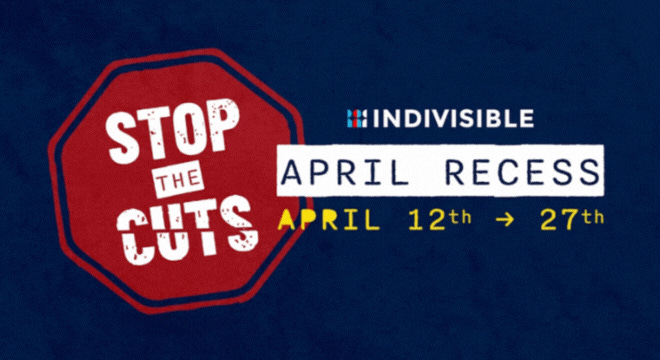
From April 12-27, Indivisible groups nationwide are hosting in-district events to make Republicans sweat and make sure Democrats stand firm. Please click here to sign up for a “Stop The Cuts” April Recess event near you.
On April 19, various groups, including 50501, are planning another day of widespread, nationwide protest. But even before then, there are online and other local events planned for the entire week. Find a way to get involved here.
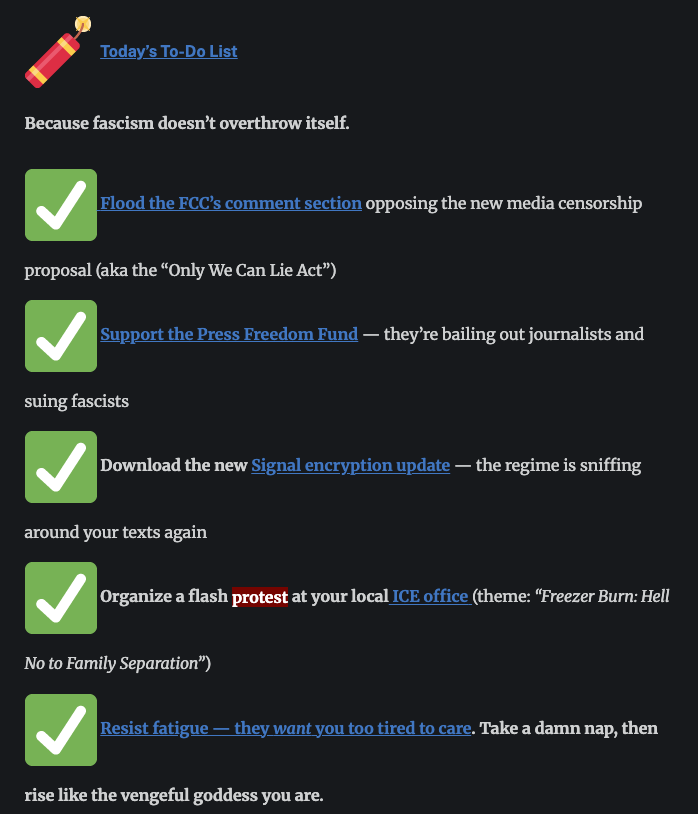
Finally, be sure to check out the Resistance Kitty newsletter, which always has great opportunities listed under “Today’s To-Do List,” because, as they say, “fascism doesn’t overthrow itself.”