Welcome to The Resistance Brief! As you may have noticed, we’re now publishing the brief twice a week, on Mondays and Thursdays, with other content offered the other days. As such, it doesn’t make sense to keep calling this The Resistance Daily Brief…because it’s no longer daily! So, The Resistance Brief it is.
In today’s brief, we highlight the powerful wave of resistance sweeping the nation. From massive rallies led by Bernie Sanders and AOC to innovative "empty chair" town halls, citizens are finding creative ways to challenge authoritarian overreach. Meanwhile, federal courts are delivering crucial blows to the administration's attempts to bypass constitutional checks and balances, and international allies are distancing themselves from the U.S. in unprecedented ways. This newsletter brings you the latest updates on the fight to preserve democracy, exposing the regime's vulnerabilities and highlighting the inspiring actions of those standing up against tyranny. Let’s get started with our…
Daily Inspiration
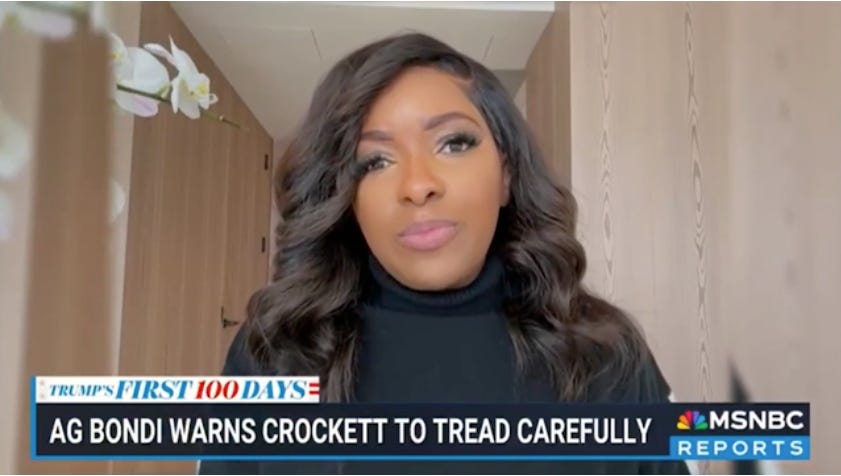
Congresswoman Jasmine Crockett forcefully responded to threats from Attorney General Pam Bondi over Crockett's support for non-violent demonstrations against Elon Musk's company, highlighting growing resistance to Musk's influence in the Trump administration and regime threats against those who speak out.
What happened: Congresswoman Jasmine Crockett has responded to Attorney General Pam Bondi's warning about her support for "Tesla Takedown" protests scheduled for March 29. Bondi accused Crockett of calling for Musk to be "taken out," while Crockett clarified she was referring to non-violent protests against Tesla and emphasized she has never advocated violence. The exchange occurred after Crockett expressed support for the Tesla Takedown movement at a virtual rally, stating she wanted to see "Elon taken down" on her birthday, referring to economic pressure through protests.
Why it matters: This conflict highlights the growing tension between civil resistance movements and authoritarian responses from the Trump administration, which has labeled attacks on Tesla as "domestic terrorism" and threatened extreme measures like deportation to El Salvador prisons. Non-violent protests like Tesla Takedown represent a strategic approach to challenging concentrated power through economic pressure rather than violence, demonstrating how citizens can exercise their constitutional rights to resist perceived threats to democracy. The administration's harsh rhetoric against peaceful protesters illustrates how authoritarian regimes often attempt to criminalize legitimate dissent, making it crucial for protest movements to clearly distinguish themselves from violence while maintaining their right to peaceful assembly.
Across the United States, citizens are mobilizing against authoritarianism and oligarchy through widespread protests targeting corporate figures like Elon Musk, decrying government cuts, and organizing "empty chair" town halls when elected officials refuse to appear. These actions represent strategic resistance tactics that create visibility for grievances, build solidarity networks, and maintain democratic pressure despite GOP elected officials’ absence. The protests at Tesla dealerships, federal buildings, and national parks demonstrate how citizens are directly confronting symbols of power and wealth that they view as threats to democratic institutions. Meanwhile, empty chair town halls in multiple states are innovatively holding representatives accountable by proceeding without them, documenting constituent concerns, and creating public records of officials' refusal to engage with voters.
Continuing Widespread Protests
What happened: Protests are erupting across the United States targeting Tesla dealerships, federal buildings, and national parks in response to the Trump administration's policies and Elon Musk's influence. In Austin, Texas, incendiary devices were found at a Tesla dealership amid growing national protests against Musk's unprecedented government influence, with nearly 20 Tesla showrooms and charging stations experiencing deliberate fires since Trump took office. Hundreds gathered in Los Angeles to protest Trump and Musk's government cuts, particularly concerned about slashed services at the Department of Veterans Affairs and other federal agencies. Additionally, protesters rallied at national parks across the country, including San Antonio Missions National Historical Park, to oppose staff reductions at the National Park Service.
Why it matters: In most cases, these protests represent strategic nonviolent resistance against perceived authoritarian overreach, creating visible opposition to policies that threaten democratic institutions. Protesters are directly confronting what they view as unaccountable influence over government functions. Mass mobilization at federal buildings and national parks demonstrates how citizens can organize to protect public resources and services, building solidarity networks across diverse constituencies. These actions align with historical patterns where successful resistance to authoritarianism has relied on building broad coalitions that can sustain pressure through various tactics beyond just street demonstrations, creating the foundation for longer-term democratic organizing. However, those targeting Tesla dealerships with vandalism are to be unequivocally condemned by movement leaders and Democratic politicians. Such tactics only undermine the legitimacy of the pro-democracy movement and provide rhetorical ammunition to the Trump regime’s call for violent crackdown on Tesla protests.
What happened: Citizens across the country are organizing "empty chair" town halls when their elected representatives refuse to attend scheduled constituent meetings. In Wilmington, North Carolina, a grassroots group called Indivisible Wilmington held a town hall for Representative David Rouzer, who hasn't held one since 2017, with over 450 people attending despite his absence. In Fairbanks, Alaska, constituents gathered to address Senator Dan Sullivan with a life-size cardboard cutout standing in for him, as residents lined up to voice concerns about deportations, Canadian tariffs, and other policies. Similarly, in Billings, Montana, nearly 1,000 people attended a town hall where three empty chairs with placards represented the absent congressional delegation, with residents traveling from across the state to participate.
Why it matters: These empty chair town halls represent an innovative tactic for maintaining democratic accountability when elected officials refuse to engage with constituents. By proceeding without the officials present, citizens create public records of both their concerns and their representatives' absence, effectively documenting the democratic deficit. This approach allows communities to build organizational capacity and solidarity networks that can sustain longer-term resistance efforts against authoritarian rule. The widespread nature of these events across multiple states indicates a coordinated strategy that aligns with historical patterns of successful resistance movements that maintain pressure through creative, disciplined actions while developing alternative democratic spaces where people can express their voices even when formal channels are blocked.
This tactic is an example of “laughtivism” and a “dilemma action” that uses irony and humor to put the autocrat or his supporters in a lose-lose situation. It is not a new tactic.
In their book, Pranksters vs. Autocarts: Why Dilemma Actions Advance Nonviolent Activism, published in 2020, Srdja Popovic and Sophia A. McClennen used the Indivisible campaign’s use of “empty chair” town hall meetings as an example of a “dilemma action.” They wrote,
But because laughtivism uses critical irony to reveal the situational irony of repression, it is extremely good at changing how the public thinks.
For example, when the Indivisible campaign, a response to the election of Donald Trump, decided to highlight the lack of congressional accountability to constituents, they devised a brilliant plan to hold town meetings where missing representatives were depicted by empty suits, cardboard cutouts, and in one case, a chicken. This tactic made it incredibly clear to the public that their political representatives were out of touch. It used the irony of representing politicians as missing to underscore the irony that their elected officials were too “busy” or “scared” to talk to voters. This is also a good example of a tactic that did draw more members—possibly because the tactics felt easy for anyone to employ.
The book is short, worth the time to read, and can be downloaded for free from the publisher, Cornell University Press.
Federal workers are facing challenges under the Trump administration, but they are pushing back, receiving support from allies, and achieving some notable successes. These developments highlight the resilience of workers and the importance of collective action in defending rights and resisting authoritarian overreach.
What happened: Federal workers are divided over President Trump’s return-to-office mandate, with many seeking alternative employment. In a significant development, the Social Security Administration chief reversed a controversial decision to shut down the agency after a court ruling limited DOGE access to personal data. Meanwhile, initiatives like NOVAnext are helping displaced federal workers transition to new careers, financial planning resources are being offered to help current and former civil servants navigate uncertainty, and gestures like free Nationals baseball tickets aim to boost morale. Radio Free Europe has also filed a lawsuit challenging U.S. funding cuts.
Why it matters: These stories demonstrate that federal workers are not passively accepting these changes but are actively resisting through legal challenges and collective action. Support systems like NOVAnext and financial planning resources show that allies are stepping up to provide tangible assistance, empowering workers to adapt and push back against authoritarian policies. The reversal in the Social Security case underscores that resistance can yield victories.
Federal courts are delivering significant blows to the Trump administration's attempts to bypass constitutional checks and balances, with judges blocking DOGE's access to sensitive personal data, halting deportations under the Alien Enemies Act, and preventing the unauthorized dismantling of the Department of Education. These judicial actions represent crucial resistance against authoritarian overreach, protecting civil liberties and democratic institutions from executive power abuses that threaten to undermine constitutional protections.
What happened: Federal judges have issued multiple significant rulings against the Trump administration's executive overreach. Judge Deborah Boardman blocked DOGE from accessing sensitive personal data held by federal agencies, ruling that Musk's unvetted operatives have no legal right to Americans' private information. Judge James Boasberg is investigating whether Trump officials defied his court order halting deportations under the Alien Enemies Act, which the administration attempted to use for summary deportations of Venezuelans to El Salvador without due process. Additionally, courts rejected Trump's attempts to dismantle the Department of Education through executive order, affirming that such actions require congressional approval.
Why it matters: These judicial interventions demonstrate how an independent judiciary serves as a critical bulwark against authoritarian tactics that seek to consolidate executive power. By blocking unauthorized access to personal data, the courts are protecting citizens from potential surveillance and targeting by regime political operatives. The rejection of summary deportations upholds due process rights that are fundamental to democratic governance. These rulings illustrate a key principle of civil resistance: institutional constraints on power are essential for preventing authoritarian consolidation. When courts maintain their independence and enforce constitutional limits, they create space for civil society to operate and prevent the normalization of authoritarian practices that typically begin with targeting vulnerable populations and eroding established legal procedures.
Senator Bernie Sanders and Representative Alexandria Ocasio-Cortez’s massive rallies demonstrate unprecedented mobilization power, signaling a growing resistance movement against oligarchic control that could fundamentally reshape American political discourse. With crowds exceeding 30,000 people in a single location, these events hold out the promise of building the critical mass needed for sustainable change, as research shows movements rarely fail after achieving active participation from just 3.5% of the population.
What happened: Bernie Sanders and Alexandria Ocasio-Cortez have drawn massive crowds during their "Stop Oligarchy" tour, with over 30,000 people attending their Denver rally and thousands more at events in Arizona, Greeley, and other locations. The progressive leaders delivered scathing critiques of Donald Trump and Elon Musk, accusing them of "screwing over" working and middle-class Americans while transforming the country into an oligarchy. Their tour has strategically targeted areas represented by Republicans but with margins close enough to potentially swing toward Democrats in future elections.
Why it matters: These large-scale rallies demonstrate the power of mobilizing diverse participation, which research shows is the most important factor for successful resistance movements against authoritarian trends. With participation rates reaching 30,000 in a single location, these events approach the critical mass needed to create sustainable momentum for change, as studies indicate that movements rarely fail after achieving active participation from just 3.5% of the population. By focusing on economic inequality and oligarchic power, Sanders and AOC are building a united front across class and racial lines that can serve as a counterweight to authoritarian tendencies, potentially inducing defections among traditional power bases and creating pressure for structural reforms.
Some state governors continue actively challenging Trump administration policies on transgender athletes and economic issues, demonstrating how state-level resistance can serve as a crucial bulwark against federal overreach and protector of democratic values. Their public confrontations highlight the potential for growing tensions between state and federal authority in America's federal system.
What happened: Illinois Governor JB Pritzker and Maine Governor Janet Mills have publicly criticized President Donald Trump's policies, particularly regarding transgender athletes and economic issues. Pritzker compared Trump's rhetoric to Nazi Germany and emphasized the need to protect democracy. Mills pushed back against Trump's attempt to ban transgender athletes in Maine, calling for a focus on "real issues" like the economy, housing, and healthcare.
Why it matters: These confrontations demonstrate state-level resistance to authoritarian consolidation. By challenging federal overreach and defending state autonomy, these governors are upholding principles of federalism and protecting minority rights. Their actions serve as a counterbalance to centralized power. Pritzker and Mills are to be commended for their courage in speaking out and pushing back while many other governors remain silent or capitulate to Trump’s demands.
Tensions continue to escalate as Trump's policies strain U.S. relations with Canada and Europe. One-time allies have now responded with travel warnings, boycotts, and symbolic gestures, reflecting concern over Trump's aggressive stance on trade, immigration, and territorial ambitions. These actions signal rapidly deteriorating economic ties, tourism, and longstanding alliances, further isolating the U.S. on the global stage as democratic norms erode domestically.
U.S.-Canada Relations
What happened: King Charles and other British royals have shown subtle support for Canada amid escalating tensions with the U.S., including wearing Canadian colors and issuing supportive statements. Nova Scotia dropped Tesla from its EV rebate program due to CEO Elon Musk's association with the Trump administration. Canadian Prime Minister Mark Carney visited Gander, Newfoundland to highlight the town's role in helping stranded Americans after 9/11, lamenting the lost U.S.-Canada friendship.
Why it matters: These actions demonstrate international solidarity with Canada in the face of Trump's aggressive rhetoric and policies. The royal gestures reinforce Canada's sovereignty, while economic pushback against U.S. companies aligned with Trump impacts trade relations. Carney's visit emphasizes the historical bonds between the two nations now under strain, highlighting the broader implications of deteriorating U.S.-Canada relations for regional stability and cooperation.
European Countries Issue U.S. Travel Warnings & Move to Counter Trump & Musk
What happened: Several European countries, including Germany, the UK, Denmark, and Finland, have issued travel advisories warning their citizens about potential risks when visiting the U.S., citing concerns over strict immigration enforcement and potential detentions. Many Europeans are canceling trips to the U.S. in protest of Trump's policies. The Czech Republic has pledged to support Radio Free Europe/Radio Liberty after U.S. funding cuts. European universities are actively recruiting American scientists as Trump puts pressure on U.S. academic institutions.
Why it matters: These actions signal a significant shift in how America's closest allies perceive the country under Trump's leadership. The travel advisories and cancellations could substantially impact the U.S. tourism industry and damage America's international reputation. The warnings highlight growing concerns about civil liberties and the treatment of foreign visitors in the U.S., potentially straining diplomatic relations. The decline in Tesla sales and support for independent media reflect broader economic and cultural pushback against U.S. influence in Europe. The recruitment of American scientists suggests a potential "brain drain" and erosion of U.S. scientific leadership.
What happened: Protesters in Serbia rallied against plans to turn a former army headquarters destroyed in a NATO bombing into a luxury complex financed by Trump's son-in-law Jared Kushner. Belgian Foreign Minister Maxime Prévot called for the EU to respond to Trump's trade war with similar vigor, suggesting potential retaliation in the digital sector. Italy's talks with SpaceX over Starlink have stalled amid outrage over Elon Musk's political role while Tesla's sales in Europe overall have dropped nearly 45%.
Why it matters: These events highlight growing international resistance to Trump-affiliated business interests and policies. The Serbian protests demonstrate opposition to U.S. influence in the Balkans and lingering resentment over past conflicts. The Belgian minister's comments reflect a hardening European stance on trade issues, potentially escalating economic tensions. The Italian Starlink situation shows how Musk's political involvement is affecting SpaceX's international business prospects, further complicating U.S.-European technological cooperation and signalling that the company may face the same fate as Tesla.
The Trump administration's policies and actions are sparking backlash across various sectors, with veterans, Tesla owners, FEMA-dependent states, and MAGA supporters at town halls voicing discontent. These events highlight the risks of authoritarian governance, the erosion of public trust in institutions, and the growing need for organized resistance to protect democracy. They represent growing vulnerabilities to the regime’s legitimacy and erosion of its pillars of support. Pro-democracy forces must continue to find and exploit these vulnerabilities.
Veterans Continue to Be Harmed
What happened: Veterans are facing disruptions in mental health services due to mass layoffs at the Department of Veterans Affairs (VA), with plans for further cuts threatening critical support systems. These layoffs have left many veterans struggling to access care, exacerbating mental health challenges such as PTSD and substance abuse.
Why it matters: The VA cuts undermine the government's commitment to those who served, creating a crisis of trust and care for a vulnerable population. This erosion of essential services exemplifies how authoritarian policies can harm marginalized groups, emphasizing the need for organized resistance to protect public welfare. As Trump regime actions continue to harm veterans, a group that largely supported the President’s election, their turn against Trump represents the emergence of potential erosion in the support of members of the security services and their families.
What happened: Tesla owners are trading in their vehicles at record rates, reflecting dissatisfaction with Elon Musk's role in government policy-making under Trump. This marks a significant shift in consumer behavior, with trade-ins rising from 0.4% last year to 1.4% this March.
Why it matters: The backlash against Musk highlights how political affiliations can erode brand loyalty and consumer trust. It also underscores broader public discontent with corporate complicity in authoritarian governance, signaling potential leverage points for resistance movements. Economic noncooperation is a powerful tool that can be used to erode economic pillars of support to the regime, in this case by harming the bottom line of Trump’s partner in crime, Elon Musk.
What happened: Homeland Security Secretary Kristi Noem announced plans to eliminate FEMA, a move that would severely impact disaster response capabilities across the U.S., particularly in Republican-leaning states prone to natural disasters. While Trump has criticized FEMA, he lacks unilateral authority to dismantle it entirely.
Why it matters: The potential elimination of FEMA reveals the administration's willingness to dismantle critical public safety institutions, leaving vulnerable communities unprotected. This decision could alienate even Trump's base in disaster-prone areas, creating opportunities for resistance movements to build cross-partisan coalitions.
What happened: Republican lawmakers faced fierce criticism at town halls over federal cuts and Elon Musk's role in government decisions. Constituents, including MAGA supporters, expressed frustration with perceived inefficiencies and authoritarian tactics during these meetings.
Why it matters: The backlash at town halls signals growing dissatisfaction within Trump's traditional support base. This dissent highlights cracks in authoritarian coalitions and demonstrates how grassroots mobilization can hold leaders accountable and challenge undemocratic policies. It further illustrates the power of “dilemma actions” mentioned above. When MAGA politicians do not hold town halls, they appear cowardly and out of touch. When they do, as in these cases, they face the wrath of their constituents. The indivisible campaign and others too should continue to use empty chair town halls as a means of creating these situations for MAGA elected representatives as they create pressure on them to defect from their support of the Trump-Musk regime.
And, finally, we close with a humorous reference to another potential emerging vulnerability that could erode support for the regime among the security services, the drunken Secretary of Defense and his crew accidentally leaking highly classified war plans to a journalist while illegally planning airstrikes in a Signal messenger group. In the GIF below, SecDef Hegseth takes a swig of champagne and asks, “New phone Houthis?!”