Welcome to today's Resistance Daily Brief, where we examine how federal workers are taking the extraordinary stance that a government shutdown is preferable to accepting the House's continuing resolution backed by Trump and Musk. Across multiple fronts, resistance is building: civil servants are organizing despite personal hardship, federal judges are blocking executive overreach targeting political opponents, and international allies are implementing billions in retaliatory tariffs against Trump's trade war. Meanwhile, some Democratic leaders show courage while others continue to dither, and media outlets continue normalizing extremism. Join us for insights on resistance actions happening now and planned protests. These include tomorrow's DC demonstrations and the nationwide "Ides of Trump" postcard campaign. Needless to say, we’re rooting for the Ides this year. But let’s start things off with some…
Daily Inspiration
A GOP Congressman misgendered the first transgender member of the United States Congress. Not only did she give it right back to him without even a hesitation, referring to him as “Madam Chair,” but one of her male colleagues quickly came to her defense. The hearing was abruptly adjourned as a result. All Democrats need to show the same level of courage and all of us need to stand up for the marginalized when they are attacked by fascist bullies. We agree with Keith Edwards’ sentiment in response to the video below: More of this!
Resistance Today
Civil Society & Publics
Trump's political influence is expanding as some Democrats echo his anti-trans rhetoric, Tesla faces significant backlash over Musk's role in the administration, and X experiences major cyberattacks amid growing political tensions.These developments highlight how Trump's administration is consolidating power while simultaneously facing resistance from various fronts. The protests and attacks against Musk's companies demonstrate how civil resistance is emerging as a response to perceived threats to democracy. This resistance aligns with historical patterns where nonviolent actions have been effective against authoritarian movements. Fragmentation on the part of Democrats, however, continues to undermine efforts to resist Trump-Musk authoritarian consolidation.
Democrats Siding with Trump
What happened: Former Democrat Jennifer Sey, who was pushed out of Levi's in 2022 for speaking against COVID school closures, has become a vocal supporter of Trump's policies on women's sports. Sey attended Trump's signing of the executive order protecting fairness in women's sports and stated he is "1,000% doing the right thing" on this issue. She launched XX-XY Athletics in March 2024 to advocate for keeping women's sports exclusively for biological females and has positioned herself as a defender of women's rights in sports despite her previous Democratic affiliation.
Why it matters: When former Democrats publicly support Trump's policies, it provides legitimacy to his administration and helps broaden his appeal beyond traditional Republican voters. This cross-party support undermines opposition unity and makes it harder to form a cohesive resistance against potential authoritarian policies. Historical examples show that effective resistance to authoritarianism requires building and maintaining a large-scale, multiracial, cross-class pro-democracy united front, and defections from the opposition weaken this possibility. The women's sports issue specifically allows Trump to position himself as a defender of women's rights while simultaneously advancing policies that many view as discriminatory.
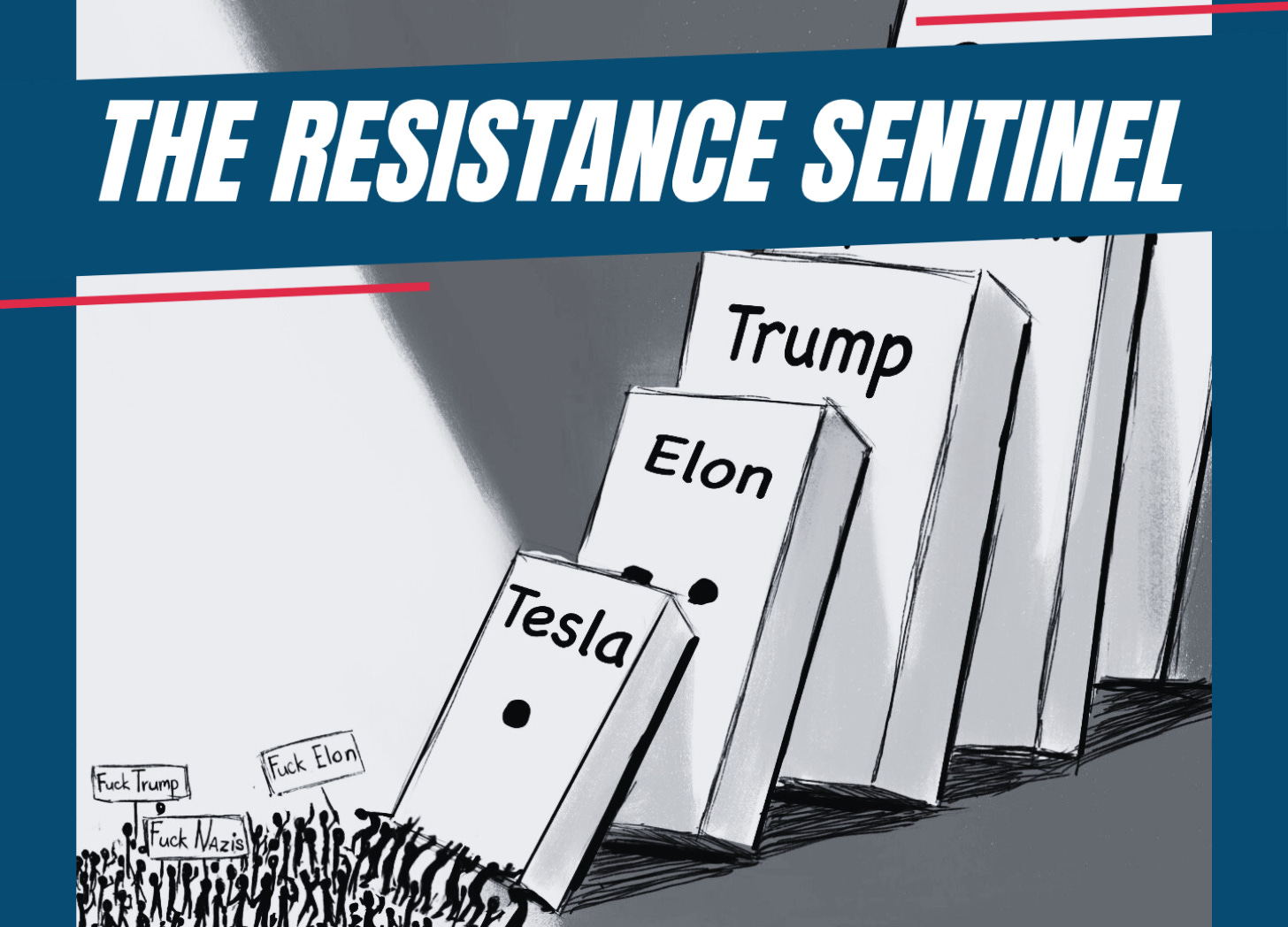
What happened: Tesla is facing significant backlash due to Elon Musk's role in the Trump administration, with protesters vandalizing Tesla dealerships and Cybertrucks across the country. Six Cybertrucks were spray-painted with anti-Musk messages and swastikas at a Lynnwood dealership, while four Cybertrucks were destroyed in a fire in Seattle's SoDo neighborhood. Tesla's stock has dropped nearly 48% since Trump took office in January, though it rebounded 3.8% after Trump publicly supported the company by purchasing a Tesla Model S on the White House lawn.
Why it matters: The targeting of Tesla represents how civil resistance can manifest through economic pressure and direct action against symbols of perceived authoritarian collaboration. This aligns with historical resistance strategies where economic noncooperation and pressure on businesses aligned with authoritarian regimes have been effective in inducing defections from authoritarian coalitions. A Morgan Stanley survey found that 85% of clients believe Musk's political activism is negatively affecting Tesla, showing how business interests can become leverage points in resistance movements. The FBI's involvement in investigating these incidents indicates the potential escalation of both resistance and state response, a pattern seen in previous struggles against authoritarian movements.
What happened: Elon Musk's social media platform X (formerly Twitter) suffered multiple outages on March 10, which Musk attributed to a "massive cyberattack." The pro-Palestinian hacktivist collective known as Dark Storm has claimed responsibility for the distributed denial of service (DDoS) attack, though security experts caution that attribution is inherently complex and difficult to verify. Musk told Larry Kudlow during a Fox Business Network interview that the attack had been traced to "IP addresses originating in the Ukraine area," but this claim remains unverified by independent sources.
Why it matters: Cyberattacks against platforms owned by key administration allies represent a new frontier in resistance tactics against perceived authoritarian figures. The targeting of information infrastructure aligns with historical resistance strategies that seek to undermine the communication capabilities of authoritarian regimes. Security experts' caution about attribution highlights the complex information landscape that both resistance movements and authorities navigate during political conflicts. The attack demonstrates how digital infrastructure has become both a tool for organizing resistance and a target for those resisting, creating new vulnerabilities and opportunities in the struggle for democracy in the digital age.
Federal workers are mobilizing against the GOP’s continuing resolution to fund the government, demonstrating unprecedented willingness to endure personal hardship to protect democratic institutions and resist authoritarian overreach. They are urging Congressional Democrats not to save the Republicans even as Democrats seem willing to cave.
What happened: The American Federation of Government Employees (AFGE), the largest federal employee union, has taken the extraordinary position that a government shutdown is preferable to passing the House-produced continuing resolution backed by Trump and Musk. Federal workers, who would be directly harmed by a shutdown through furloughs or working without pay, are actively organizing on Reddit to pressure Democratic leadership not to compromise. This resistance comes after the Trump administration unilaterally canceled collective bargaining agreements with TSA workers and declared the agency "union-free," while also announcing intentions to "effectively destroy the Department of Education.”
Why it matters: This grassroots mobilization represents a critical form of civil resistance against authoritarian tactics that target democratic institutions. When civil servants collectively refuse to accept the dismantling of government agencies and worker protections, they create significant obstacles to authoritarian consolidation. Their willingness to endure personal hardship demonstrates the power of principled nonviolent resistance in defending democratic norms and institutions. The federal workforce's stand illustrates how bureaucratic resistance can serve as a crucial check against executive overreach, particularly when formal institutional guardrails are being systematically weakened. Their willingness to endure even more hardship while Congressional Democrats waiver further illustrates the courage disparity between lawmakers and other sections of government and civil society when it comes to resistance efforts.
Federal judges are actively checking Trump's executive overreach, protecting democratic institutions and the rule of law. Several new judicial rulings demonstrate that an independent judiciary remains a critical bulwark against authoritarian tendencies, with courts rejecting attempts to weaponize government power against political opponents and unilaterally dismantle federal agencies. While some concerning precedents have been set that could erode democratic norms if not challenged, the legal resistance shows that institutional guardrails continue to function when defenders of democracy actively engage the legal system. The emergence of new legal fronts indicates civil society's continuing willingness to challenge executive power through the courts.
Wins for the Resistance
What happened: Federal judges have ordered the Trump administration to reinstate thousands of unlawfully fired federal workers, with Judge William Alsup calling the mass dismissal process a "sham." A judge reinstated Susan Tsui Grundmann to the Federal Labor Relations Authority, ruling that Trump lacked the power to remove her and emphasizing that "ours is not an autocracy; it is a system of checks and balances." Multiple courts have blocked Trump's executive order targeting the law firm Perkins Coie, with Judge Beryl Howell declaring the order "a punishment for a singled-out entity being disloyal" and rejecting the administration's claim of unreviewable presidential power. A federal appeals court handed Trump his third appellate loss in his attempt to curtail birthright citizenship, refusing to lift a nationwide injunction blocking his executive order. A federal judge ruled that Trump's freeze of USAID funding likely violated the Constitution by usurping Congress's authority over government spending. In yet another decision against Trump, a judge temporarily blocked the deportation of Mahmoud Khalil, a Palestinian Columbia University student arrested by immigration authorities after Trump publicly denounced him, with the president threatening that this was "the first arrest of many to come."
Why it matters: These judicial victories demonstrate that the courts remain a crucial bulwark against authoritarian overreach, preventing the executive branch from arbitrarily punishing perceived opponents. The reinstatement of federal workers protects institutional knowledge and prevents the hollowing out of government agencies that could otherwise be captured by loyalists. By protecting law firms from retribution, courts are safeguarding the legal profession's independence, which is essential for defending democratic rights and challenging government abuses. These rulings show that nonviolent resistance through legal channels can effectively counter attempts to consolidate power and undermine democratic institutions, particularly when diverse stakeholders mobilize to protect constitutional norms.
What happened: A federal judge rejected a request to block the Trump administration from firing Ward Brehm, the head of the U.S. African Development Foundation, though the judge warned that installing a replacement without Senate confirmation would likely violate federal law. The acting head of the Office of Personnel Management, Charles Ezell, will no longer testify in a case challenging the mass firings of federal workers, another example of the Trump administration pushing the boundaries by ignoring a court order.
Why it matters: These setbacks highlight the vulnerability of smaller agencies and government transparency to executive overreach. The refusal of officials to testify undermines accountability mechanisms and makes it harder for civil society to document and challenge abuses of power. These developments show how authoritarian tactics can advance through administrative actions that receive less public attention but can significantly damage democratic governance and institutional integrity, requiring vigilant monitoring and rapid response from civil society organizations and courts.
What happened: The law firm Perkins Coie has sued the Trump administration over an executive order targeting the firm for its past work representing Democratic clients, arguing the order violates federal law and constitutional protections. Trump officials at USAID have reportedly ordered the shredding and burning of classified and personnel records, prompting unions to file an emergency motion to stop the destruction of documents. The attempted destruction of government records destroys institutional knowledge and is a flagrant violation of the law.
Why it matters: These new legal challenges represent critical tests of executive power limits and constitutional protections for political opposition and free expression. The targeting of law firms and student activists signals an attempt to intimidate those who might represent or engage in legitimate political dissent, a hallmark tactic of authoritarian regimes. By challenging these actions in court, civil society organizations are creating legal precedents that could protect democratic spaces and prevent the normalization of political retribution. These cases demonstrate how resistance to authoritarianism requires vigilance across multiple fronts, from defending legal representation to protecting foreign aid appropriations and safeguarding immigrant rights. Civil servant unions pushing back in court is one more example of this group fighting back from within against abuses of power and destruction of government agencies.
Democrats face a critical test of resistance as Trump's destruction of federal agencies continues. Nonetheless, the party continues to struggle with internal divisions over strategy and messaging. The GOP government funding bill has become a flashpoint revealing both emerging resistance and persistent fragmentation within Democratic ranks. Some Democrats like Senator Elissa Slotkin are taking bold stands against Trump's foreign policy and executive overreach, while others remain hesitant to use their limited leverage. This moment represents a crucial juncture for the Democratic party as it attempts to define its opposition role in Trump's second term.
Democrats who are Fighting Back
What happened: Senator Elissa Slotkin has emerged as a fierce voice against Trump's foreign policy and executive overreach, particularly criticizing his treatment of Ukrainian President Zelenskyy and relationship with Russian President Valdimir Putin. She delivered a powerful Democratic response to Trump's address to Congress, condemning his approach to foreign policy and declaring he "would have lost us the Cold War." Across the country, grassroots resistance is growing with Bernie Sanders drawing large crowds at anti-oligarchy rallies and protesters targeting Tesla stores to pressure Elon Musk.
Why it matters: These acts of resistance demonstrate that opposition to authoritarianism requires both institutional and grassroots responses. Slotkin's national security background gives her unique credibility to challenge Trump's foreign policy decisions that undermine democratic alliances. Sanders' rallies show there is significant public energy for resistance that Democratic leadership could harness.
What happened: Despite a growing protest movement nationwide and calls from the civil service not to support the GOP government funding bill, Senate Democrats are deeply divided over whether to use their leverage on the government funding bill, with some willing to vote with Republicans to avoid a shutdown while others demand concessions. House Democrats are presenting a unified opposition but are frustrated by Senate Democrats' lack of clear strategy. Democratic leaders like Senate Minority Leader Chuck Schumer have been criticized for not providing clear direction, with reports suggesting they may be orchestrating a "performative episode" of resistance before ultimately allowing the bill to pass.
Why it matters: This fragmentation undermines Democrats' ability to effectively counter Trump's agenda and protect democratic institutions. The party's inability to present a unified strategy on the government funding bill reveals deeper divisions about how to exercise opposition power in the minority. Without cohesive resistance, Trump and Musk face fewer obstacles in their efforts to dismantle federal agencies and override Congressional spending authority. The contrast between grassroots energy for resistance and Congressional Democrats' hesitation creates a dangerous disconnect that could further demoralize the party's base and undermine the resistance movement’s discipline to remain nonviolent. Congressional Democrats are, so far, failing to serve as a necessary pressure release valve for growing anger and frustration among the public, thereby increasing the risk that some may choose to lash out with counterproductive violence.
Democratic state leaders are taking divergent approaches to the Trump administration, with some pushing back against authoritarian policies through legal action and public mobilization, while others seek common ground with MAGA figures. The stark contrast in strategies reflects the complex political landscape facing Democratic governors and officials as they navigate a second Trump presidency. These divergent approaches reveal tensions within the Democratic party about how best to protect democratic institutions and serve constituents. How state leaders respond to federal authoritarianism will significantly impact local communities' rights and resources, particularly regarding education, environmental protection, and civil liberties.
Democratic State Leaders Pushing Back
What happened: Democratic attorneys general from 21 states filed a lawsuit against the Trump administration over the mass layoffs at the Department of Education, which saw more than 1,300 workers fired. Wisconsin Governor Tony Evers released a statement supporting the lawsuit, calling the dismantling of the Education Department "a non-starter" that would hurt Wisconsin's kids and schools. Several Democratic governors are organizing to protect their states from federal overreach, with Minnesota Governor Tim Walz planning a national tour of town halls in Republican House districts to mobilize resistance.
Why it matters: This coordinated legal and political resistance represents a crucial bulwark against authoritarian consolidation of power at the federal level. By challenging the legality of Trump's actions through the courts, these state leaders are attempting to preserve institutional checks and balances that are essential for democratic governance. The pushback demonstrates how state-level resistance can create friction against federal authoritarianism, potentially slowing or preventing the implementation of harmful policies. These actions align with historical evidence that effective pro-democratic mobilization requires building broad coalitions that can contest power and protect vulnerable communities from authoritarian overreach.
Democratic State Leaders Making Nice with Trump & MAGA
What happened: California Governor Gavin Newsom has launched a podcast featuring conversations with prominent MAGA figures, including Steve Bannon and Charlie Kirk, where he found surprising common ground on issues like transgender athletes in women's sports and skepticism of Elon Musk. Hawaii Governor Josh Green stated he would "take" and "make good use" of education funding if Trump's plan to shift education policy to states proceeds. In California, Newsom's top water official Karla Nemeth announced willingness to work with the Trump administration to weaken environmental protections for the Sacramento River and Delta, potentially benefiting wealthy agricultural donors.
Why it matters: This accommodationist approach reveals the difficult calculations Democratic leaders are making in a Trump-dominated political landscape, weighing pragmatic cooperation against principled resistance. By engaging with MAGA figures and policies, these governors risk normalizing authoritarian tendencies and undermining broader resistance efforts. The willingness to collaborate with the Trump administration on controversial policies suggests some Democratic leaders may prioritize maintaining relationships with federal power or serving specific donor interests over protecting democratic norms and environmental protections. The potential success of an accommodationist approach is undermined by historical evidence that successful resistance to authoritarianism requires maintaining a united front rather than seeking individual accommodations that can fracture resistance movements.
American media outlets continue to normalize extremism and imply that Democrats are to blame for MAGA failures. Tony Hinchcliffe, who made racist comments at a Trump rally, has landed a Netflix deal while The New York Times frames a looming government shutdown as the fault of Democrats who are in the minority in both houses of Congress. Finally, The Washington Post, whose motto used to be that “democracy dies in darkness” continues to bend the knee to authoritarianism as long-time editors and writers quit in protest.
What happened: Netflix has signed comedian Tony Hinchcliffe to a deal for three comedy specials months after he made racist comments about Latinos and other minority groups at a Trump rally. This deal comes as The New York Times implies that it is Senate Democrats’ fault that a Republican-written stopgap bill to fund the government through September might not pass the Republican majority body, threatening a government shutdown. Meanwhile, long-time editors and writers for the Washington Post continue to quit as the paper’s billionaire owner exerts personal editorial control over the opinion page.
Why it matters: The normalization of extremist rhetoric through mainstream platforms like Netflix demonstrates how authoritarian regimes gain power by shifting the boundaries of acceptable discourse. The looming government shutdown represents a classic authoritarian tactic of manufacturing crisis to consolidate power, while corporate media blames the minority party instead of those causing the crisis and continues to push out legitimate voices. These developments highlight how democratic erosion occurs not just through dramatic power grabs but through incremental changes that weaken democratic institutions and norms.
Trump's trade war has sparked global retaliation with allies implementing billions in counter-tariffs, while Greenland's election resulted in a victory for parties favoring independence but differing on pace and approach. These developments represent significant challenges to U.S. foreign policy as traditional allies actively resist economic bullying and territories targeted for acquisition assert their sovereignty. The global resistance to Trump's policies is strengthening domestic political support for leaders who stand up to the U.S., while creating economic uncertainty and market instability worldwide.
Responses to the Trump Trade War
What happened: President Trump's 25% tariffs on global steel and aluminum imports have triggered immediate retaliation from multiple allies. The European Union announced counter-tariffs worth €26 billion ($28 billion) on U.S. goods ranging from bourbon to motorcycles, while Canada imposed C$29.8 billion ($20 billion) in retaliatory tariffs on U.S. products including computers and sports equipment. France's trade minister Laurent Saint Martin declared France "will not yield to U.S. threats" after Trump threatened 200% tariffs on French wines if the EU doesn't remove whiskey tariffs.
Why it matters: This coordinated international resistance demonstrates how authoritarian economic policies can backfire by unifying opposition and strengthening solidarity among targeted nations. The retaliatory measures are strategically targeting Republican-held states, showing how civil resistance can effectively identify pressure points against authoritarian policies. Canadian tourism to the U.S. has already dropped 23% in February, with an estimated 3 million fewer Canadian visitors expected this year, illustrating how economic resistance through economic noncooperation can impose significant costs on the aggressor. This trade war is actually boosting political support for leaders who stand firm against Trump, with Canada's Liberal Party seeing a remarkable comeback under Mark Carney's promise to oppose Trump's policies.
What happened: Greenland's center-right Democratic Party won a surprise victory in elections, securing around 30% of the vote and tripling their seats to 10 in the 31-seat parliament. The strongly pro-independence Naleraq party came in second with nearly 25% of the vote, while the ruling coalition parties suffered significant losses. The election was dominated by debates over independence from Denmark and responses to President Trump's repeated statements about acquiring Greenland for the United States, with Democrats leader Jens-Frederik Nielsen advocating for a gradual approach to independence.
Why it matters: This election represents a powerful example of how democratic processes can serve as nonviolent resistance against territorial ambitions of powerful nations. The victory of parties favoring independence, albeit at different paces, demonstrates how external threats can accelerate self-determination movements and strengthen national identity. Despite Trump's declaration that "We need Greenland for national security. One way or the other we're gonna get it," Greenlanders have peacefully asserted their right to determine their own future through the ballot box. The Democrats' preference for gradual independence focused on building economic foundations shows strategic thinking about sustainable resistance rather than reactive opposition.
Conservative media figures and business leaders are openly criticizing Trump's tariff policies as economic chaos threatens to derail his presidency. Widespread opposition from traditional Republican allies signals growing regime vulnerability as markets tumble and recession fears mount.
What happened: President Trump's aggressive tariff policies have sparked significant backlash from conservative media figures and business leaders who traditionally support Republican policies. Fox News hosts, Daily Wire personalities, and Wall Street Journal editors have all now publicly criticized Trump's tariff approach as economically unsound and potentially damaging. Markets have responded with steep selloffs as Trump's administration characterizes the economic turmoil as a necessary "transition period."
Why it matters: This internal dissent represents a critical vulnerability for Trump's administration, demonstrating that even his natural allies recognize the economic danger of his policies. When respected voices within conservative media break ranks to criticize a leader's core economic strategy, it creates space for broader resistance to authoritarian consolidation. The public criticism from typically supportive media figures helps legitimize opposition and could potentially constrain Trump's ability to implement more extreme policies as economic conditions worsen.
Plan to take action this week, there’s still a couple days left! Start planning now for how you’ll resist next week. Here are some ideas:
🚨For those in the DC area, there are three days of planned protests starting TOMORROW. Veterans, media critics, and democracy advocates are mobilizing against cuts to the VA, Fox News lies, and the authors of Project 2025.🚨
What happened: A series of protests are planned in Washington, DC from March 14-16, 2025, including a "March on D.C." at the National Mall with veterans protesting benefit cuts, a "Media March" to Fox News headquarters focusing on "Truth Over Propaganda," and a "Save America" protest at the Heritage Foundation, author of Project 2025. These coordinated actions come as resistance movements gain momentum following widespread criticism of Trump's policies, including proposed Medicaid cuts that sparked protest during his address to Congress and controversial tariffs described by governors as harmful to working families.
Why it matters: These planned protests represent strategic nonviolent resistance targeting key pillars of authoritarian power - military support, media control, and ideological think tanks. By focusing on veterans' issues, the protests aim to create divisions within a traditional support base for the administration, while challenging propaganda sources and policy architects directly challenges the regime's legitimacy. Such coordinated actions align with effective resistance strategies that seek to induce defections among regime supporters and build broader coalitions across diverse constituencies.
🚨The "Ides of Trump" postcard campaign on March 15th is an opportunity for citizens to collectively express opposition through a coordinated mass mailing, demonstrating that peaceful civic action can visibly challenge authority and create solidarity among participants.🚨
What happened: The "Ides of Trump" postcard campaign calls for people across the country to mail postcards to Donald Trump at the White House on March 15th (just two days from now). This coordinated action by the growing 50501 Movement aims to flood the White House post office with pink slips symbolically "firing" Trump. The campaign explicitly states its goal is to show both media and politicians the consequences of supporting Trump.
Why it matters: This campaign exemplifies how ordinary citizens can participate in nonviolent resistance through simple, accessible actions that create visible public pressure. Mass participation in such coordinated efforts demonstrates collective power and can help overcome the fear and isolation that authoritarian leadership often cultivates. The symbolic timing (the Ides of March) and visual impact (flooding the White House with pink slips) creates a compelling narrative that can attract media attention and inspire further civic engagement, potentially building momentum for broader resistance movements.
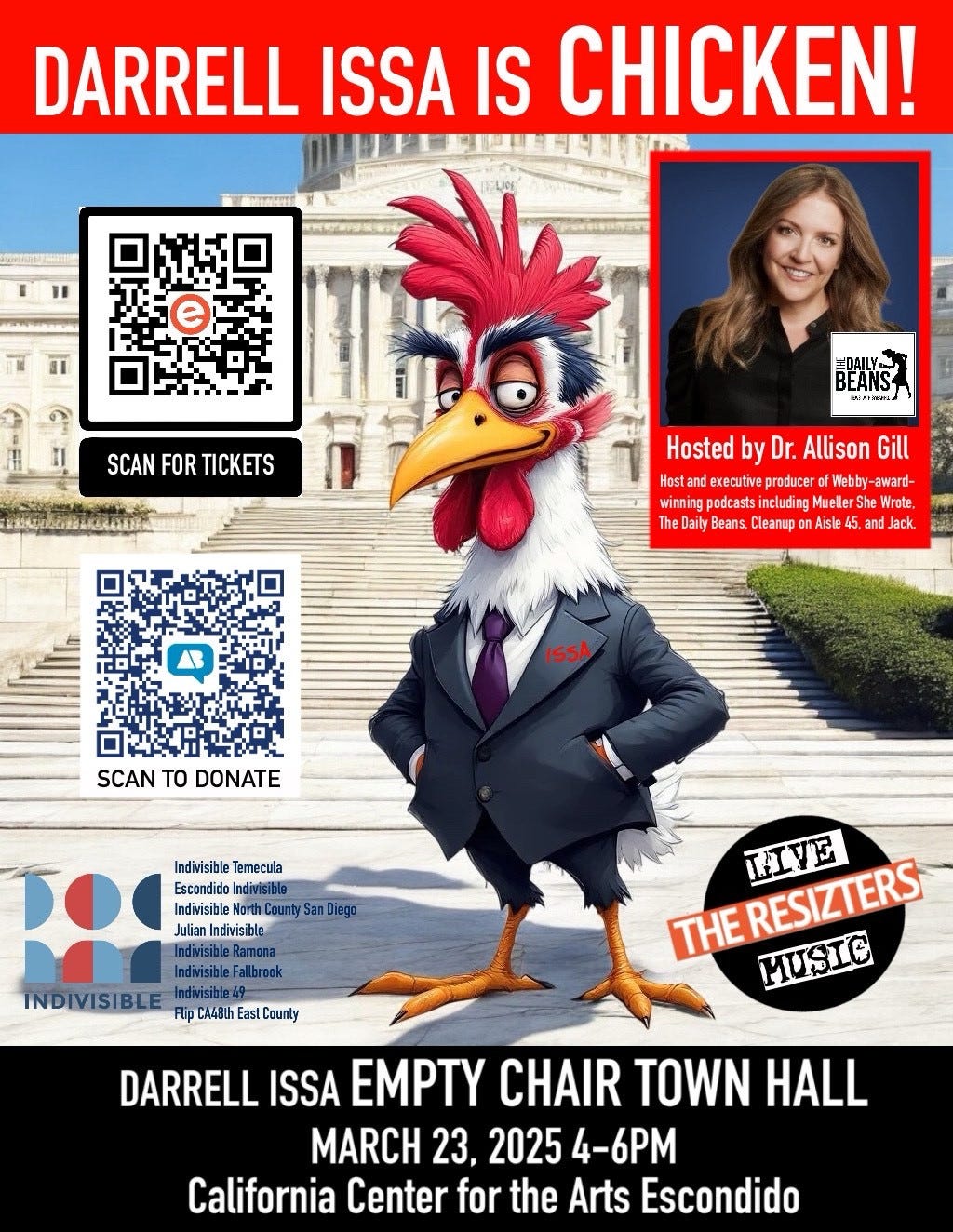
🚨Indivisible groups across Southern California are organizing an "Empty Chair Town Hall" to hold GOP Rep. Darrell Issa accountable even in his absence. This community-driven event on March 23, 2025, aims to address constituent concerns through a structured format where attendees can submit questions that will be addressed by a panel of Indivisible leaders.🚨
What happened: Indivisible North County San Diego and affiliated local Indivisible groups are hosting a town hall event at the California Center for the Arts in Escondido on March 23, 2025, from 4-6 PM. The "Empty Chair Town Hall" format allows constituents to voice concerns and ask questions even when their elected representative chooses not to attend. Participants are instructed to bring written questions on cards with their names, which will be selected by Indivisible leaders and addressed by panelists during the event.
Why it matters: This event demonstrates a strategic nonviolent action that creates accountability mechanisms when elected officials avoid direct engagement with constituents. By organizing an alternative forum, citizens maintain civic pressure and demonstrate collective power even when facing unresponsive representation. The empty chair symbolism effectively highlights an elected official's absence while still creating space for community dialogue and organizing, preventing the representative from controlling the narrative by simply not showing up. This approach builds community solidarity while documenting constituent concerns that might otherwise be dismissed.
Thanks for reading! Subscribe for free to receive new posts and support our work.
Also, please feel free to comment. We love to hear your feedback as we work to build out our publication. Your comments have already helped us to improve and given us ideas for topics to cover in future issues.